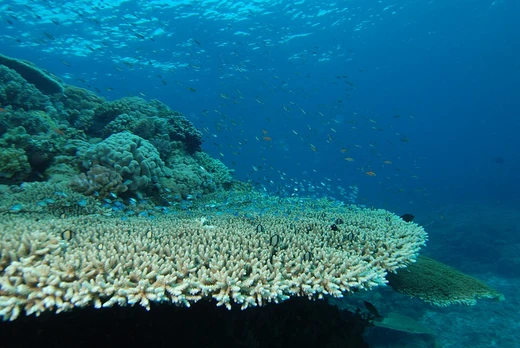
Acropora aculeus
An uncommon, endangered acroporid coral prone to bleaching and disease.

Acropora aculeus, an acroporid coral, lives across a wide range from the Indian Ocean and central Indo-Pacific through Australia, Southeast Asia, Japan, the East China Sea, and the western Pacific. This coral is not commonly seen and faces serious threats: it bleaches easily, catches diseases, gets eaten by crown-of-thorns starfish, and is collected for aquariums. Because of these pressures and significant habitat loss, the International Union for Conservation of Nature lists it as endangered.
Quick Facts
- Taxon
- Acropora aculeus
Facts from the source article.
Lore & Background
Acropora aculeus forms corymbose, pillow-like structures with slender, spreading horizontal branches and narrow, shorter upright branches. Its corallites are distinctive, longer than they are wide, smooth and polished. The coral is usually yellowish or grey, but can be bright bluish-green, and the tips of the branches are often yellow, pale blue, green or brown. It is usually yellow on the Great Barrier Reef and in the Philippines, but pale brown in western Australia. It is named as ACR ACUL in Coral Codes. This species is native to the Indo-Pacific region, ranging from the east coast of Africa and Madagascar to Taiwan, Japan, Indonesia, Australia, and some island groups in the eastern Pacific Ocean. It is endemic to the Philippines distributed in Samoa, Great Barrier Reef, Sri Lanka, Vietnam, and the Marshall Islands. It occurs at depths between about 5 and 20 m (16 and 66 ft) or even deeper, on all parts of the reef, particularly the front slope, and also in lagoons. Its form varies with exposure to wave action, being more massive in exposed locations and more pillow-like in lagoons. The reefs on which Acropora aculeus lives are under threat from global warming, increased ocean acidification, and reef destruction. It is a generally uncommon species and is particularly susceptible to bleaching and coral diseases. The International Union for Conservation of Nature has assessed its conservation status as endangered, considering that 37% of the colonies may be lost in the next thirty years (three generation lengths).
Reader's Guide
Acropora aculeus is notable as an uncommon species of acroporid coral that is particularly prone to coral bleaching, disease, and crown-of-thorns starfish predation, and is also harvested for use in aquaria. The International Union for Conservation of Nature has assessed it as endangered, with habitat loss being a large concern. Its conservation status reflects the broader threats to reef ecosystems, including global warming, increased ocean acidification, and reef destruction. The species is considered to face a projected loss of 37% of its colonies within the next thirty years, based on three generation lengths. Its distribution spans the Indian Ocean, central Indo-Pacific, Australia, south-eastern Asia, Japan, the East China Sea, and the western Pacific Ocean, occurring at depths between about 5 and 20 m or deeper on reef front slopes and lagoons. The coral's form varies with wave exposure, being more massive in exposed locations and more pillow-like in lagoons. Its distinctive corallites are longer than wide, smooth and polished, and its coloration varies regionally—typically yellow on the Great Barrier Reef and in the Philippines, but pale brown in western Australia. The species is coded as ACR ACUL in Coral Codes.
Colony Architecture & Polyp Behavior
Acropora aculeus belongs to a genus of small polyp stony corals within the phylum Cnidaria, a diverse group that encompasses over 149 described species commonly known by names like table coral, elkhorn coral, and staghorn coral. Like all members of this genus, A. aculeus exists as a colony composed of individual polyps roughly two millimeters in diameter. These polyps are not solitary organisms; they share tissue and a nerve net with their neighbors, functioning together as a coordinated unit. When undisturbed, the polyps protrude slightly from the colony's surface, but they can quickly retract deep into the coral structure if they sense movement or a potential predator nearby. At night, when the risk of disturbance is lower, the polyps extend further outward to capture plankton and organic particles drifting through the surrounding water. Depending on environmental conditions and the particular species involved, Acropora colonies may take on plate-like shapes or grow as slender or broad branching structures.
Reef Engineering & Geographic Range
Members of the Acropora genus, including A. aculeus, play a foundational role in constructing the vast calcium carbonate frameworks that underpin tropical reef ecosystems. These corals are among the primary architects responsible for building the immense substructure upon which the thin living tissue of a reef depends. The genus has a broad geographic footprint: more than 100 species are found across the Indo-Pacific region, while three species occur in the Caribbean. However, the true diversity of the genus remains uncertain. Taxonomists have raised questions about the validity of many described species, noting that some, such as Acropora prolifera, appear to be hybrids rather than distinct lineages. Additionally, certain named species have been revealed to be complexes of cryptic species—genetically distinct populations that look identical on the surface. This taxonomic ambiguity means the full biological richness of the genus, and by extension the precise ecological role of species like A. aculeus within it, is still being unraveled by researchers.
Bleaching & Conservation Status
The survival of Acropora aculeus, like all corals in the genus, depends on a symbiotic relationship with photosynthetic algae called Symbiodinium. These algae reside within the coral's cells and generate energy through photosynthesis, giving the colonies their characteristic golden-brown coloration. When environmental stressors push the system past its tolerance, the corals expel or lose these zooxanthellae, a process known as bleaching. The once-colored tissue turns stark white, and if new Symbiodinium cells cannot be reabsorbed, the colony will likely perish. The culprits behind this collapse are numerous: pollution, abnormally elevated water temperatures, rising ocean acidification, sedimentation, and eutrophication all contribute to the decline. The severity of the threat has prompted regulatory action; in 2014, the U.S. Fish and Wildlife Service designated ten Acropora species as threatened, underscoring how widespread the pressure on this genus has become across its range.
Captive Culture & Reef Restoration
In the reef-keeping hobby, Acropora species including A. aculeus occupy a special niche. While most colonies in the wild are brown or green, a handful display vivid coloration that makes them highly sought after by aquarists. Captive propagation of Acropora is widespread, and under optimal conditions these corals grow remarkably fast. In the wild, individual colonies can span more than a meter; in a well-maintained aquarium, a fragment the size of a finger can expand to the size of a medicine ball within one to two years. Through ongoing selective breeding, captive populations are gradually adapting to thrive in home aquarium settings. Keeping them successfully is demanding, however: they need bright lighting, stable temperatures, regular supplementation of calcium and alkalinity, and clean, turbulent water flow. Common parasites that plague captive colonies include the Acropora-eating flatworm (Amakusaplana acroporae) and the red bug (Tegastes acroporanus). Notably, fragments cultured in captivity are sometimes transplanted back into the ocean to help repopulate degraded or barren reefs.
Frequently Asked Questions
What is Acropora aculeus?
Acropora aculeus is a stony coral in the Acropora genus that inhabits shallow reef zones, typically between about 5 and 20 meters deep, though it can be found even further down. It is a relatively uncommon species within the acroporid group and is recognized by the coral code ACR ACUL.
What does Acropora aculeus look like?
Colonies generally show yellowish, grey, or vivid bluish-green body coloration, with branch tips that may shift to yellow, pale blue, green, or brown. These tip-color variations help distinguish it from other branching acroporids in the field.
Where does Acropora aculeus occur in the wild?
Its range spans the Indian Ocean, the central Indo-Pacific, Australia, Southeast Asia, Japan, the East China Sea, and the western Pacific. Despite covering such a broad area, it is not frequently encountered by divers or reef researchers.
Why is Acropora aculeus considered endangered?
The IUCN lists it as endangered because it bleaches readily, is vulnerable to disease and crown-of-thorns starfish predation, and suffers from aquarium harvesting on top of widespread habitat loss. Broader drivers like global warming and ocean acidification compound these local threats.
What is the projected outlook for Acropora aculeus populations?
Current estimates indicate that roughly 37% of existing colonies could be lost over the next three generation lengths, about thirty years, if present pressures remain unaddressed. This trajectory highlights the urgency of protecting the reefs where it still persists.
More in Acropora Corals 1-24
Spotted an error? Know more?
Reader corrections go straight into our review queue. Suggest an edit · How this site is sourced