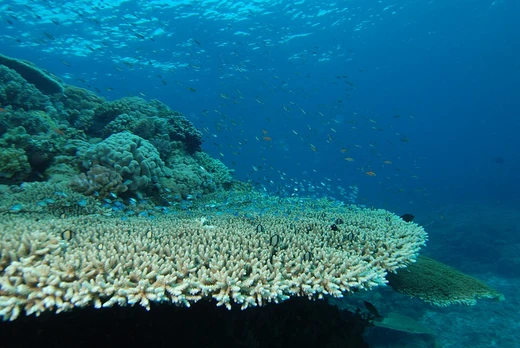
Acropora batunai
A fragile, vulnerable acroporid coral from shallow Indo-Pacific reefs.

Acropora batunai is a species of acroporid coral first identified by Carden Wallace in 1997. It forms cushion-like or corymbose structures up to 1.25 meters wide and 35 millimeters thick. The coral’s colour ranges from grey, blue, and pale brown to pink or brown-white. Its long, flat branches have upright-facing tips and can create a table-like shape. The corallites—both radial and axial—are small, sharp, and tube-like, with the radial ones arranged like bottlebrushes. Axial corallites measure 0.6–1 millimeter in outer diameter and 0.2–0.5 millimeters inside. The species resembles *Acropora microclados* and *Acropora rambleri*.
This coral lives in sheltered, shallow reefs at depths up to 44 meters, but is most common on reef slopes between 10 and 40 meters, and may occasionally be found as shallow as 1 meter. It feeds by catching plankton with its polyps. *Acropora batunai* is extremely fragile and is listed as vulnerable on the IUCN Red List, with a declining population. It is also included in Appendix II of CITES.
The species occurs across a wide but patchy range in the Indo-Pacific, including Fiji, Ponape, the Solomon Islands, Papua New Guinea, the Philippines, Malaysia, and Indonesia—though only in one region of Indonesia. It is threatened by the global loss of coral reefs, rising temperatures that cause bleaching, disease, and predation by the crown-of-thorns starfish (*Acanthaster planci*). Some populations are found within Marine Protected Areas. Overall, the species is not common.
Quick Facts
- Taxon
- Acropora batunai
Facts from the source article.
Lore & Background
Acropora batunai forms structures resembling cushions or corymboses, reaching 35 millimetres thick and 1.25 metres wide. Its color varies among grey, blue, pale brown, and sometimes pink or brown-white. The coral has long flat branches with upright-facing branches that can form a table-like arrangement. Its radial and axial corallites are combined, small, sharp, and tube-like, with radial corallites arranged like bottlebrushes. Axial corallites have outer diameters of 0.6–1 millimetre and inner diameters of 0.2–0.5 millimetres. The species is similar to Acropora microclados and Acropora rambleri. It is found in sheltered shallow reefs at depths up to 44 m, but is most common on reef slopes at 10 to 40 m, and possibly at 1 m deep. It uses its polyps to catch plankton.
Reader's Guide
Acropora batunai is significant as a species described in 1997 by Carden Wallace, contributing to the taxonomic understanding of acroporid corals in the Indo-Pacific. Its distribution spans Fiji, Ponape, the Solomon Islands, Papua New Guinea, the Philippines, Malaysia, and Indonesia, though it is not common overall. The species is listed as vulnerable on the IUCN Red List with a decreasing population, and is included in Appendix II of CITES. Threats include the global reduction of coral reefs, temperature increase causing bleaching, disease, and predation by Acanthaster planci. Some specimens occur in Marine Protected Areas. Its extreme fragility and restricted occurrence in one region of Indonesia underscore its conservation concern. The species' table-like structure and bottlebrush corallite arrangement distinguish it from related taxa, though it shares similarities with Acropora microclados and Acropora rambleri.
Did You Know?
- Acropora batunai was first described by Carden Wallace in 1997.
- It is extremely fragile and rated as vulnerable on the IUCN Red List.
- Its radial corallites are arranged like bottlebrushes.
- It is prey to the crown-of-thorns starfish Acanthaster planci.
Colony Architecture and Polyp Behavior
As a member of the small polyp stony coral group within the phylum Cnidaria, Acropora batunai belongs to a genus that includes over 149 described species commonly recognized by names such as table coral, elkhorn coral, and staghorn coral. These corals play a foundational ecological role, constructing the vast calcium carbonate framework upon which the thin living tissue of a reef depends. The colony itself is composed of numerous tiny polyps, each roughly two millimeters in diameter, that share a common tissue layer and a diffuse nerve net. Growth morphology varies by species and environment, ranging from flat plate-like structures to slender or broad branching forms. Behaviorally, the polyps are responsive to their surroundings: they retract into the skeleton when they detect movement or the presence of potential predators, but when conditions are calm they extend slightly beyond the surface. At night, they protrude even further, taking advantage of darkness to capture drifting plankton and dissolved organic particles from the surrounding water column.
Distribution and Taxonomic Uncertainty
Acropora batunai is part of a genus whose members are found across two major oceanic regions: the Indo-Pacific, where more than one hundred species occur, and the Caribbean, home to just three. Despite this broad geographic spread, the true species count remains uncertain. Taxonomists have raised questions about the validity of numerous described species, noting that some what were long considered distinct actually represent hybrid lineages—a phenomenon exemplified by Acropora prolifera. Additionally, certain named species have been revealed to be cryptic species complexes, meaning that what appears to be a single taxon is in fact a cluster of reproductively isolated populations that are morphologically indistinguishable. These complications make definitive identification of any given colony, including A. batunai, a challenging task for marine biologists. The genus as a whole has been the subject of ongoing genomic research, with studies examining gene expression during larval settlement and the complete genome of related species to better understand how these corals respond to shifting environmental conditions.
Vulnerability to Environmental Stress and Bleaching
The survival of Acropora batunai, like all members of its genus, depends on a mutualistic relationship with Symbiodinium, a group of photosynthetic algae that reside within the coral's cells and supply the animal with energy. When environmental conditions deteriorate, this partnership breaks down. The golden-brown zooxanthellae are expelled or lost, leaving the coral stark white in a process known as bleaching. If the animal cannot re-acquire new Symbiodinium cells, it will eventually starve and die. Acropora is particularly vulnerable to this stress response. The primary drivers include pollution, sustained abnormally warm water temperatures, rising ocean acidification, increased sedimentation, and eutrophication. The cumulative impact of these pressures has caused measurable declines in Acropora populations worldwide. In recognition of this crisis, the U.S. Fish and Wildlife Service designated ten Acropora species as threatened in 2014, underscoring the urgency of protecting the reef ecosystems these corals help build.
Aquaculture, Selective Breeding, and Reef Restoration
Within the reef-keeping community, Acropora species occupy a dual role as both prized ornamental corals and tools for ecological restoration. While most colonies display muted brown or green coloration, the rare brightly colored specimens are especially sought after by aquarists. Captive propagation is widespread, and under optimal conditions these corals exhibit remarkably rapid growth: a fragment no larger than a fingertip can expand to the size of a medicine ball within one to two years in a well-maintained aquarium, while wild colonies can exceed a meter in diameter. However, keeping Acropora successfully demands careful attention to bright lighting, stable water temperatures, regular supplementation of calcium and alkalinity, and clean, turbulent water flow. Over time, captive populations have undergone selective changes that make them better suited to home aquarium conditions. Notably, fragments from these captive specimens are now being transplanted onto degraded reefs to help repopulate barren areas. Common challenges in captivity include parasitic flatworms (Amakusaplana acroporae) and small crustaceans known as red bugs (Tegastes acroporanus).
Frequently Asked Questions
Who described Acropora batunai and when?
Carden Wallace first identified and named this species in 1997. It was recognized as a distinct acroporid coral within the Indo-Pacific reef system.
What does Acropora batunai look like?
It builds cushion-like or corymbose colonies with long, flat branches whose tips point upward, often giving the colony a table-like silhouette. Colours span grey, blue, pale brown, pink, and brown-white, while the small tube-shaped corallites are arranged in bottlebrush-like clusters along the branches.
How big can an Acropora batunai colony grow?
Mature colonies can spread to roughly 1.25 meters in width, though they remain quite thin at only about 35 millimeters. This wide-but-slim profile is one of the features that sets it apart from bulkier table corals.
Where and at what depth is Acropora batunai found?
It inhabits shallow Indo-Pacific reefs, most commonly between 10 and 40 meters, with records extending to around 44 meters. Its preference for these upper reef zones makes it especially exposed to wave action and human-impacted environments.
What is Acropora batunai's conservation status?
The IUCN lists this species as Vulnerable, reflecting its fragile structure and the pressures its shallow reef habitats face. Its thin, plate-like growth form makes colonies particularly susceptible to breakage from storms, fishing gear, and coastal development.
More in Acropora Corals 1-24
Spotted an error? Know more?
Reader corrections go straight into our review queue. Suggest an edit · How this site is sourced