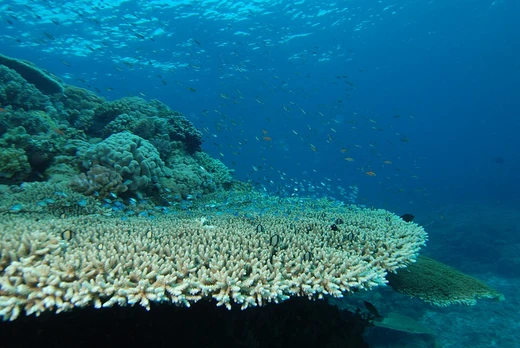
Acropora aspera
A shallow-water staghorn coral found in the western Indo-Pacific.

Acropora aspera, a member of the staghorn coral family Acroporidae, grows as low, branching clumps with slender branches that narrow only near the tips. Its corallites—the small, stony cups housing the polyps—vary in size and are densely packed, each with a slightly protruding lower lip. The coral’s coloration ranges from pale green, grey, or brown to occasionally pale blue.
This species inhabits very shallow waters, up to 5 meters deep, on reef flats and in lagoons across the Indian Ocean and western Pacific. In areas with distinct coral zones, it sits between the similar-looking *Acropora pulchra* in shallower water and *Acropora millepora* in deeper water.
Like many corals, *Acropora aspera* hosts symbiotic dinoflagellates (zooxanthellae) in its tissues, relying heavily on the energy they produce through photosynthesis. Off southern India, research showed the coral grows year-round through branch extension and skeletal calcification, though calcification slows from June to September during the southwest monsoon. This reduction is attributed to increased cloud cover and suspended sediment, which lower photosynthetic activity.
The IUCN Red List classifies *Acropora aspera* as endangered. It is especially vulnerable to bleaching, where high sea temperatures or stress cause it to expel its zooxanthellae and turn white. Additional threats include coral reef destruction, ocean acidification, high sea temperatures, and coral diseases. The crown-of-thorns starfish, which preferentially feeds on *Acropora* species, can experience population surges that locally endanger this coral.
Quick Facts
- Taxon
- Acropora aspera
Facts from the source article.
Lore & Background
Acropora aspera is a scantily branching, colonial coral that forms low clumps. Its individual branches are slender and taper only towards the tips. The corallites—the stony cups from which polyps grow—vary in size and are crowded closely together, with the lower lip of each corallite protruding slightly. The coral varies in colour, appearing pale green, grey, brown, or occasionally pale blue.
This species is found in the Indian Ocean and western parts of the Pacific Ocean, inhabiting reef flats and lagoons in very shallow water up to 5 metres deep. Where coral zoning occurs, it grows between the shallow-water Acropora pulchra, which it closely resembles, and the deeper-water Acropora millepora.
Acropora aspera is a zooxanthellate coral that harbours symbiotic dinoflagellates in its tissues, relying heavily on the energy produced during photosynthesis. A study off the coast of southern India found that this coral grew by branch extension and skeleton calcification year-round, but calcification was reduced during the south-west monsoon season (June to September), likely due to increased cloud cover and suspended sediment reducing photosynthesis.
Reader's Guide
Acropora aspera is listed as endangered on the IUCN Red List, primarily because it is particularly prone to bleaching—a process where high sea temperatures or stress cause the coral to expel its zooxanthellae and turn white. Additional threats include general destruction of coral reefs, ocean acidification, high sea temperatures, and coral diseases. The crown-of-thorns starfish feeds preferentially on Acropora species, and sudden increases in its population may threaten this coral locally. The species' reliance on symbiotic algae for energy makes it vulnerable to environmental changes that reduce light penetration, such as monsoon-related cloud cover and sediment. Its restricted habitat of very shallow reef flats and lagoons further exposes it to human and natural disturbances. The coral's growth patterns, with reduced calcification during monsoon seasons, suggest that ongoing climate shifts affecting cloud cover and water clarity could impact its long-term survival.
Did You Know?
- A study off southern India found that calcification in this coral is reduced during the south-west monsoon season (June to September).
- Acropora aspera closely resembles Acropora pulchra, which grows in shallower water.
Anatomy and Growth Architecture
Acropora belongs to the small polyp stony corals within the phylum Cnidaria, and its members are commonly recognized by names like table coral, elkhorn coral, and staghorn coral. The genus encompasses more than 149 described species, each capable of adopting a different architectural form—some spread out as broad plates while others extend as slender or wide branching structures. At the most fundamental level, every colony is a cooperative community of tiny individual polyps, each roughly two millimeters in diameter, that share a common tissue layer and an interconnected nerve net. These polyps are remarkably responsive to their surroundings: any sudden movement or the presence of a potential predator triggers them to retract safely into the coral skeleton. In calm conditions they protrude just slightly, but as night falls they extend considerably farther, reaching out into the water column to snare plankton and dissolved organic particles. This daily rhythm of retraction and extension is a key survival strategy for a sessile organism that must feed without the ability to chase its prey.
Ecological Role and Geographic Range
Few organisms contribute as dramatically to marine architecture as Acropora. These corals are among the principal builders of the massive calcium carbonate framework that underpins every tropical reef. That rigid skeleton provides the structural foundation upon which the thin, living tissue of the reef ecosystem is draped, making Acropora a keystone engineer of shallow-water habitats. Geographically, the genus has a strong Indo-Pacific presence, where more than one hundred species have been documented, while only three species are found in the Caribbean. However, taxonomists caution that the true species count remains uncertain. The validity of several named species has been challenged because some turn out to be hybrids rather than distinct lineages—Acropora prolifera is a notable example. In other cases, what was once considered a single species has been revealed to be a complex of cryptic species that look identical but are genetically distinct. This ongoing taxonomic uncertainty means the full biodiversity of the genus is still being unraveled.
Bleaching and Environmental Threats
The survival of Acropora depends on a delicate partnership with Symbiodinium, microscopic algae that reside inside the coral's cells and generate energy through photosynthesis. When environmental pressures mount, this relationship breaks down. Acropora is particularly vulnerable to bleaching, a process in which the golden-brown zooxanthellae are expelled or lost, leaving the colony stark white. If replacement Symbiodinium cells cannot be acquired in time, the coral starves and dies. The triggers for this cascade are numerous and increasingly common: pollution, abnormally elevated water temperatures, rising ocean acidification, sedimentation from coastal development, and eutrophication from nutrient runoff. The cumulative effect has been a measurable decline in Acropora populations worldwide, alongside other coral groups. In a landmark regulatory step, the U.S. Fish and Wildlife Service designated ten Acropora species as threatened in 2014, acknowledging that without intervention these reef architects face serious risk of local extinction.
Reef-keeping and Conservation Potential
In the wild, most Acropora colonies display muted brown or green hues, though a rare few exhibit vivid coloration that makes them highly sought after by hobbyist aquarists. Captive propagation of this genus is now widespread in the reef-keeping community, and the results can be striking: given appropriate conditions, finger-sized fragments can balloon into colonies the size of a medicine ball within one to two years, while in the ocean individual colonies can surpass a meter in diameter. Over time, captive populations are gradually adapting through selective breeding to thrive in home aquarium settings. This hobby also carries a conservation dimension—fragments of captive-bred specimens are sometimes transplanted to help repopulate barren reef sites in the wild. However, keeping Acropora successfully is no small feat. The corals demand intense lighting, tightly stable temperatures, regular supplementation of calcium and alkalinity, and consistently clean, turbulent water flow. Even under ideal conditions, colonies remain vulnerable to parasites such as the Acropora-eating flatworm Amakusaplana acroporae and the red bug Tegastes acroporanus.
Frequently Asked Questions
What is Acropora aspera?
Acropora aspera is a staghorn coral in the family Acroporidae that forms low, branching clumps with slender branches narrowing only near their tips. Its densely packed corallites each bear a slightly protruding lower lip.
Where does Acropora aspera live?
This species occupies very shallow water—no deeper than roughly 5 metres—on reef flats and in lagoons throughout the Indian Ocean and western Pacific. In reefs with clear zonation, it sits in a band between visually similar Acropora neighbours.
What colours does Acropora aspera display?
Most colonies show up in pale green, grey, or brown tones, though some individuals occasionally carry a faint pale blue hue.
What is Acropora aspera's IUCN conservation status?
The species is listed as Endangered, reflecting ongoing pressure on the shallow reef-flat and lagoon habitats it depends on across the western Indo-Pacific.
When does Acropora aspera slow its growth?
Calcification drops noticeably during the south-west monsoon season, roughly June through September, so the bulk of skeletal building happens in the remaining months of the year.
More in Acropora Corals 1-24
Spotted an error? Know more?
Reader corrections go straight into our review queue. Suggest an edit · How this site is sourced