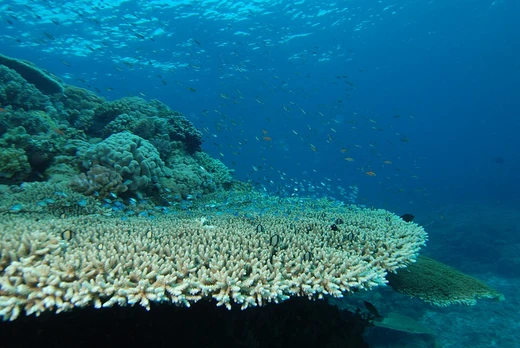
Acropora cervicornis
A fast-growing, branching stony coral critical to Western Atlantic reefs.

Acropora cervicornis, commonly known as staghorn coral, is a branching, stony coral within the Order Scleractinia. It is notable for its thick, upright branches that can grow in excess of 2 meters (6.5 ft) in height and resemble the antlers of a stag. It is one of the fastest growing fringe coral species in the Western Atlantic, adding up to 5 cm of new skeleton for every 1 cm of existing skeleton each year, and serves as an important reef-building coral, functioning as marine nurseries for juvenile fish, buffer zones for erosion and storms, and center points of biodiversity.
Quick Facts
- Taxon
- Acropora cervicornis
Facts from the source article.
Lore & Background
Up until the late 1970s, much of the fore reef zones within the Atlantic around the coasts of Southern Florida and the Caribbean Islands were covered with vast, dense colonies of staghorn coral consisting largely of single-species stands. However, a combination of white-band disease and various anthropogenic factors have reduced this coral coverage by over 95% in some areas. As of 2006, staghorn coral is listed as Critically Endangered under the International Union for Conservation of Nature and is federally designated as a threatened species under the Endangered Species Act of 1973.
The skeleton of staghorn coral is made up of a specific type of calcium carbonate known as aragonite, secreted by specialized calicoblastic cells. The coral typically grows large, thick stems called branches, which can range from 1 to 3 inches in width and grow in close proximity to one another. Tissue color can vary from light brown and beige to green, blue, or purple, largely dependent on the symbiotic zooxanthellae living within the coral's tissue.
Staghorn coral is both autotrophic and heterotrophic. The autotrophic method, from photosynthetic symbiotic zooxanthellae, accounts for up to 90% of total nutritional requirements. The heterotrophic method involves polyps ingesting organisms like zooplankton using their long feeding tentacles and stinging nematocysts. The contribution of nutrients from heterotrophy is poorly understood but may account for anywhere from 0 to 66% of carbon fixation.
Reader's Guide
Acropora cervicornis is one of the most important reef-building corals in the Western Atlantic due to its fast growth and structural complexity. It provides essential ecosystem services, including serving as marine nurseries for juvenile fish, buffer zones for erosion and storms, and center points of biodiversity. Its historical dominance in shallow fore and back reefs, as well as patch reefs, made it a foundational species, but white-band disease and anthropogenic factors have reduced its coverage by over 95% in some areas since the late 1970s. The species reproduces primarily through fragmentation, which can result in entire reefs being genetically identical, potentially rendering them more susceptible to disease or bleaching. Sexual reproduction occurs through synchronized broadcasting of eggs and sperm, typically in late summer (July and August) several days after a full moon. The coral's decline has led to its listing as Critically Endangered by the IUCN and as a threatened species under the Endangered Species Act of 1973, highlighting its precarious status and the need for conservation efforts.
Did You Know?
- The species is found throughout the Western Atlantic, from the Florida Keys and Bahamas to various Caribbean islands, but is absent from Bermuda and the west coast of South America.
- Up to 90% of the coral's nutritional requirements come from symbiotic zooxanthellae (dinoflagellates) living within its tissue.
- Fragmentation is the most common mode of reproduction in staghorn coral and can result in a single coral giving rise to many new colonies or entirely new coral reefs.
Architectural Mastery of the Reef
Acropora cervicornis, commonly called elkhorn coral, belongs to a genus of small-polyp stony corals within the phylum Cnidaria that plays a foundational role in constructing the vast calcium carbonate frameworks upon which tropical reefs depend. While the living tissue of a reef is a thin veneer, the true engineering is done by corals like elkhorn, which deposit hard skeletal material over centuries to create the substructure that shelters thousands of other marine species. The genus Acropora encompasses more than 149 described species, and its members grow in diverse forms—slender branching structures, broad plates, or table-like shapes—giving reefs their characteristic three-dimensional complexity. Each colony is not a single organism but a dense community of tiny polyps, roughly two millimeters across, that share a common tissue layer and a decentralized nerve net. This collective architecture allows elkhorn coral to reach impressive sizes in the wild, with some colonies spanning well over a meter in diameter.
A Life Lived in Symbiosis
The daily rhythm of elkhorn coral is governed by a partnership that defines its survival. Within the cells of each polyp reside Symbiodinium algae, microscopic partners that harness sunlight through photosynthesis and channel the resulting energy to the coral animal. This golden-brown symbiont gives healthy colonies their characteristic brown or green coloration. When conditions are calm, the polyps remain gently extended, but they can rapidly retract into the skeleton at the slightest sign of disturbance—a defensive reflex against predators. At night, the polyps extend further still, opening wider to sweep plankton and dissolved organic matter from the surrounding water, supplementing the photosynthetic income. This dual feeding strategy makes the coral both a farmer and a hunter. The shared nerve net coordinating thousands of polyps means the colony functions as a single, responsive organism, capable of coordinated withdrawal or expansion in response to its environment.
Under Siege
Elkhorn coral and its close relatives face mounting pressure from a convergence of environmental stressors. The most visible sign of distress is bleaching: when water temperatures spike, pollution accumulates, or ocean chemistry shifts toward greater acidity, the coral expels its Symbiodinium partners, losing the golden-brown pigmentation that sustains it. Stripped of this symbiosis, the colony turns stark white and, without the ability to reabsorb new algal cells, it starves and dies. Sedimentation and eutrophication compound the damage by smothering polyps and disrupting the water chemistry the algae need. The Caribbean, home to only three Acropora species including elkhorn, has seen particularly severe population declines. In 2014, the U.S. Fish and Wildlife Service formally listed ten Acropora species as threatened, a recognition that without intervention, these reef architects risk disappearing from the waters that shaped them.
From Aquarium to Reef Restoration
In the reef-keeping community, elkhorn coral occupies a fascinating dual role as both a prized ornament and a restoration tool. While most Acropora species display muted brown or green tones, a handful exhibit vivid coloration that makes them highly sought after by aquarists. Under optimal captive conditions—intense lighting, stable temperatures, regular supplementation of calcium and alkalinity, and clean, turbulent water—growth can be remarkably rapid: a fragment no larger than a finger may expand to the size of a medicine ball within one to two years. This fast growth, combined with widespread captive propagation, has made Acropora one of the most cultivated genera in marine aquariums. However, keeping them is far from simple; parasites such as the Acropora-eating flatworm and the red bug Tegastes acroporanus can devastate a colony. Despite these challenges, fragments raised in captivity are increasingly deployed to repopulate degraded reefs, turning the aquarium hobby into a genuine conservation pipeline.
Frequently Asked Questions
What is Acropora cervicornis?
Staghorn coral is a branching stony coral in the Scleractinia order, instantly recognizable by its thick, upright antler-like branches. It is a fringe reef-builder native to the Western Atlantic.
How fast does Acropora cervicornis grow?
It is one of the fastest-growing corals in the Western Atlantic, laying down up to 5 cm of new skeleton for every 1 cm of existing skeleton each year. That rapid calcification is what lets it build the towering structures that define shallow reef edges.
What are Acropora cervicornis's size and depth limits?
Individual branches can exceed 2 meters (about 6.5 ft) in height, with branch widths between 1 and 3 inches. The species typically occupies depths up to 20 meters (65 ft) in water ranging from 66 to 80 °F (19–27 °C) and 33–37 ppt salinity.
Why is Acropora cervicornis important to reef ecosystems?
It serves as a marine nursery for juvenile fish, a natural buffer against wave erosion and storm surge, and a biodiversity hub that anchors entire reef communities. Losing it removes the structural backbone of many shallow Western Atlantic reefs.
What role does Acropora cervicornis play in the reef's ongoing 'story'?
As a fast-growing fringe coral, it repeatedly outpaces slower species at the reef's outer edge, constantly reshaping habitat for other organisms. Its cycle of growth, branching, and occasional storm damage keeps the reef's architecture dynamic and productive.
More in Acropora Corals 1-24
Spotted an error? Know more?
Reader corrections go straight into our review queue. Suggest an edit · How this site is sourced