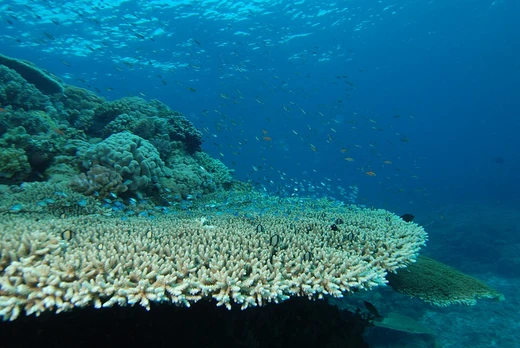
Acropora caroliniana
Rare acroporid coral with flat branches, vulnerable and decreasing.

Acropora caroliniana, a type of acroporid coral, was first documented by F. Nemenzo in 1976. This coral builds thick, horizontal structures made up of flat branches. Its color ranges from light green and pale blue to white-brown, with small branchlets that feature large axial corallites—measuring 1.7 to 3.5 millimeters in diameter—that narrow at the tips and curve upward. The radial corallites are small and pocket-like. It resembles the species *Acropora lokani* and *Acropora loripes*. This coral lives on the upper slopes of tropical, shallow reefs at depths of 5 to 25 meters, and it takes over eight years to reach maturity. It thrives in water temperatures between 25.48 and 27.5 °C. Colonies can grow up to 50 centimeters across, with branchlets reaching lengths of 25 millimeters and widths of 8 millimeters.
The species is uncommon but has a wide distribution, appearing in Australia, the western Pacific, the Indo-Pacific, Pohnpei, Fiji, Papua New Guinea, and two-thirds of Indonesia’s regions. It faces threats from global reef loss, rising temperatures that cause bleaching, disease, coral harvesting, climate change, fishing, human development, pollution, and predation by the crown-of-thorns starfish (*Acanthaster planci*). It is sometimes found within Marine Protected Areas. Listed as vulnerable on the IUCN Red List due to a declining population, it is also included in Appendix II of CITES.
Quick Facts
- Taxon
- Acropora caroliniana
Facts from the source article.
Lore & Background
Acropora caroliniana forms thick horizontal structures made of flat branches, with colors ranging from light green, pale blue, to white-brown. Its large axial corallites, 1.7 to 3.5 millimetres in diameter, narrow at the ends and curve upward, while the radial corallites are small and pocket-like. The species resembles Acropora lokani and Acropora loripes. Colonies reach diameters up to 50 centimetres, and branchlets can be 25 millimetres long and 8 millimetres wide. It is found on the upper slopes of tropical, shallow reefs at depths of 5 to 25 metres, at temperatures of 25.48 to 27.5 °C, and reaches maturity at over eight years.
Reader's Guide
Acropora caroliniana is significant as a vulnerable species with a decreasing population, threatened by global coral reef reduction, temperature-induced bleaching, disease, coral harvesting, climate change, fishing, human development, pollution, and predation by the starfish Acanthaster planci. Despite being rare, it has been found over a large area including Australia, the western Pacific, the Indo-Pacific, Pohnpei, Fiji, two-thirds of Indonesia, and Papua New Guinea. It is sometimes found in Marine Protected Areas and is listed under Appendix II of CITES. Its legacy lies in its restricted distribution and the multiple anthropogenic and natural pressures it faces, highlighting the broader challenges of coral conservation. The species was first described by F. Nemenzo in 1976 in the Philippines, and its morphological similarity to other acroporids underscores the complexity of coral taxonomy.
Did You Know?
- Acropora caroliniana was first described by Nemenzo in 1976.
- It is found at depths of 5 to 25 metres on tropical shallow reef slopes.
- The species reaches maturity at over eight years.
- It is prey to the starfish Acanthaster planci.
Colony Architecture and Polyp Behavior
Acropora caroliniana belongs to a genus of small polyp stony corals within the phylum Cnidaria, a group that includes species commonly called table coral, elkhorn coral, and staghorn coral. More than 149 species have been formally described across the genus, and their growth forms vary considerably depending on the particular species and its local environment, ranging from flat plate-like structures to slender or broad branching frameworks. At the most fundamental level, every Acropora colony is a cooperative community of tiny individual polyps, each roughly two millimeters in diameter. These polyps are linked by shared tissue and a distributed nerve net, allowing the colony to function as a single organism. When undisturbed, the polyps extend just slightly beyond the skeletal surface, but they can rapidly retract inward if they sense movement or a potential predator. In the quiet hours of the night, the polyps reach out considerably further, extending their tentacles to snare passing plankton and dissolved organic particles from the surrounding water column.
Reef Architecture and Taxonomic Complexity
Members of the Acropora genus, including A. caroliniana, play a foundational role in coral reef ecosystems. They are among the principal reef-building corals responsible for constructing the vast calcium carbonate framework that underpins every tropical reef. This massive skeletal substructure provides the physical foundation upon which the thin, living tissue of the reef is draped, making Acropora essentially the architect of an entire habitat. Geographically, the genus spans the Indo-Pacific region, where more than 100 species have been recorded, and the Caribbean, where only three species are recognized. However, the true species count remains uncertain. Taxonomists have raised questions about the validity of several described species, noting that some, such as Acropora prolifera, appear to be hybrids rather than distinct lineages. Additionally, research has revealed that certain named species are actually complexes of cryptic species—genetically distinct populations that look nearly identical on the surface. This ongoing taxonomic uncertainty means the full biodiversity of the genus is still being unraveled.
Bleaching Vulnerability and Conservation Status
The survival of Acropora caroliniana depends on a delicate partnership with Symbiodinium, microscopic symbiotic algae that reside within the coral's cells and supply the animal with energy through photosynthesis. When environmental stressors push the coral beyond its tolerance, it expels these zooxanthellae—cells that give healthy colonies their characteristic golden-brown hue. The result is bleaching: the coral turns stark white, and if it cannot re-acquire new Symbiodinium cells, it will likely perish. Acropora is particularly vulnerable to this process. A constellation of human-driven pressures drives the phenomenon, including pollution, abnormally elevated water temperatures, rising ocean acidification, increased sedimentation, and eutrophication. The cumulative effect has been a steady decline in Acropora populations worldwide. In 2014, the U.S. Fish and Wildlife Service formally listed ten Acropora species as threatened, a recognition that the genus faces serious and accelerating risk in the wild.
Aquarium Culture and Reef Restoration
Within the reef-keeping community, Acropora species occupy a unique position as both prized display organisms and tools for conservation. While most colonies appear in shades of brown or green, a small number exhibit vivid, eye-catching coloration, and these rare specimens are especially sought after by aquarists. Captive propagation of Acropora is widespread, and under optimal conditions the corals grow remarkably fast. In the wild, individual colonies can span more than a meter across; in a well-maintained home aquarium, a fragment no larger than a finger can develop into a colony the size of a medicine ball within one to two years. Over successive generations, captive specimens are gradually adapting through selection to thrive in artificial environments. This technology has a conservation upside: fragments raised in captivity are increasingly deployed to repopulate degraded or barren reefs in the wild. Keeping Acropora successfully demands bright lighting, stable temperatures, regular supplementation of calcium and alkalinity, and clean, turbulent water flow. Parasites such as the Acropora-eating flatworm (Amakusaplana acroporae) and the red bug (Tegastes acroporanus) remain persistent challenges for hobbyists.
Frequently Asked Questions
Who is Acropora caroliniana?
Acropora caroliniana is a rare acroporid coral species first formally described by F. Nemenzo in 1976. It is known for constructing thick, horizontal colonies composed of flat, spreading branches.
What does Acropora caroliniana look like?
Its coloration spans light green, pale blue, and white-brown tones, and its small branchlets bear large axial corallites (1.7–3.5 mm across) that taper toward the tips and curve upward. The radial corallites, by contrast, are tiny and pocket-shaped. A mature colony can reach up to 50 cm in diameter.
Where does Acropora caroliniana live?
It inhabits the upper slopes of tropical, shallow-water reefs at depths between 5 and 25 meters. Water temperatures in its preferred range sit roughly between 25.5 °C and 27.5 °C.
What is Acropora caroliniana's conservation status?
The IUCN lists this species as Vulnerable, with its population in decline. As a rare acroporid with a limited depth niche, it is especially sensitive to reef degradation and warming waters.
How is Acropora caroliniana different from similar species?
It is most often confused with Acropora lokani and Acropora loripes, which share a comparable flat-branching growth form. The distinguishing features lie in the specific size and upward-curving shape of its axial corallites and the pocket-like structure of its radial corallites.
More in Acropora Corals 1-24
Spotted an error? Know more?
Reader corrections go straight into our review queue. Suggest an edit · How this site is sourced