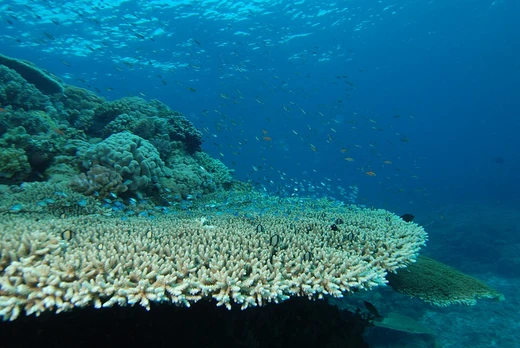
Acropora cerealis
Acroporid coral found across Indian and Pacific oceans.

Acropora cerealis is an acroporid coral that lives in the Indian and Pacific Oceans, ranging from the Red Sea and Gulf of Aden to Hawaii and Johnston Atoll. It inhabits upper reef slopes in shallow tropical waters between 3 and 20 meters deep. Crown-of-thorns starfish specifically target this coral, and it is also collected for use in aquariums.
The species forms either corymbose or cespitose colonies made of thin, interlocking branches, each branch connected to three others. Its branches are wide due to numerous corallites. The radial corallites are tube-shaped and built into the branches, with nariform tips, while the axial corallites are also tubular. Branch tips can be blue, cream, pink, or purple, and the overall colony is cream, pale brown, or white. It resembles *Acropora kimbeensis* and *Acropora plantaginea*.
Listed as least concern on the IUCN Red List, its population is thought to be declining because of the global loss of coral reefs. It is also listed under CITES Appendix II. Exact population numbers are unknown, but threats include coral reef decline, rising temperatures causing bleaching, climate change, human activity, crown-of-thorns starfish (*Acanthaster planci*), and disease. It is found in the eastern and western Indian Ocean, Australia, and across the eastern central, northwest, central-western, and southwest Pacific Ocean, from the Gulf of Aden and Red Sea to Hawaii and Johnston Atoll. James Dwight Dana first described the species in 1846.
Quick Facts
- Taxon
- Acropora cerealis
Facts from the source article.
Lore & Background
Acropora cerealis was described by James Dwight Dana in 1846. It occurs in either corymbose or cespitose colonies consisting of interlocking branches, each locked to three other branches. Its thin branches contain a large number of corallites considerably contributing to their widths. Radial corallites are tube-shaped and built into the branches, with nariform obvious tips; axial corallites are also tubular. Branches have blue, cream, pink or purple branch tips, and the species is either cream, pale brown or white in colour. It has a similar appearance to Acropora kimbeensis and Acropora plantaginea.
Reader's Guide
Acropora cerealis is classed as a least concern species on the IUCN Red List, but its population is believed to be decreasing due to the global decline in coral reefs. It is listed under Appendix II of CITES. Figures of its population are not known, but it is likely to be threatened by the global reduction of coral reefs, the increase of temperature causing coral bleaching, climate change, human activity, the crown-of-thorns starfish (Acanthaster planci), and disease. The species is also harvested for the aquarium trade. Its distribution spans the eastern and western Indian Ocean, Australia, and the eastern central, northwest, central-western and southwest Pacific Ocean, from the Gulf of Aden and Red Sea to the Hawaiian Islands and Johnson Atoll. Crown-of-thorns starfish preferentially prey upon Acropora corals, including this species.
Colony Architecture and Polyp Behavior
Acropora cerealis belongs to a genus of small polyp stony corals within the phylum Cnidaria, a group encompassing over 149 described species popularly known as table coral, elkhorn coral, and staghorn coral. Each colony is not a single organism but a tightly integrated community of individual polyps, each roughly two millimeters across, that share both tissue and a nerve net. Depending on the particular species and its environment, colonies can develop as flat plates or as slender and broad branching structures. The polyps exhibit a remarkable behavioral duality: when undisturbed, they protrude slightly from the skeleton, but any movement or the presence of a potential predator triggers a rapid retraction back into the coral body. At night, when the threat of predation is lower, the polyps extend further outward, a strategy that maximizes their ability to capture plankton and suspended organic matter drifting through the water column.
Reef Architecture and Geographic Range
Acropora species occupy a foundational role in coral reef ecosystems. They are among the principal builders of the vast calcium carbonate substructure that underpins the thin, living surface of a reef, effectively constructing the architectural skeleton upon which countless other marine organisms depend. The genus shows a striking geographic split: more than one hundred species are found across the Indo-Pacific, while only three are native to the Caribbean. However, the true species count remains uncertain. Taxonomists have questioned the validity of several named species, some of which have been revealed to be hybrids rather than distinct lineages, with Acropora prolifera cited as a notable example. Additionally, certain species have been shown to represent cryptic species complexes, meaning that what appears to be a single species may in fact comprise multiple genetically distinct populations. This taxonomic ambiguity complicates conservation planning and our understanding of the genus's full biological diversity.
Symbiosis, Bleaching, and Conservation Status
The survival of Acropora cerealis and its relatives hinges on a mutualistic partnership with Symbiodinium, symbiotic algae that reside within the coral's cells and generate energy through photosynthesis. When environmental stressors disrupt this relationship, the corals expel or lose their zooxanthellae, the golden-brown pigmented algae, resulting in a phenomenon known as bleaching. The once-colored coral turns stark white, and if new Symbiodinium cells cannot be reabsorbed, the colony may perish. Acropora is particularly vulnerable to this process. The primary drivers include pollution, abnormally elevated water temperatures, rising ocean acidification, sedimentation, and eutrophication. The cumulative impact of these pressures has led to a marked decline in Acropora populations worldwide. In 2014, the U.S. Fish and Wildlife Service formally listed ten Acropora species as threatened, underscoring the severity of the crisis facing this genus.
Captive Culture and Reef Restoration
In the reef-keeping community, Acropora species command particular attention. While most are brown or green, a few display vivid coloration that makes them highly sought after by aquarists. Captive propagation is widespread, and under favorable conditions these corals grow remarkably fast; in the wild, individual colonies can span more than a meter, and in a well-maintained aquarium, a finger-sized fragment can develop into a medicine-ball-sized colony within one to two years. Through ongoing selective breeding, captive specimens are gradually adapting to thrive in home aquarium settings. However, keeping Acropora is demanding: they need bright lighting, stable temperatures, regular supplementation of calcium and alkalinity, and clean, turbulent water. Two parasites pose particular challenges in captivity: the Acropora-eating flatworm (Amakusaplana acroporae) and the red bug (Tegastes acroporanus). In a promising conservation application, fragments from captive specimens are sometimes transplanted to repopulate degraded or barren reefs in the wild.
Frequently Asked Questions
What is Acropora cerealis?
Acropora cerealis is a branching acroporid coral species first described by James Dwight Dana in 1846. It forms colonies of thin, interlocking branches in which each branch connects to three others, giving the coral a distinctive lattice-like structure.
Where can Acropora cerealis be found?
This species ranges across the Indian and Pacific Oceans, stretching from the Red Sea and Gulf of Aden all the way to Hawaii and Johnston Atoll. It typically occupies upper reef slopes in shallow tropical waters between 3 and 20 meters deep.
What does Acropora cerealis's colony structure look like?
The coral grows as either corymbose or cespitose colonies composed of thin, interlocking branches. Each branch is relatively wide because it is packed with numerous tube-shaped radial corallites built into its structure.
What are the main threats to Acropora cerealis?
Crown-of-thorns starfish specifically target this species as prey, making it a preferred food source for those predators. It is also harvested for the aquarium trade, adding a second pressure on wild populations.
What is the conservation status of Acropora cerealis?
The IUCN lists Acropora cerealis as Least Concern, reflecting its broad geographic range across the Indian and Pacific Oceans. It is included on CITES Appendix II, which regulates international trade to ensure sustainable use.
More in Acropora Corals 1-24
Spotted an error? Know more?
Reader corrections go straight into our review queue. Suggest an edit · How this site is sourced