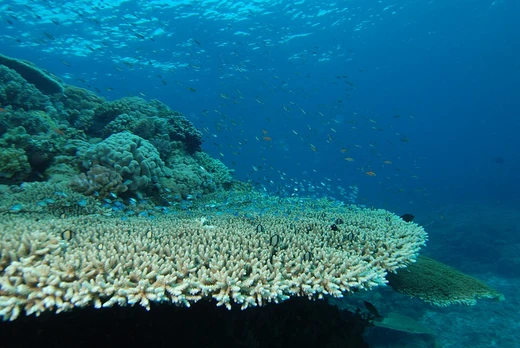
Acropora arabensis
Endangered digitate coral from the Indian Ocean.

Acropora arabensis, a type of acroporid coral, lives in the Indian Ocean and was first scientifically described in 1995 by Gregor Hodgson and Kent Carpenter. This coral is fairly common in its local range, typically growing on upper reef slopes and in lagoons at depths of 3 to 5 meters. As with other members of the Acropora genus, it is vulnerable to coral bleaching. The skeleton of Acropora arabensis is digitate, with branches that divide infrequently and taper at their tips. Its surface features dome-shaped axial corallites and thick-walled radial corallites that are strongly appressed. Both axial and radial corallites form two synapticular rings, and corallite size decreases toward the branch ends. In deeper, more sheltered reef areas, colonies tend to develop more tubular radial corallites mixed with immersed ones. The lamellar septa are moderately developed, extending nearly to the center, with a radius about half that of the calice. To date, Acropora arabensis is only known to live natively off the coast of Kuwait in the Persian Gulf where the species was initially discovered. Additional specimens have been discovered in the southern Red Sea and off the northern Madagascar coast. In the field, this coral appears pale brown to grey. It resembles Acropora ocellata, but that species has longer branches and more elongated radial corallites. It can be distinguished from Acropora clathrata by its tree-like structure and its strongly appressed, evenly spaced corallites.
Quick Facts
- Taxon
- Acropora arabensis
Facts from the source article.
Lore & Background
Acropora arabensis has a digitate skeletal structure with infrequently dividing branches that taper at the ends. Its surface features dome-shaped axial corallites and thick-walled, strongly appressed radial corallites. Axial and radial corallites form two synapticular rings, and corallite size decreases towards the ends of the branches. Colonies that form in deeper, more protected reef areas tend to develop more tubular radial corallites among immersed ones. Lamellar septa are moderately well-developed and almost extend to the center with a radius about one half of calice radius.
Reader's Guide
Acropora arabensis is notable as an endangered species with a decreasing population, primarily known from the coast of Kuwait in the Persian Gulf where it was initially discovered, with additional specimens found in the southern Red Sea and off northern Madagascar. Its susceptibility to coral bleaching, a common threat to Acropora species, underscores its conservation concern. The species was described by Hodgson and Carpenter in 1995, and its digitate growth form with appressed corallites aids field identification. It can be differentiated from similar species like Acropora ocellata, which has longer branches and more elongate radial corallites, and from Acropora clathrata by its tree-like structure and strongly appressed, regularly distributed corallites. Its pale brown to grey coloration and preference for upper reef slopes and lagoons between 3 and 5 m depth define its ecological niche.
Did You Know?
- Acropora arabensis was originally described by Gregor Hodgson and Kent Carpenter in 1995.
- It is classified as 'Endangered' by the IUCN Red List and its population numbers are currently decreasing.
Anatomy and Colony Architecture
Acropora arabensis belongs to a genus of small polyp stony corals classified within the phylum Cnidaria, a group that includes over 149 described species commonly recognized by names such as table coral, elkhorn coral, and staghorn coral. Like all members of this genus, A. arabensis exists as a colonial organism composed of numerous tiny polyps, each roughly two millimeters in diameter. These polyps are not independent creatures; they share a common tissue layer and a diffuse nerve net that coordinates the colony's responses. Under calm conditions the polyps extend slightly beyond the skeletal surface, but any perceived threat—whether a shifting current or the approach of a predator—triggers a rapid retraction back into the calcium carbonate structure. Nocturnal behavior shifts the colony's feeding strategy: polyps extend considerably farther after dark, sweeping through the water column to trap plankton and suspended organic particles. In favorable environments, a single colony can spread to a diameter exceeding one meter, forming the dense branching or plate-like frameworks that give the genus its familiar silhouettes across tropical reefs.
Ecological Role and Biogeographic Range
Members of the genus Acropora, including A. arabensis, serve as principal architects of coral reef ecosystems. They deposit vast quantities of calcium carbonate that form the rigid substructure upon which the comparatively thin living tissue of the reef depends. Without this skeletal scaffolding, the intricate three-dimensional habitat that shelters countless marine organisms would simply not exist. Geographically, the genus spans two major oceanic regions: the Indo-Pacific, where more than one hundred species have been recorded, and the Caribbean, which hosts only three. However, taxonomists caution that the true species count remains uncertain. Several names once treated as distinct species have been revealed to be hybrid forms, as demonstrated in the case of Acropora prolifera, while others have turned out to be complexes of cryptic species—genetically divergent lineages that are morphologically indistinguishable. This ongoing taxonomic revision means that the ecological and evolutionary picture of the genus, and by extension of any single species within it, is still being refined.
Symbiotic Vulnerability and Bleaching Risk
The survival of Acropora arabensis, like that of every stony coral, hinges on a mutualistic partnership with microscopic algae called Symbiodinium. These symbionts reside within the coral's cells and harness sunlight to generate energy that the animal could not otherwise obtain. When environmental stressors push the system past its tolerance threshold, the relationship collapses: the golden-brown zooxanthellae are expelled or lost, and the coral's tissue turns a stark, ghostly white. If new Symbiodinium cells cannot be re-established, the bleached colony starves and dies. The genus is notably more susceptible to this bleaching response than many other reef builders. A constellation of human-driven pressures accelerates the process—pollution runoff, abnormally elevated sea temperatures, rising ocean acidification, increased sedimentation, and eutrophication all compound one another. The conservation consequences are already visible: in 2014 the U.S. Fish and Wildlife Service formally designated ten Acropora species as threatened, a recognition that population declines across the genus have crossed a critical threshold.
Captive Culture and Reef Restoration
Within the global reef-keeping community, Acropora species occupy a position of both admiration and difficulty. While most colonies display muted brown or green hues, the rare brightly colored individuals are highly sought after by aquarists. Captive propagation of the genus is widespread, and under optimal conditions the growth rate is impressive: a fragment no larger than a human finger can expand into a colony the size of a medicine ball within one to two years in a well-maintained aquarium. Over successive generations, captive populations are undergoing subtle selective changes that make them better suited to the controlled conditions of a home tank. Keeping them successfully, however, demands bright illumination, stable water temperatures, regular supplementation of calcium and alkalinity, and consistently clean, turbulent flow. Two parasites—Amakusaplana acroporae, a flatworm, and Tegastes acroporanus, colloquially called red bugs—pose recurring threats to captive colonies. Perhaps most significantly, fragments bred in captivity are increasingly deployed to repopulate degraded or barren reefs in the wild, bridging the gap between aquarium science and marine conservation.
Frequently Asked Questions
Who is Acropora arabensis?
Acropora arabensis is a digitate branching coral native to the Indian Ocean, formally named in 1995 by Gregor Hodgson and Kent Carpenter. It occupies shallow upper reef slopes and lagoon settings, typically at depths of about 3 to 5 meters.
What does Acropora arabensis look like?
Its skeleton grows as finger-like branches that split only rarely and taper to fine tips. The surface shows rounded, dome-shaped axial corallites paired with thick-walled radial corallites that press tightly against the branch.
Where does Acropora arabensis typically grow?
Within its Indian Ocean range this species is fairly common on upper reef slopes and in lagoons, favoring shallow water between 3 and 5 meters. It is not a deep-water or open-ocean coral.
Why is Acropora arabensis listed as Endangered?
Like other members of the Acropora genus, it is highly vulnerable to coral bleaching driven by warming sea temperatures. Despite being locally common in its preferred shallow habitats, that bleaching sensitivity pushes it to the IUCN Endangered category.
Who originally described Acropora arabensis?
The species was introduced to science in 1995 by Gregor Hodgson and Kent Carpenter. Their description placed it within the Acropora genus based on its distinctive infrequently branching, tapering digitate form and its appressed thick-walled radial corallites.
More in Acropora Corals 1-24
Spotted an error? Know more?
Reader corrections go straight into our review queue. Suggest an edit · How this site is sourced