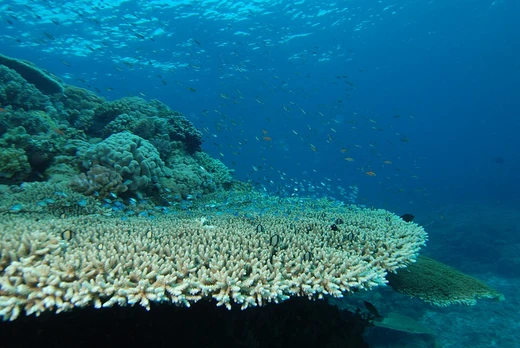
Acropora
A major reef-building coral genus with over 149 species.

Acropora is a genus of small, stony corals with polyps, belonging to the phylum Cnidaria. Common names for some of its over 149 described species include table coral, elkhorn coral, and staghorn coral. These corals are key builders of reefs, creating the thick calcium carbonate framework that lies beneath the reef's thin living surface.
Depending on the species and where it grows, Acropora can form plates or branches that are either slender or broad. Like other corals, each Acropora colony is made up of individual polyps, each about 2 mm across, that share tissue and a nerve net. When disturbed by movement or potential predators, the polyps can retract into the coral; otherwise, they protrude slightly. At night, they often extend further to capture plankton and organic matter from the water.
Acropora species are found in the Indo-Pacific (with over 100 species) and the Caribbean (3 species). The exact number of species is uncertain, partly because some described species may actually be hybrids—for example, Acropora prolifera—and partly because others are now known to be complexes of cryptic species.
Symbiodinium algae live inside the coral's cells, producing energy through photosynthesis. Environmental damage has reduced populations of Acropora and other corals. Acropora is particularly prone to bleaching under stress, which occurs when it loses its golden-brown zooxanthellae. Bleached corals turn stark white and may die if they cannot take in new Symbiodinium. Common causes of bleaching and death include pollution, unusually warm water, increased ocean acidification, sedimentation, and eutrophication. In 2014, the U.S. Fish and Wildlife Service listed ten Acropora species as threatened.
Most Acropora species are brown or green, but a few are brightly colored and highly valued by aquarists. Captive propagation is common in the reef-keeping community. With proper conditions, many Acropora species grow quickly; wild colonies can exceed a meter across. In a well-maintained aquarium, finger-sized fragments can grow to the size of a medicine ball in one to two years. Captive specimens are gradually changing through selection to better suit home aquariums, and fragments are sometimes used to restore barren reefs.
Quick Facts
- Taxon
- Acropora
Facts from the source article.
Lore & Background
Depending on the species and location, Acropora species may grow as plates or slender or broad branches. Like other corals, Acropora corals are colonies of individual polyps, which are about 2 mm across and share tissue and a nerve net. The polyps can withdraw back into the coral in response to movement or disturbance by potential predators, but when undisturbed, they protrude slightly. The polyps typically extend further at night to help capture plankton and organic matter from the water. The species are distributed in the Indo-Pacific (over 100 species) and Caribbean (3 species). However, the true number of species is unknown: firstly, the validity of many of these species is questioned as some have been shown to represent hybrids, for example Acropora prolifera; and secondly, some species have been shown to represent cryptic species complexes.
Reader's Guide
Acropora species are some of the major reef corals responsible for building the immense calcium carbonate substructure that supports the thin living skin of a reef. Environmental destruction has led to a dwindling of populations of Acropora, along with other coral species. Acropora is especially susceptible to bleaching when stressed. Bleaching is due to the loss of the coral's zooxanthellae, which are a golden-brown color. Bleached corals are stark white and may die if new Symbiodinium cells cannot be assimilated. Common causes of bleaching and coral death include pollution, abnormally warm water temperatures, increased ocean acidification, sedimentation, and eutrophication. In 2014 the U.S. Fish and Wildlife Service listed ten Acropora species as 'threatened'. Most Acropora species are brown or green, but a few are brightly colored, and those rare corals are prized by aquarists. Captive propagation of Acropora is widespread in the reef-keeping community. Given the right conditions, many Acropora species grow quickly, and individual colonies can exceed a meter across in the wild. In a well-maintained reef aquarium, finger-sized fragments can grow into medicine ball-sized colonies in one to two years. Captive specimens are steadily undergoing changes due to selection which enable them to thrive in the home aquarium. In some cases, fragments of captive specimens are used to repopulate barren reefs in the wild.
Did You Know?
- Over 149 species of Acropora are described, with over 100 in the Indo-Pacific and 3 in the Caribbean.
- Acropora is especially susceptible to bleaching when stressed, due to the loss of golden-brown zooxanthellae.
The Architects of the Reef
Acropora is a genus of small polyp stony corals within the phylum Cnidaria, and its members are among the most consequential reef builders in the tropical oceans. Familiar common names—table coral, elkhorn coral, staghorn coral—capture the variety of shapes these colonies assume, ranging from broad, plate-like spreads to slender, branching frameworks. What unites them is their role in erecting the vast calcium carbonate substructure that every healthy reef depends upon; the living tissue of a coral community is, in effect, a thin skin draped over this stony architecture. Each colony is a cooperative body of individual polyps, roughly two millimeters in diameter, linked by shared tissue and a distributed nerve net. At rest the polyps protrude only slightly from the skeleton, but the faintest water movement or the approach of a predator prompts them to withdraw into the protective structure. Once the threat passes, and especially after dark, the polyps extend further to sweep through the water and capture plankton and organic particles for nourishment. The genus is distributed across the Indo-Pacific, where more than one hundred species have been documented, and the Caribbean, where three species occur.
Bleaching and the Fragile Symbiosis
The survival of Acropora hinges on a partnership with microscopic algae called Symbiodinium, which reside inside the coral's cells and convert sunlight into energy through photosynthesis. These symbiotic partners also lend the coral its characteristic golden-brown hue. When environmental stress mounts, the relationship breaks down: the zooxanthellae are expelled or lost, and the coral is left stark white in a phenomenon known as bleaching. If new Symbiodinium cells cannot be re-established, the bleached colony will die. Acropora is particularly vulnerable to this process. The drivers are numerous and often overlapping—pollution, abnormally elevated water temperatures, rising ocean acidification, sedimentation, and eutrophication all contribute to the decline of Acropora populations alongside other coral species. The cumulative effect of environmental destruction has been a marked dwindling of these reef-building corals worldwide. The severity of the crisis prompted formal action: in 2014, the U.S. Fish and Wildlife Service designated ten Acropora species as threatened, acknowledging that without intervention these keystone reef architects face genuine risk of local extinction.
Life in the Aquarium
For reef-keeping enthusiasts, Acropora occupies a unique and somewhat paradoxical position. Most species display muted brown or green coloration, but a handful of rare, vividly colored variants are highly sought after by aquarists who prize their visual impact. Captive propagation of Acropora is widespread within the hobby, and the results can be dramatic: under proper conditions, a fragment no larger than a finger can swell into a colony the size of a medicine ball within one to two years. In the wild, individual colonies can exceed a meter across. Yet keeping Acropora is far from simple. These corals demand bright lighting, stable water temperatures, regular supplementation of calcium and alkalinity, and clean, turbulent water flow. Two parasites are particularly troublesome in home systems: the Acropora-eating flatworm (Amakusaplana acroporae) and the so-called red bug (Tegastes acroporanus). Despite these challenges, the hobby has produced a tangible conservation benefit. Captive specimens, shaped over generations by selective breeding for aquarium resilience, are now sometimes used as donor material to repopulate barren reefs in the wild, turning a home aquarium into a small nursery for ocean recovery.
A Taxonomic Puzzle
With more than 149 species formally described, Acropora is one of the more species-rich genera among stony corals, yet the true count remains uncertain. Taxonomists face a two-fold problem. First, the validity of many described species is in question: some have been shown to be hybrids rather than distinct lineages, with Acropora prolifera cited as a notable example. Second, several named species have turned out to be cryptic species complexes—groups of genetically distinct populations that look morphologically identical but are reproductively isolated. This taxonomic murkiness is compounded by the genus's uneven geographic distribution. The Indo-Pacific harbors well over one hundred species, reflecting the extraordinary diversity of reef environments in that region, while the Caribbean supports only three. The disparity hints at different evolutionary pressures and biogeographic histories on either side of the Atlantic. For researchers, the challenge is not merely cataloguing but disentangling: determining which names represent genuine species, which are artifacts of hybridization, and which are masks hiding multiple hidden lineages. Until that work is complete, the full biological richness of Acropora remains partially obscured.
Frequently Asked Questions
Who is Acropora?
Acropora is a genus of small, stony corals within the phylum Cnidaria, encompassing more than 149 described species. Hobbyists and divers often encounter its members under nicknames like table coral, elkhorn coral, or staghorn coral.
What role does Acropora play in the reef ecosystem?
Acropora acts as one of the principal architectural builders of coral reefs, depositing thick layers of calcium carbonate that form the structural skeleton beneath the reef's thin living surface. Without this foundational framework, the complex three-dimensional habitat that supports countless marine species would not exist.
How is an Acropora colony organized?
Each colony is a collective of tiny polyps roughly two millimeters in diameter that share a common tissue layer and a distributed nerve net. Depending on the species and local conditions, the colony may grow into broad plates or into slender, branching structures.
Where can Acropora species be found?
The vast majority of Acropora species—well over 100—occur across the Indo-Pacific region, while only three species are recorded in the Caribbean. This makes the Indo-Pacific the genus's primary home range.
Why is Acropora considered important and at risk?
As a major reef-building genus, Acropora underpins the physical structure of many tropical reefs, making it ecologically indispensable. Ten of its species have been flagged as threatened by the U.S. Fish and Wildlife Service, underscoring the pressure these corals face from environmental change.
More in Acropora Corals 1-24
Spotted an error? Know more?
Reader corrections go straight into our review queue. Suggest an edit · How this site is sourced