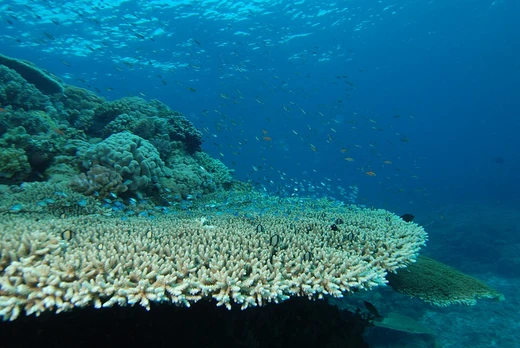
Acropora acuminata
A table-shaped coral vulnerable to bleaching and starfish predation.

Acropora acuminata is a coral species that forms table-shaped colonies, with horizontal branches that taper to pointed tips. Its color ranges from brown to pale blue, and it closely resembles Acropora hoeksemai. On the horizontal branches, corallites are not visible and are integrated into the branch structure, while vertical branches have two types of corallites, including large, tube-shaped ones. The radial corallites have nariform or oval openings and generally do not touch each other.
This species lives on shallow coral reefs at depths of 5 to 20 meters. It is especially vulnerable to coral bleaching, predation by the crown-of-thorns starfish (Acanthaster planci), and collection for the aquarium trade. Its population is declining and is listed as vulnerable on the IUCN Red List, as well as under Appendix II of CITES. The exact population size is unknown, but the species faces threats from global reef degradation, rising temperatures, climate change, human activities, aquarium harvesting, crown-of-thorns starfish, and disease.
Acropora acuminata is found across a wide range, including Australia, the Red Sea, the central Indo-Pacific, Japan, the northern Indian Ocean, the East China Sea, Southeast Asia, and the western Pacific Ocean. It was first described by Addison Emery Verrill in 1864 under the name Madrepora acuminata.
Quick Facts
- Taxon
- Acropora acuminata
Facts from the source article.
Lore & Background
Acropora acuminata forms table-shaped colonies mainly consisting of horizontal branches that taper to points. Corallites are not visible on the horizontal branches of specimens and form parts of the branches, while corallites on vertical branches exist in two forms, including a large tube-shaped form. It is brown or pale blue in colour and appears similar to Acropora hoeksemai. Radial corallites have nariform or oval openings and generally do not come in contact with each other.
Reader's Guide
Acropora acuminata is notable for its susceptibility to multiple threats, including coral bleaching, the crown-of-thorns sea star (Acanthaster planci), and harvesting for the aquarium trade. It is classed as a vulnerable species on the IUCN Red List as the population is decreasing, and is listed under Appendix II of CITES. Its population is unknown, but is likely to be threatened by the global reduction of coral reefs, the increase of temperature causing bleaching, climate change, human activity, aquarium-related harvesting, the crown-of-thorns starfish, and disease. The species was first described by Addison Emery Verrill in 1864 as Madrepora acuminata. Its distribution spans the Red Sea, southeast Asia, Australia, the northern Indian Ocean, Japan, the central Indo-Pacific, the East China Sea, and the western Pacific Ocean, where it occurs on shallow coral reefs from depths of 5–20 m.
Architecture of a Living Colony
Acropora acuminata belongs to a genus of small-polyp stony corals within the phylum Cnidaria, a group that collectively includes corals commonly called table coral, elkhorn coral, and staghorn coral. With more than 149 described species, Acropora stands as one of the principal architects of tropical reefs, laying down the vast calcium carbonate framework upon which the thin living surface of a reef depends. Morphologically, the genus displays remarkable plasticity: depending on the particular species and its local environment, colonies may spread as broad plates or extend as slender, branching structures. At the microscopic level, each colony is an integrated community of individual polyps roughly two millimetres across, all connected by shared tissue and a diffuse nerve net. These polyps are not static; they retract into the skeleton when they sense movement or a potential predator, yet they protrude slightly during calm periods. At night, they extend even further, reaching out into the water column to trap plankton and dissolved organic matter. The genus is broadly distributed across the Indo-Pacific, where more than a hundred species occur, with just three found in the Caribbean, though taxonomists continue to debate the true species count due to hybridization and cryptic complexes.
Symbiosis and the Fragility of Color
The survival of Acropora acuminata depends on a partnership with microscopic algae known as Symbiodinium, which reside inside the coral's cells and convert sunlight into chemical energy through photosynthesis. This mutualism is what gives healthy colonies their characteristic brown or green hues. However, the relationship is delicate. When the coral experiences environmental stress, it expels or loses these golden-brown zooxanthellae, and the tissue turns a stark, bleached white. If the animal cannot re-acquire new Symbiodinium cells, it will starve and die. Acropora is noted as being especially vulnerable to this bleaching process compared to many other reef organisms. The triggers are numerous and often overlapping: pollution, abnormally elevated water temperatures, rising ocean acidification, sedimentation from coastal runoff, and eutrophication from excess nutrients. The cumulative effect of these pressures has driven a marked decline in Acropora populations worldwide, making the loss of this symbiotic color not merely an aesthetic change but a signal of ecosystem collapse.
Regulatory Recognition and Taxonomic Uncertainty
By the mid-2010s, the steady erosion of Acropora populations had become impossible to ignore from a policy standpoint. In 2014, the U.S. Fish and Wildlife Service formally designated ten Acropora species as threatened, acknowledging that human-driven environmental destruction was pushing these reef-building corals toward local extinction. The listing reflected a broader pattern: pollution, warming seas, acidification, sedimentation, and nutrient overload were converging to create conditions under which Acropora's already fragile symbiosis with its algal partners breaks down. Because Acropora is particularly prone to bleaching under stress, even short-duration thermal anomalies can strip a colony of its zooxanthellae, leaving it white and vulnerable to mortality if it cannot recruit replacement Symbiodinium. The regulatory action also underscored a taxonomic uncertainty that complicates conservation planning: many of the over 149 described Acropora species have had their validity questioned, with some turning out to be hybrids, as with Acropora prolifera, and others representing cryptic species complexes. This means the true number of distinct lineages requiring protection may differ substantially from the catalogued count.
Cultivation, Selection, and Reef Restoration
Within the reef-keeping hobby, Acropora species occupy a unique niche: most are unremarkable in color, appearing brown or green, but a small subset displays vivid pigmentation that makes them highly sought after by aquarists. Captive propagation of Acropora is now widespread, and under optimal conditions the genus is remarkably fast-growing. In the wild, individual colonies can span more than a meter across; in a well-maintained aquarium, a fragment no larger than a finger can balloon into a colony the size of a medicine ball within one to two years. Over successive generations, captive specimens are undergoing subtle changes driven by selection, gradually adapting to the constraints of a home tank. These cultivated colonies also serve a conservation purpose: fragments are occasionally transplanted back onto degraded or barren reefs to help re-establish living cover. Keeping Acropora successfully is demanding, however. The corals need intense lighting, tightly stable temperatures, regular supplementation of calcium and alkalinity, and clean, turbulent water flow. Even in captivity, colonies face parasitic pressure from the flatworm Amakusaplana acroporae and the so-called red bugs (Tegastes acroporanus), both of which target Acropora specifically.
Frequently Asked Questions
What does Acropora acuminata look like?
It grows into a distinctive table shape, with horizontal branches that narrow down to sharp, pointed tips. Its coloration typically falls somewhere between brown and a soft pale blue, giving it a muted appearance on the reef.
Who originally described Acropora acuminata and when?
Addison Emery Verrill first described the species back in 1864, naming it Madrepora acuminata at the time. It was later reclassified into the genus Acropora, but the specific epithet 'acuminata' (meaning pointed) stuck.
How is Acropora acuminata different from Acropora hoeksemai?
The two species look very similar at a glance, which makes them easy to confuse in the field. A closer look reveals differences in corallite arrangement: on A. acuminata's horizontal branches the corallites blend into the branch wall and aren't individually visible, while its vertical branches carry large tube-shaped corallites alongside smaller radial ones with oval or nariform openings that generally don't press against one another.
Where does Acropora acuminata typically grow?
It is a shallow-reef species, usually found between roughly 5 and 20 meters depth. It favors well-lit, open reef areas where its flat, table-like structure can spread out and capture sunlight for its symbiotic algae.
Why is Acropora acuminata listed as Vulnerable?
The species is particularly sensitive to thermal stress-driven bleaching events and to predation by crown-of-thorns starfish, both of which can wipe out entire colonies quickly. Its IUCN status is Vulnerable, and it also appears on CITES Appendix II, meaning international trade in the species is regulated to help prevent further population declines.
More in Acropora Corals 1-24
Spotted an error? Know more?
Reader corrections go straight into our review queue. Suggest an edit · How this site is sourced