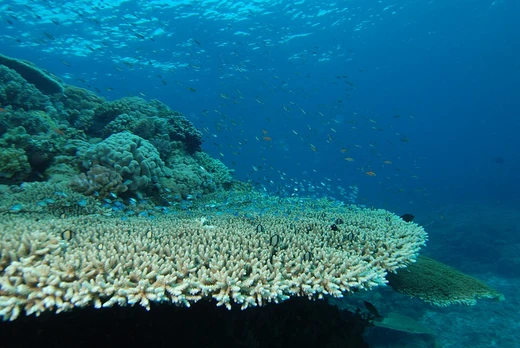
Acropora awi
Endangered bottlebrush coral found across the Indo-Pacific.

Acropora awi is an acroporid coral species first identified by Wallace and Wolstenholme in 1998. Its colonies grow in a bottlebrush shrub form, with long, dense branches that are mostly conspicuous. The colour ranges from grey-brown to pink-brown. The axial corallites at the branch tips are long and merge with some of the radial corallites on the sides, though smaller radial corallites—described as pocket-shaped and less than 1 mm across—also occur. The species resembles Acropora echinata and Acropora navini. It reaches up to 1.5 metres in size and inhabits fringing reefs, shallow reef slopes, and sandy slopes in marine environments.
The coral has a wide but sparse distribution, found across the Indo-Pacific, Japan, Pohnpei, the East China Sea, Micronesia, Southeast Asia, the Solomon Islands, and two-thirds of Indonesia’s regions, as well as the Marshall Islands—though no known population exists there. It is easily damaged, has poor resistance to disease and pathogens, and is threatened by global coral reef loss, rising temperatures causing bleaching, disease, and predation by Acanthaster planci. Its population is decreasing, leading to its Endangered status on the IUCN Red List. It is also listed under Appendix II of CITES. Some colonies occur within Marine Protected Areas.
Quick Facts
- Taxon
- Acropora awi
Facts from the source article.
Lore & Background
Acropora awi forms colonies with a structure resembling bottlebrush shrubs, with many long, tightly packed branches. The species is grey-brown or pink-brown in colour. Axial corallites on top of the branches are long and fuse with some radial corallites on the sides, while smaller radial corallites are described as 'pocket-shaped' with diameters below 1 mm. It is similar to Acropora echinata and Acropora navini. The species grows to a size of 1.5 metres.
Acropora awi is found over a large range including the Indo-Pacific, Japan, Pohnpei, the East China Sea, Micronesia, Southeast Asia, the Solomon Islands, and two-thirds of the regions of Indonesia. It was also found in the Marshall Islands, but there is no known population for it. It lives in marine habitats in reefs, specifically fringing reefs, slopes of shallow reefs, and sandy slopes.
The species is easily damaged and has a poor resistance to disease and pathogens. It is classed as Endangered on the IUCN Red List with a decreasing population, and is listed under Appendix II of CITES. Threats include the global reduction of coral reefs, temperature increase causing bleaching, disease, predation by Acanthaster planci, and its vulnerability to damage. Some of the species is within Marine Protected Areas.
Reader's Guide
Acropora awi is significant as an Endangered coral species with a decreasing population, highlighting the vulnerability of reef ecosystems. Its description by Wallace and Wolstenholme in 1998 added to the known diversity of acroporid corals. The species is easily damaged and has poor resistance to disease and pathogens, making it particularly susceptible to environmental stressors. Its presence across a large Indo-Pacific range, including Japan, Micronesia, Southeast Asia, and the Solomon Islands, indicates a broad but not abundant distribution. The species is threatened by global reef reduction, temperature-induced bleaching, disease, and predation by Acanthaster planci. Its listing under Appendix II of CITES reflects international concern. The fact that some populations occur within Marine Protected Areas offers a measure of conservation, but the overall population continues to decline. The species' bottlebrush colony structure and pocket-shaped radial corallites distinguish it from similar species like Acropora echinata and Acropora navini. Its legacy lies in representing the challenges facing coral biodiversity in the face of climate change and habitat degradation.
Did You Know?
- Acropora awi was first described by Wallace and Wolstenholme in 1998.
- Its colony structure resembles bottlebrush shrubs, with branches that are tightly packed.
- It is prey to the crown-of-thorns starfish Acanthaster planci.
Architecture of a Living Scaffold
Acropora corals belong to the phylum Cnidaria and represent one of the most architecturally diverse groups of small polyp stony corals, with more than 149 described species collectively known by common names such as table coral, elkhorn coral, and staghorn coral. Their growth forms range from broad, shelf-like plates to slender, branching structures, and in the wild, individual colonies can stretch beyond a meter in diameter. Each colony is not a single organism but a tightly knit community of tiny polyps, roughly two millimeters across, that share a common tissue layer and a distributed nerve net. These polyps behave almost like miniature recluses: they tuck themselves back into the skeletal structure whenever water movement or a potential predator stirs the surroundings, yet when conditions are calm they protrude just slightly. At night, they extend noticeably farther, reaching into the water column to snare plankton and dissolved organic matter. Together, these countless polyps secrete the vast calcium carbonate framework that forms the structural backbone of coral reefs, supporting the thin living tissue draped over the surface.
The Fragile Partnership and the White Tide
The survival of Acropora hinges on a microscopic partnership: symbiotic algae called Symbiodinium reside within the coral's cells and, through photosynthesis, generate the energy that fuels the animal. These algae carry a golden-brown pigment, and their presence gives healthy colonies their characteristic coloration. When environmental stress pushes the system past its tolerance, the coral expels or loses these zooxanthellae, and the once-colored tissue turns stark white in a phenomenon known as bleaching. If the coral cannot re-acquire new Symbiodinium cells, it will starve and die. Acropora is particularly vulnerable to this process. The triggers are numerous and often human-driven: rising water temperatures, pollution, ocean acidification, sediment runoff, and eutrophication all compound the stress. The consequences are severe enough that in 2014 the U.S. Fish and Wildlife Service formally designated ten Acropora species as threatened, acknowledging that the pace of environmental destruction is outstripping the coral's capacity to recover.
A Census That Keeps Shifting
Acropora spans a remarkably broad geographic range, with more than one hundred species documented across the Indo-Pacific and just three in the Caribbean. Yet the true species count remains elusive. Taxonomists have described over 149 species, but the validity of many of those names is actively questioned. Some taxa once treated as distinct species have turned out to be hybrids, with Acropora prolifera serving as a notable example. Others have been revealed as cryptic species complexes—groups of morphologically similar organisms that are genetically distinct but look nearly identical to the naked eye. This taxonomic uncertainty means that conservation planning, ecological studies, and even reef-keeping practices may be operating on an incomplete or inaccurate picture of biodiversity. The genus is, in a sense, a moving target: every new genomic tool or hybridization study has the potential to redraw the boundaries of what we consider a single species, reminding researchers that the full biological diversity of Acropora is still being unpacked.
From Aquarium Tank to Reef Restoration
In the reef-keeping hobby, Acropora occupies a dual role as both a prized ornamental and a practical tool for conservation. While most species display muted brown or green hues, a handful exhibit vivid coloration that makes them especially sought after by aquarists. Captive propagation is widespread, and under optimal conditions—bright lighting, stable temperatures, regular supplementation of calcium and alkalinity, and clean, turbulent water—growth is remarkably rapid. A fragment no larger than a finger can swell into a colony the size of a medicine ball within one to two years. Over successive generations, captive populations are subtly adapting through selection to thrive in home aquariums. This same capability has been turned toward restoration: fragments bred in captivity are now transplanted onto degraded or barren reefs to help rebuild lost structure. The challenge, however, is real. Parasites such as the Acropora-eating flatworm Amakusaplana acroporae and the red bug Tegastes acroporanus can devastate colonies, and the demanding husbandry requirements mean that success is far from guaranteed.
Frequently Asked Questions
What is Acropora awi?
Acropora awi is a stony coral species in the genus Acropora, formally described by Wallace and Wolstenholme in 1998. It is a bottlebrush-form coral native to the Indo-Pacific region.
How large can Acropora awi grow?
Colonies of this species can reach a maximum size of roughly 1.5 metres (about 4 feet 11 inches). They develop into dense, long-branching shrub structures characteristic of the bottlebrush growth form.
Where does Acropora awi typically live?
This coral is found on fringing reefs, the slopes of shallow reefs, and sandy slopes throughout the Indo-Pacific. It inhabits relatively shallow reef environments rather than deep-water habitats.
What does Acropora awi look like?
The coral displays a bottlebrush shrub shape with long, dense branches and colouration ranging from grey-brown to pink-brown. Its branch-tip axial corallites are elongated and partially merge with adjacent radial corallites, while smaller pocket-shaped radial corallites under 1 mm in diameter also appear along the branches.
What is the conservation status of Acropora awi?
Acropora awi is classified as Endangered by the IUCN, and its population trend is currently decreasing. It is sometimes confused with visually similar species such as Acropora echinata and Acropora navini.
More in Acropora Corals 1-24
Spotted an error? Know more?
Reader corrections go straight into our review queue. Suggest an edit · How this site is sourced