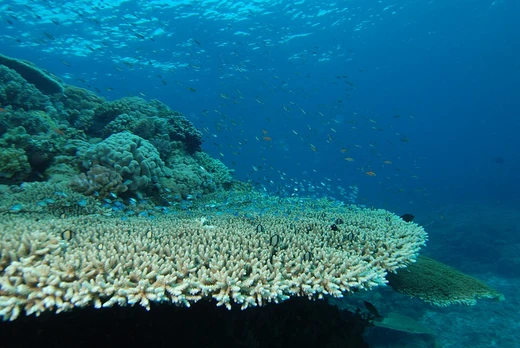
Acropora kimbeensis
A vulnerable acroporid coral from Indo-Pacific shallow reefs.

Acropora kimbeensis is a species of acroporid coral first described by Dr. Carden Wallace in 1999. It forms compact, bush-like colonies with upward-facing branches that taper toward the ends and are caespitose. The branches can reach up to 80 millimeters in length, and the coral appears in yellow, blue, or cream. Small, obvious axial corallites sit on the branchlets, with equally spaced incipient axial corallites. Radial corallites line the sides of the branchlets, each with an opening smaller than 1 millimeter. This species resembles Acropora cerealis and Acropora subulata.
It inhabits marine, tropical, shallow reefs, typically on upper slopes at depths of 3 to 12 meters, though it can occur as deep as 15 meters. It is also found in lagoons, patch reefs, reef fronts, and reef flats. The coral reaches maturity between three and eight years and lives for more than ten years.
The species has a wide but uncommon distribution across the Indo-Pacific, including the East China Sea, the west Pacific, Eastern Australia, Southeast Asia, Papua New Guinea, Osprey Reef in the Coral Sea, Micronesia, and Pohnpei. It occurs in one region of Indonesia and at two sites in the Marshall Islands. Population data are lacking, but the species is known to be declining. In 2005, 1,282 live specimens were exported for aquarium use. Threats include bleaching from rising sea temperatures, coral disease, climate change, pollution, human development, fishing, infrastructure, and export. It is listed as vulnerable on the IUCN Red List and on CITES Appendix II, and it can be found within Marine Protected Areas.
Taxonomically, it was first described by C. C. Wallace in 1999 as Acropora kimbeensis in the Indo-Pacific.
Quick Facts
- Taxon
- Acropora kimbeensis
Facts from the source article.
Lore & Background
Acropora kimbeensis forms compact, bush-like colonies with upward-facing branches that become thinner toward the ends and are caespitosed. The branches can reach up to 80 mm (3.1 in) in length. Its color varies among yellow, blue, or cream. The branchlets have small, obvious axial corallites and equally spaced incipient axial corallites; radial corallites with openings below 1 mm (0.039 in) are present along the sides. It resembles Acropora cerealis and Acropora subulata. The species is found in marine, tropical, shallow reefs on upper slopes, typically at depths of 3 to 12 m, but can occur as low as 15 m. It also inhabits lagoons, patch reefs, reef fronts, and reef flats. It reaches maturity between three and eight years and lives for more than ten years.
Reader's Guide
Acropora kimbeensis is significant as a vulnerable species with a decreasing population, affected by bleaching from rising sea temperatures, coral disease, climate change, pollution, human development, fishing, infrastructure, and export for aquariums. In 2005, 1,282 live specimens were exported for aquarium use. It is listed on CITES Appendix II, indicating it may become threatened if trade is not regulated. The species occurs over a large area but is uncommon, with records from the Indo-Pacific, East China Sea, west Pacific, Eastern Australia, Southeast Asia, Papua New Guinea, Osprey Reef Coral Sea, Micronesia, and Pohnpei. It is found in one region of Indonesia and at two sites of the Marshall Islands. There is a lack of population data, but the known decline underscores conservation concern. It can occur within Marine Protected Areas, offering some protection. Its legacy lies in being a documented example of a coral species impacted by multiple anthropogenic stressors, and its inclusion in international trade regulations highlights the need for monitoring.
More in Acropora Corals 1-24
Spotted an error? Know more?
Reader corrections go straight into our review queue. Suggest an edit · How this site is sourced