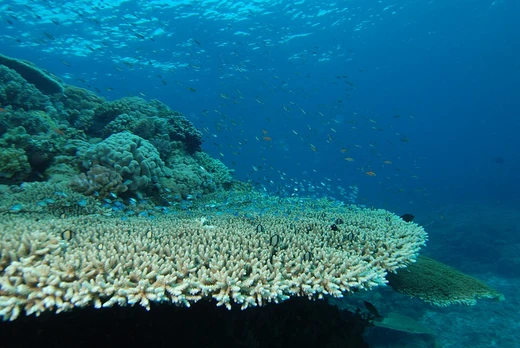
Acropora indonesia
Endangered acroporid coral from Indo-Pacific shallow reefs.

Acropora indonesia is a species of acroporid coral first described by Dr Carden Wallace in 1997. It is notable for its dense, tiered cushion-shaped structures and is found in marine, tropical, shallow reefs in sheltered flat locations or gentle slopes at depths of 10 to 20 m. The species is listed as endangered on the IUCN Red List and on CITES Appendix II, with a decreasing population.
Quick Facts
- Taxon
- Acropora indonesia
Facts from the source article.
Lore & Background
Acropora indonesia occurs in dense tiered cushion-shaped structures up to 1 metre in depth. Its colour ranges between dark grey/dark brown and pale, with tightly packed, thin, upright branches. Branches at the perimeter have upward-facing ends up to 80 mm long, and the axial corallites are normally obvious, with radial corallites of the same size. Within the genus Acropora, no species are similar to this one. The species is composed of aragonite (calcium carbonate).
It is found in marine, tropical, shallow reefs at depths of 10 to 20 m, on gently sloping submerged surfaces and ledges. Its distribution covers a large area of the Indo-Pacific, including Indonesia (all six regions, such as the Banggai islands of Sulawesi and Raja Ampat islands), Thailand, the Solomon Islands, the Philippines, Singapore, Australia, Malaysia, Papua New Guinea, and Myanmar. The exact population is unknown, but it is known to be decreasing overall due to threats from disease and bleaching caused by rising sea temperatures. It is prey to the starfish Acanthaster planci, which is becoming common and threatening numbers of Acropora species. Human activities, fishing, climate change, and industry also threaten it.
Reader's Guide
Acropora indonesia is significant as a species first described in 1997 by Dr Carden Wallace, contributing to the taxonomic understanding of the genus Acropora. Its listing as endangered on the IUCN Red List and on CITES Appendix II highlights its conservation concern, despite being common over a large area of the Indo-Pacific. The species faces multiple threats, including disease, bleaching from rising sea temperatures, predation by the starfish Acanthaster planci, and human activities such as fishing, climate change, and industry. Its population is decreasing, and it may occur in Marine Protected Areas, though the article does not specify the effectiveness of these protections. The species' unique morphology—dense tiered cushion-shaped structures with no similar species within the genus—makes it a distinct component of shallow reef ecosystems. Its composition of aragonite (calcium carbonate) is typical of reef-building corals. The legacy of Acropora indonesia lies in its representation of the vulnerability of coral species to environmental and anthropogenic pressures, as documented in the source article.
More in Acropora Corals 1-24
Spotted an error? Know more?
Reader corrections go straight into our review queue. Suggest an edit · How this site is sourced