Acropora hyacinthus
A table-forming coral restricted to the central Pacific and Australian east coast.

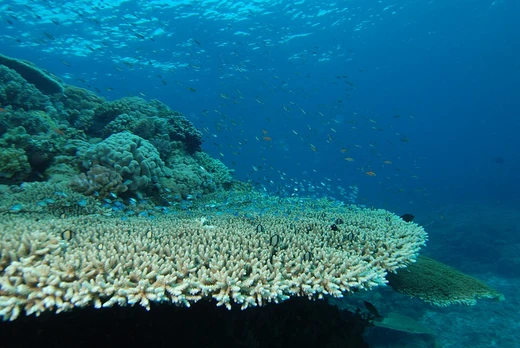
Acropora hyacinthus is a species of Acropora coral described from a specimen collected in Fiji by James Dwight Dana in 1846. It is notable for its plate- or table-shaped colonies and for being preferentially preyed upon by crown-of-thorns starfish. The species was long thought to have a broad Indo-Pacific range but has recently been shown to be restricted to the central Pacific and the Australian east coast.
Quick Facts
- Taxon
- Acropora hyacinthus
Facts from the source article.
Lore & Background
Acropora hyacinthus was originally described by James Dwight Dana in 1846 as Madrepora hyacinthus from a sample collected in Fiji during the U.S. Exploring Expedition. It was historically believed to range across the Indian Ocean, Indo-Pacific waters, southeast Asia, Japan, the East China Sea, and the western Pacific Ocean, but recent morphological and molecular data indicate that the species is likely restricted to the south and south-western Pacific, specifically the central Pacific and the Australian east coast. Several species previously treated as synonyms—including A. sinensis, A. flabelliformis, A. turbinata, A. conferta, A. pectinata, A. bifurcata, A. patella, A. surculosa, and A. recumbens—have been reinstated as distinct taxa pending further study.
The species forms plate- or table-shaped wide colonies composed of thin branches in a lattice structure, with strongly inclined branchlets. It has axial dominant branches, each with a large dominant axial corallite and much smaller cup-shaped radial corallites. The corallites are often darker than the main branch structure. A. hyacinthus looks similar to many tabular Acropora species and is frequently misidentified in the field.
Branching corals of the genus Acropora are among the fastest-growing taxa on most coral reefs. A. hyacinthus has an average growth rate ranging from 3 to 10 centimetres diameter increase per year, with much of this variation thought to be a response to temperature, competition, and other abiotic and biotic factors. It lives on shallow reefs on upper reef slopes at depths from 1 to 25 metres.
Reader's Guide
Acropora hyacinthus is significant as a species whose taxonomy and distribution have been substantially revised, highlighting the complexity of coral identification and biogeography. Originally described from Fiji in 1846, it was long considered widespread across the Indo-Pacific, but recent research has restricted its range to the central Pacific and Australian east coast, with many former synonyms reinstated as distinct species. This revision underscores the importance of combining morphological and molecular data in coral systematics.
The species is classed as Data Deficient on the IUCN Red List, but its population is believed to be decreasing in line with global reef decline. It is listed under Appendix II of CITES. Threats include global reduction of coral reefs, temperature increase causing coral bleaching, climate change, human activity, predation by crown-of-thorns starfish, and disease. Its growth rate, ranging from 3 to 10 centimetres per year, makes it a relatively fast-growing Acropora, but this growth is influenced by temperature and competition. The species' plate-like morphology and frequent misidentification in the field add to the challenges of monitoring its status and distribution.
Did You Know?
- Acropora hyacinthus was originally described as Madrepora hyacinthus by James Dwight Dana in 1846 from a specimen collected in Fiji.
- Crown-of-thorns starfish preferentially prey upon Acropora corals, including A. hyacinthus.
- The species has an average growth rate of 3–10 centimetres diameter increase per year.
More in Acropora Corals 1-24
Spotted an error? Know more?
Reader corrections go straight into our review queue. Suggest an edit · How this site is sourced