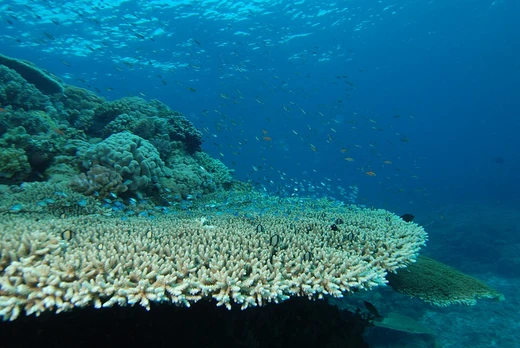
Acropora humilis
A digitate acroporid coral found across the Indo-Pacific.

Acropora humilis, commonly known as finger coral, is a species of acroporid coral found in tropical shallow reefs across the Indo-Pacific, including the Red Sea, Indian Ocean, Australia, Japan, and the Hawaiian Islands. It is notable for its digitate colonies of thick tapering branches and its listing as Near Threatened on the IUCN Red List.
Quick Facts
- Taxon
- Acropora humilis
Facts from the source article.
Lore & Background
Acropora humilis was originally described as Madrepora humilis by Dana in 1846. The species forms digitate colonies composed of thick tapering branches. Each branch typically bears one or more large, dome-shaped axial corallites, with incipient axial corallites or branchlets at their bases. The radial corallites occur in two distinct diameters, with the larger ones arranged in rows. The coral is mainly cream, blue, brown, or purple in colour, and the branches have cream or blue tips.
Reader's Guide
Acropora humilis is classified as Near Threatened on the IUCN Red List, with a decreasing population trend. Although exact population figures are unknown, the species faces threats from the global reduction of coral reefs, rising temperatures causing coral bleaching, climate change, human activity, predation by the crown-of-thorns starfish (Acanthaster planci), and disease. It occurs across a wide geographic range including the Gulf of Aden, the Red Sea, the northern and southwestern Indian Ocean, Australia, the central Indo-Pacific, Japan, southeast Asia, the East China Sea, the central and western Pacific Ocean, the Johnston Atoll, the northwestern Hawaiian Islands, the Raja Ampat Islands, the Mariana Islands, Palau, and the Pitcairn Islands. The species is also exported to aquariums. Its listing under Appendix II of CITES regulates international trade, reflecting concern over its vulnerability.
Did You Know?
- The species occurs at depths of up to 12 metres (39 ft) on tropical upper reef flats and slopes.
- Its radial corallites are found in two different diameters, with the larger ones organised in rows.
- It is listed as Near Threatened on the IUCN Red List and under Appendix II of CITES.
More in Acropora Corals 1-24
Spotted an error? Know more?
Reader corrections go straight into our review queue. Suggest an edit · How this site is sourced