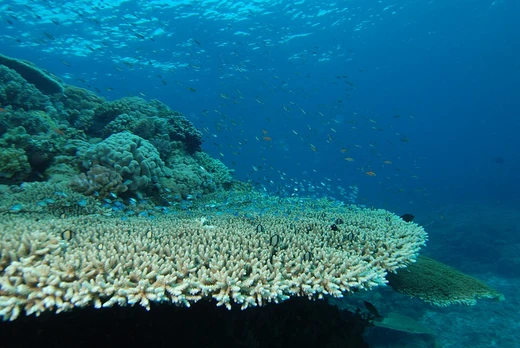
Acropora horrida
A vulnerable acroporid coral found in turbid tropical reefs.

Acropora horrida, a type of acroporid coral, was originally named Madrepora horrida by James Dwight Dana in 1846. This species forms colonies with mostly open branches, colored light blue, dark blue, light yellow, or brown, and has white or pale blue polyps. Its main branches feature an unorganized arrangement of branchlets, which appears bristly with short branchlets in clear water but more chaotic in turbid conditions. The corallites are rough and irregularly placed, with tentacles that enlarge during the day. No other species in the genus Acropora resembles it. Composed of aragonite (calcium carbonate), it lives in tropical, shallow marine reefs, especially near fringing reefs in turbid water, as well as shallow lagoons and sand slopes, at depths of 5 to 20 meters. Its lifespan exceeds ten years, and it reaches maturity between three and eight years.
This coral is found over a broad area but is not common, occurring in the Red Sea, Indian Ocean, Gulf of Aden, Persian Gulf, Indo-Pacific, East China Sea, Japan, Southeast Asia, the Line Islands, Indonesia, and Palau. Recent declines have been observed in the Great Barrier Reef, Papua New Guinea, Kimbe Bay, and Orpheus Island. No specific population data exists, but numbers are decreasing in some locations and believed to be falling elsewhere. It is vulnerable to disease and bleaching from rising sea temperatures, and faces threats from predation by Acanthaster planci, climate change, fishing, human activity, industry, and pollution. It thrives in water temperatures between 25.48 and 28.54 °C and first appeared between 5.33 and 2.59 million years ago. Listed as vulnerable on the IUCN Red List and under CITES Appendix II, its population trend is decreasing.
Quick Facts
- Taxon
- Acropora horrida
Facts from the source article.
Lore & Background
Acropora horrida forms colonies that are mainly open branched, with colors including light blue, dark blue, light yellow, or brown, and white or pale blue polyps. The main branches have an unorganized structure of branchlets in turbid water, but in clear water the branchlets are short and the structure appears bristly. The corallites are rough and irregularly placed, and tentacles enlarge during the day. It is composed of aragonite (calcium carbonate) and is believed to survive for more than ten years, reaching maturity between three and eight years. No similar species within the genus Acropora are described.
Reader's Guide
Acropora horrida is significant as a species adapted to turbid, shallow reef environments, occurring near fringing reefs, shallow lagoons, and sand slopes at depths of 5 to 20 m. Its distribution spans a large area including the Red Sea, Indian Ocean, Gulf of Aden, Persian Gulf, Indo-Pacific, East China Sea, Japan, Southeast Asia, the Line Islands, Indonesia, and Palau. Despite its wide range, it is not common and has experienced population declines in locations such as the Great Barrier Reef, Papua New Guinea, Kimbe Bay, and Orpheus Island. The species is not very resistant to disease and bleaching caused by sea temperature increases, and is affected by predation from Acanthaster planci, climate change, fishing, human activity, industry, and pollution. Its vulnerable status on the IUCN Red List and listing under CITES Appendix II reflect these threats and the observed decreasing population trend.
Did You Know?
- Acropora horrida was first described by James Dwight Dana in 1846 as Madrepora horrida in Fiji.
- It is found at depths of 5 to 20 m (16 to 66 ft) in turbid water near fringing reefs.
- The species is composed of aragonite (calcium carbonate) and can survive for more than ten years.
More in Acropora Corals 1-24
Spotted an error? Know more?
Reader corrections go straight into our review queue. Suggest an edit · How this site is sourced