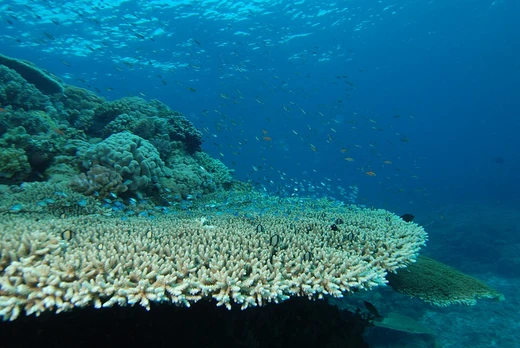
Acropora hoeksemai
Endangered acroporid coral found in shallow Indo-Pacific reefs.

Acropora hoeksemai, an acroporid coral species, was first scientifically described by Dr. Carden Wallace in 1997. It grows in colonies that typically span 1 to 2 meters wide, though some exceed 4 meters, with branches joining at the center. The branches, which can reach 150 millimeters in length and 7 to 15 millimeters in diameter, are irregular and feature both axial and radial corallites. Axial corallites measure 2 to 2.6 millimeters across, while the tube-shaped radial corallites are neat, uniform in size, and have basic spinules. The colony is colored light brown, white, or cream, with upturned branch ends except on the outer edges. This coral is composed of aragonite and lives in shallow marine reefs at depths of 8 to 20 meters, often on slopes and walls. It reaches maturity between three and eight years and is thought to live over a decade. In captivity, it grows up to 25 centimeters. It resembles *Acropora valenciennesi* and species in the *Acropora divaricata* group.
The species is common across a broad range, including the Solomons, Indo-Pacific, Papua New Guinea, Okinawa, Southeast Asia, and Thailand. It is native to Australia, Indonesia, Malaysia, Japan, Papua New Guinea, Singapore, Thailand, the Philippines, and the Solomon Islands. Although no specific population count exists, numbers are declining. Threats include disease, bleaching, predation by the starfish *Acanthaster planci*, climate change, rising temperatures, fishing, infrastructure, and other human activities. Some populations occur in Marine Protected Areas. It is listed as endangered on the IUCN Red List and appears on CITES Appendix II.
Taxonomically, *Acropora hoeksemai* was first described by C.C. Wallace in 1997 from Indonesia.
Quick Facts
- Taxon
- Acropora hoeksemai
Facts from the source article.
Lore & Background
Acropora hoeksemai forms colonies 1 to 2 meters wide, composed of branches joined at the center, with some larger colonies exceeding 4 meters. The branches are irregular, upturned at the ends except on the outer structure, and contain both axial and radial corallites. Axial corallites have diameters of 2 to 2.6 mm, while radial corallites are tube-shaped, neat, orderly, and of uniform size, with basic spinules. The coral is light brown, white, or cream in color, and is composed of aragonite (calcium carbonate). It reaches maturity between three and eight years and is believed to survive more than ten years. In captivity, it grows to lengths up to 25 cm. It resembles Acropora valenciennesi and species of the Acropora divaricata group.
Reader's Guide
Acropora hoeksemai is significant as a common but endangered species with a decreasing population, found across a large range including the Solomons, Indo-Pacific, Papua New Guinea, Okinawa, Southeast Asia, and Thailand. It is native to Australia, Indonesia, Malaysia, Japan, Papua New Guinea, Singapore, Thailand, the Philippines, and the Solomon Islands. The species is easily damaged by disease and bleaching, and threatened by predation from the starfish Acanthaster planci, climate change, temperature rises, fishing, infrastructure, and other human activities. Some populations occur in Marine Protected Areas. Its listing on CITES Appendix II and the IUCN Red List as endangered underscores its conservation concern. The species was first described by C.C. Wallace in 1997 in Indonesia.
Did You Know?
- It is found at depths of 8 to 20 meters (26 to 66 ft) on shallow reefs, slopes, and walls.
- Colonies can reach widths over 4 meters (13 ft).
- It is preyed upon by the starfish Acanthaster planci.
More in Acropora Corals 1-24
Spotted an error? Know more?
Reader corrections go straight into our review queue. Suggest an edit · How this site is sourced