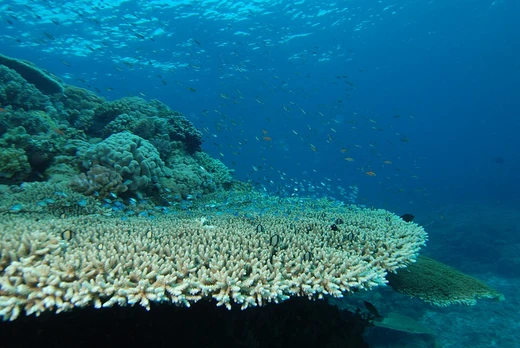
Acropora hemprichii
Endangered acroporid coral from the Red Sea and Indian Ocean.

Acropora hemprichii is an acroporid coral first recorded by Christian Gottfried Ehrenberg in 1834. It forms colonies of dense, flat or upward-facing branches, each branch reaching 12 to 30 millimeters in diameter and about 80 millimeters long. Colonies often exceed 2 meters in width and can grow without other species present. The axial corallites are dome-shaped and rounded; some specimens also have incipient axial corallites. Radial corallites are large, cone-shaped, irregularly spaced, and have smooth walls. The coenosteum is smooth, and the coral is mainly brown or pink-brown. It is made of aragonite and lives in shallow marine reefs at depths of 3 to 15 meters. Based on Red Sea specimens, its lifespan ranges from 13 to 24 years.
The species is common but has a restricted distribution, occurring in the Gulf of Aden, the Red Sea, the Philippines, and the Indian Ocean. It first appeared between 0.78 and 0.13 million years ago. Although bleaching has affected it, northern Red Sea populations have largely escaped major damage, with only 6 percent of reefs destroyed in recent decades; southern Red Sea populations fared worse. No precise population count exists, but numbers are thought to be declining. Threats include disease, bleaching from rising sea temperatures, fishing, human infrastructure, and predation by *Acanthaster planci*. The species is listed as endangered on the IUCN Red List and appears on Appendix II of CITES.
In taxonomy, Ehrenberg originally described it in 1834 as *Heteropora hemprichii*, later reclassified as *Acropora hemprichi*.
Quick Facts
- Genus
- Acropora
- Species
- hemprichii
Facts from the source article.
Lore & Background
Acropora hemprichii lives in colonies of densely-packed branches that are flat or upward-facing. Branches grow to diameters of 12 to 30 mm and lengths of around 80 mm, with colonies often exceeding 2 m in width. The axial corallites are rounded and dome-shaped, while radial corallites are cone-shaped, irregularly spaced, with smooth walls. The coenosteum is smooth, and the species is mainly brown or pink-brown. It is composed of aragonite and exists in shallow reefs at depths of 3 to 15 m.
The species is common but found only in a small area: the Gulf of Aden, the Red Sea, the Philippines, and the Indian Ocean. In northern Red Sea areas, it has avoided most bleaching, with only 6% of reefs destroyed over recent decades, but it did not survive as well in southern areas. The species first existed between 0.78 and 0.13 myr ago. It is affected by disease, bleaching from sea temperature rises, fishing, human infrastructure, and predation by Acanthaster planci.
Originally described as Heteropora hemprichii by Ehrenberg in 1834, it was later re-classified as Acropora hemprichi. Its population is believed to be decreasing, though no exact population figures are known.
Reader's Guide
Acropora hemprichii holds significance as an endangered species with a decreasing population, despite being common across a wide geographic range. Its listing on Appendix II of CITES indicates international concern over its trade and conservation. The species' vulnerability to bleaching, disease, fishing, and human infrastructure highlights the pressures on reef ecosystems, particularly in the Red Sea where northern populations have shown resilience with only 6% reef destruction over recent decades, contrasting with poorer survival in southern areas. Its presence in the Gulf of Aden, Red Sea, Philippines, and Indian Ocean underscores its limited but broad distribution. The species' lifespan of 13 to 24 years and its existence since between 0.78 and 0.13 myr ago provide context for its evolutionary history. As prey to Acanthaster planci, it plays a role in the reef food web. The original description by Christian Gottfried Ehrenberg in 1834 and subsequent reclassification from Heteropora hemprichii to Acropora hemprichi reflect taxonomic developments. Its aragonite composition and colony structure of densely-packed branches up to 2 m wide contribute to reef building, though no other species is required for its colonies to exist.
Did You Know?
- Acropora hemprichii was first described by Christian Gottfried Ehrenberg in 1834 as Heteropora hemprichii.
- The species lives for between 13 and 24 years, based on specimens from the Red Sea.
- In northern areas of the Red Sea, only 6% of reefs have been destroyed over recent decades, but the species did not survive as well in southern areas.
- It is prey to Acanthaster planci and is affected by disease, bleaching, fishing, and human infrastructure.
More in Acropora Corals 1-24
Spotted an error? Know more?
Reader corrections go straight into our review queue. Suggest an edit · How this site is sourced