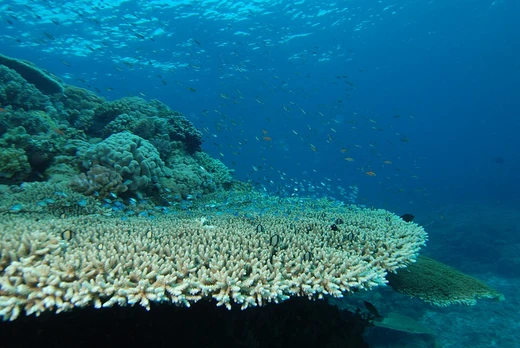
Acropora granulosa
A vulnerable acroporid coral with plate-like colonies.

Acropora granulosa is a species of acroporid coral found in tropical shallow reefs across the Indian and Pacific Oceans, including the Red Sea, Australia, Japan, and the central Indo-Pacific. It is notable for its distinctive colony form—a single horizontal plate of evenly spaced branches with short, inclined branchlets—and for being classified as a vulnerable species by the IUCN.
Quick Facts
- Taxon
- Acropora granulosa
Facts from the source article.
Lore & Background
Acropora granulosa was originally described as Madrepora granulosa by Milne Edwards in 1860. Its colonies consist of a single horizontal plate of branches less than 1 metre in diameter, with evenly spaced branches and short, inclined branchlets. Each branchlet bears at least one incipient axial and axial corallite, and the small radial corallites are pocket-shaped. The species is mostly pale blue, cream, or grey in colour, and no similar-looking species are known.
Reader's Guide
Acropora granulosa is significant as a vulnerable indicator species in tropical shallow reef ecosystems. Its population is believed to be decreasing, threatened by global coral reef reduction, temperature-induced coral bleaching, climate change, human activity, predation by the crown-of-thorns starfish (Acanthaster planci), and disease. Although population figures are unknown, its listing under Appendix II of CITES reflects international concern. The species occurs across a broad geographic range—from the northern and southwest Indian Ocean, the Red Sea, Australia, the East China Sea, Japan, to the oceanic central and western Pacific Ocean and the central Indo-Pacific—at depths between 8 and 40 metres. Its unique colony morphology and lack of similar-looking species make it a distinct component of reef biodiversity, yet its vulnerability underscores the broader pressures facing coral ecosystems globally.
More in Acropora Corals 1-24
Spotted an error? Know more?
Reader corrections go straight into our review queue. Suggest an edit · How this site is sourced