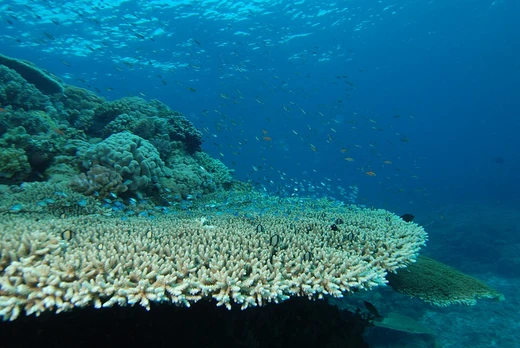
Acropora grandis
A large, branching staghorn coral of the western Indo-Pacific.

Acropora grandis is a colonial species of stony coral that forms large, bush-like structures up to 7 meters across. It is notable for its wide distribution across the tropical western Indo-Pacific, from East Africa to the east coast of Australia, and for its use in reef restoration efforts after the 2004 Indian Ocean Tsunami.
Quick Facts
- Taxon
- Acropora grandis
Facts from the source article.
Lore & Background
Acropora grandis is a colonial staghorn coral that can grow into a clump as much as 7 metres across. In shallow water it tends to grow as a prostrate, tangled bush with thick branches, while in deeper water it has a more upright and open structure. The radial corallites vary in shape and size, and those near the branch tips are tubular and elongated. The general colour is usually reddish-brown but can be various shades of blue, green or purple. The branch tips are a paler colour, have multiple axial corallites, and are fragile and easily damaged. The polyps usually have twelve tentacles, one of which is elongated, and are connected inside the skeleton by a maze of interconnecting channels.
This species is found in shallow water in the western Indo-Pacific, with a range including Madagascar, Mozambique, the Red Sea, Mauritius, Malaysia, Indonesia, New Guinea, and the Great Barrier Reef. It grows in various reef locations but is more common on upper slopes and in lagoons, at depths of 5 to 15 metres, favouring well-lit sites with strong currents.
Acropora grandis is a zooxanthellate species, hosting symbiotic dinoflagellates within its tissues that contribute to its colour and nutrition. It reproduces through synchronized spawning, releasing gametes into the sea; in the Northern Hemisphere, this occurs four or five days after the full moon. The planktonic larvae drift before settling to form new colonies.
Reader's Guide
Acropora grandis is significant as a large, fast-growing staghorn coral that plays a role in reef structure and regeneration. Its notable use in restoration was demonstrated when fragments were planted into a mid-water nursery bed, where over 95% survived. These fragments were later transplanted onto a reef at Phi Phi Islands, Thailand, that had been devastated by the 2004 Indian Ocean Tsunami. This successful transplantation showed that damaged reefs can be regenerated with the help of fast-growing corals like Acropora grandis. The species' wide distribution across the western Indo-Pacific, from East Africa to Australia, and its presence in various reef habitats—including upper slopes and lagoons—underscore its ecological importance. Its ability to thrive in well-lit sites with strong currents, combined with its zooxanthellate biology and synchronized spawning strategy, contributes to its resilience and role in coral reef ecosystems.
Did You Know?
- Acropora grandis can form colonies up to 7 metres (23 ft) across.
- Over 95% of fragments survived when planted in a mid-water nursery bed.
More in Acropora Corals 1-24
Spotted an error? Know more?
Reader corrections go straight into our review queue. Suggest an edit · How this site is sourced