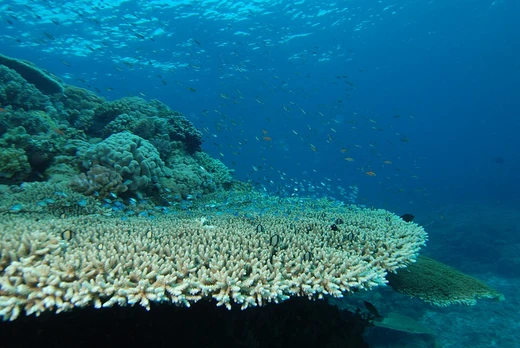
Acropora globiceps
An endangered acroporid coral from the Pacific and Indo-Pacific.

Acropora globiceps is a species of acroporid coral that lives in the central and western Pacific Ocean and the central Indo-Pacific, including the Great Barrier Reef, the Philippines, the Andaman Islands, Polynesia, Micronesia, and the Pitcairn Islands. It grows on reef slopes, reef flats, and in shallow tropical reefs, typically at depths of about 8 meters (26 feet). James Dwight Dana first described it in 1846.
This coral forms small, compact, digitate colonies with branches. Its corallites vary in shape depending on location: those on reef slopes are tube-shaped, while those on reef flats are built into the branches. The axial corallites are small, and the radial corallites may be arranged in rows. The coral is cream or blue in color and resembles several other species, including *Acropora gemmifera*, *Acropora monticulosa*, *Acropora retusa*, and *Acropora secale*.
The species is listed as endangered on the IUCN Red List, with a decreasing population. Exact population numbers are unknown, but threats include the global decline of coral reefs, rising temperatures that cause coral bleaching, climate change, human activity, the crown-of-thorns starfish (*Acanthaster planci*), and disease. It is also included in Appendix II of CITES.
Quick Facts
- Taxon
- Acropora globiceps
Facts from the source article.
Lore & Background
Acropora globiceps was first described as Madrepora globiceps by James Dwight Dana in 1846. It forms small digitate colonies with compact branches. Its corallites vary in size depending on habitat: specimens on reef slopes have tube-shaped corallites, while those on reef flats have corallites built into the branches. The axial corallites are small, and radial corallites may be ordered in rows. The coral is cream or blue in colour and resembles Acropora gemmifera, Acropora monticulosa, Acropora retusa, and Acropora secale.
Reader's Guide
Acropora globiceps is significant as an endangered species whose population is believed to be decreasing. Its distribution spans the central and western Pacific Ocean and central Indo-Pacific, including the Great Barrier Reef, the Philippines, the Andaman Islands, Polynesia, Micronesia, and the Pitcairn Islands. The species is threatened by the global reduction of coral reefs, rising temperatures causing coral bleaching, climate change, human activity, predation by the crown-of-thorns starfish (Acanthaster planci), and disease. Its population figures are unknown, but these combined pressures place it at risk. It is also listed under Appendix II of CITES, reflecting international concern over its trade and conservation. The coral's variable corallite morphology across different reef zones illustrates its adaptation to microhabitats, though this does not alter its endangered status.
More in Acropora Corals 1-24
Spotted an error? Know more?
Reader corrections go straight into our review queue. Suggest an edit · How this site is sourced