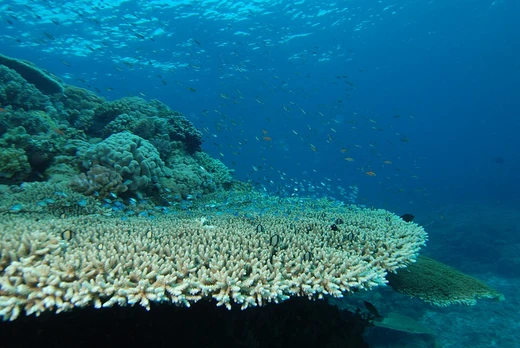
Acropora gemmifera
A digitate acroporid coral with blue, brown, cream or purple branches.

Acropora gemmifera, a type of acroporid coral, was first documented by Brook in 1892. This species forms digitate colonies with thick, tapering branches. Each branch ends in a single axial corallite, and radial corallites grow in rows; incipient axial corallites appear near the branch bases. The coral can be blue, brown, cream, or purple, with white or blue branch tips. Its corallites are dark grey with white rims, and specimens from the Indian Ocean sometimes have yellowish axial corallites.
This coral is found on exposed upper reef flats and slopes at depths of 1 to 15 meters. Its range includes the Gulf of Aden, the Red Sea, the central Indo-Pacific, the southwest and northern Indian Ocean, southeastern Asia, Australia, the East China Sea, Japan, the oceanic central and western Pacific, and northwestern Hawaiʻi. Although classified as Least Concern on the IUCN Red List, its population is thought to be decreasing due to global coral decline. It faces threats from rising temperatures causing bleaching, climate change, human activity, the crown-of-thorns starfish (*Acanthaster planci*), and disease. Population figures are unknown, and it is listed under Appendix II of CITES.
Quick Facts
- Taxon
- Acropora gemmifera
Facts from the source article.
Lore & Background
Acropora gemmifera was originally described by Brook in 1892 under the name Madrepora gemmifera. It forms digitate colonies consisting of thick tapering branches, each branch ending in a single axial corallite, with radial corallites arranged in rows. Incipient axial corallites are located towards the bases of branches. The coral is blue, brown, cream or purple in colour, with white or blue tips on the branches. The corallites are dark grey with white rims, and specimens in the Indian Ocean have been observed with yellowish axial corallites.
This species occurs on exposed upper reef flats and slopes at depths of 1–15 m. Its distribution spans a wide range including the Gulf of Aden, the Red Sea, the central Indo-Pacific, the southwest and northern Indian Ocean, southeastern Asia, Australia, the East China Sea, Japan, the oceanic central and western Pacific Ocean, and northwestern Hawaiʻi.
It is classed as a least concern species on the IUCN Red List, but its population is thought to be decreasing in line with global coral decline. Figures of its population are unknown. It is listed under Appendix II of CITES and is likely threatened by the global reduction of coral reefs, increased temperature causing coral bleaching, climate change, human activity, the crown-of-thorns starfish (Acanthaster planci), and disease.
Reader's Guide
Acropora gemmifera is notable for its wide distribution across the Indian and Pacific Oceans, including northwestern Hawaiʻi, and its occurrence on exposed upper reef flats and slopes. Described by Brook in 1892 as Madrepora gemmifera, it is recognized as a least concern species on the IUCN Red List, though its population is thought to be decreasing due to global coral decline. The species is listed under Appendix II of CITES, indicating it is subject to international trade regulations. Its threats include the global reduction of coral reefs, temperature increases causing coral bleaching, climate change, human activity, predation by the crown-of-thorns starfish (Acanthaster planci), and disease. Despite its conservation status, population figures remain unknown. The coral's digitate colony form, with thick tapering branches and distinctive coloration—blue, brown, cream, or purple with white or blue tips—makes it a recognizable acroporid. The presence of incipient axial corallites near branch bases and dark grey corallites with white rims are key identifying features, with Indian Ocean specimens sometimes showing yellowish axial corallites. Its significance lies in its broad geographic range and its role as an indicator of reef health, given its sensitivity to environmental stressors.
More in Acropora Corals 1-24
Spotted an error? Know more?
Reader corrections go straight into our review queue. Suggest an edit · How this site is sourced