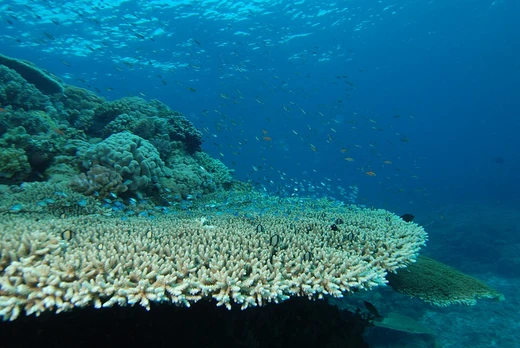
Acropora elegans
A deep-water acroporid coral with a small, declining range.

Acropora elegans is a type of acroporid coral first named by Henri Milne-Edwards in 1860. It forms flat colonies over one meter wide, built from flat branches that radiate from the center. These branches can grow up to 40 millimeters long and 10 millimeters wide, with branchlets on the surface reaching 20 millimeters. The ends of the branches and branchlets are pale, while the rest of the coral is tan. Tube-shaped radial corallites run along the sides of most branches but are mostly absent underneath; they blend with the axial corallites. This species resembles Acropora simplex. Found on the steep slopes of sheltered reefs, it lives at depths between 30 and 60 meters. Its range is small and it is not common, occurring in the Indo-Pacific: the Ryukyu Islands, Papua New Guinea, Milne Bay, the Philippines, and two regions of Indonesia. It is native to Australia, Japan, Indonesia, the Philippines, Papua New Guinea, and Taiwan. Exact population numbers are unknown, but the population is decreasing. Because it lives in deep water, it may be less vulnerable to disease and bleaching from rising sea temperatures than other Acropora species. However, it still faces threats from the crown-of-thorns starfish (Acanthaster planci), coral harvesting, climate change, disease, coral bleaching, fishing, and human activity. It is listed as least concern on the IUCN Red List and is included in CITES Appendix II. In terms of taxonomy, it was first described by Milne Edwards and Haime in 1860 as Madrepora elegans. In 1971, Nemenzo considered it a synonym of Acropora magnifica, but it was later reclassified as a distinct species, Acropora elegans.
Quick Facts
- Taxon
- Acropora elegans
Facts from the source article.
Lore & Background
Acropora elegans forms flat colonies over 1 meter wide, composed of flat branches radiating from the center. Branches grow up to 40 mm long and 10 mm wide, with branchlets on the surface reaching 20 mm. The branch and branchlet ends are pale, while the overall coral is tan. Radial corallites are tube-shaped and long, occurring on the sides of most branches but mostly absent below the structure; they combine with axial corallites. The species resembles Acropora simplex. It occurs on steep slopes of sheltered reefs at depths of 30 to 60 m. Its distribution is limited to the Indo-Pacific, specifically the Ryukyu Islands, Papua New Guinea, Milne Bay, the Philippines, and two regions of Indonesia. It is native to Australia, Japan, Indonesia, the Philippines, Papua New Guinea, and Taiwan. No exact population count exists, but numbers are known to be decreasing. Taxonomically, it was first described as Madrepora elegans by Milne Edwards and Haime in 1860. It was later identified as a synonym of Acropora magnifica by Nemenzo in 1971, but was subsequently re-classified as a separate species, Acropora elegans.
Reader's Guide
Acropora elegans is significant as a deep-water acroporid that may be less vulnerable to disease and bleaching from rising sea temperatures than other Acropora species, due to its depth range. However, it remains threatened by the crown-of-thorns starfish Acanthaster planci, coral harvesting, climate change, disease, coral bleaching, fishing, and human activity. Its listing as least concern on the IUCN Red List and under CITES Appendix II reflects its current conservation status, though its small range and decreasing population indicate ongoing pressures. The species is not common and has a limited distribution across the Indo-Pacific, making it a subject of interest for conservation monitoring. Its taxonomic history—initially described as Madrepora elegans, later considered a synonym of Acropora magnifica, and then re-established as a distinct species—highlights the complexities of coral taxonomy. The species is noted for being more resistant to disease than other Acropora species, a trait that may contribute to its persistence in deeper habitats.
More in Acropora Corals 1-24
Spotted an error? Know more?
Reader corrections go straight into our review queue. Suggest an edit · How this site is sourced