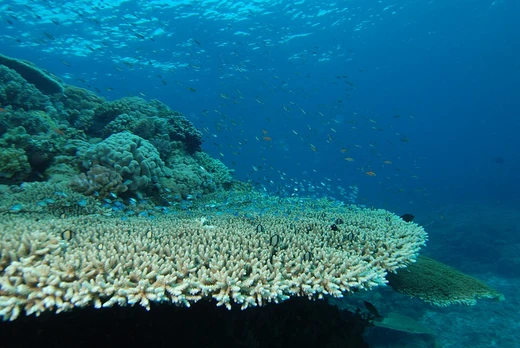
Acropora echinata
Endangered acroporid coral with blue-tipped bottlebrush branches.

Acropora echinata is an acroporid coral first named by James Dwight Dana in 1846. Its colonies consist of flat, bottlebrush-shaped branches with thin, neatly arranged branchlets. The branchlet tips are blue or purple, while the rest of the coral is usually white or cream, though it can be entirely blue. The axial and incipient axial corallites look the same, and the radial corallites are short, tube-shaped, and either inconspicuous or absent. This species lives in clear, shallow, tropical, sheltered reef environments at depths of 8 to 25 meters (26 to 82 feet), and is also found on sandy slopes and lagoon floors. In aquariums, it can reach diameters of up to 15 centimeters (5.9 inches).
The coral is uncommon but has a wide distribution, occurring in Palau, the central Pacific, Southeast Asia, the Indo-Pacific, Australia, the Indian Ocean, the East China Sea, and Japan. It has been recorded in five of Indonesia’s six regions and at 17 locations in the Marshall Islands. No population data exist, but the population is known to be decreasing. The species has very low resistance to bleaching from water temperature changes; all specimens in Palau were affected as of 1998. Additional threats include coral reef decline, coral disease, fishing, climate change, ocean acidification, pollution, and predation by *Acanthaster planci*. It occurs at water temperatures between 27.99 and 28.09 °C (82.38 and 82.56 °F). It is listed as endangered on the IUCN Red List and under CITES Appendix II.
In taxonomy, Dana originally described it in 1846 as *Madrepora echinata*. It was later considered a synonym of *Madrepora durvillei* by Milne Edwards in 1860, and then a synonym of *Madrepora procumbens* by Brook in 1892. It was subsequently recognized as a distinct species, *Acropora echinata*.
Quick Facts
- Taxon
- Acropora echinata
Facts from the source article.
Lore & Background
Acropora echinata was first described by James Dwight Dana in 1846 as Madrepora echinata. It was later classed as a synonym of Madrepora durvillei by Milne Edwards in 1860, and then as a synonym of Madrepora procumbens by Brook in 1892, before being described as a distinct species, Acropora echinata. Colonies are composed of flat, bottlebrush-like branches with thin, neatly-arranged branchlets; the tips are blue or purple, and the overall color is white or cream, though it can be completely blue. The incipient axial and axial corallites are indistinguishable, and the radial corallites are tube-shaped, short, and not obvious or absent. It occurs in sheltered, tropical, shallow reefs at depths of 8 to 25 m in clear water, and can also be found on sand slopes and lagoon floors. In aquariums it reaches diameters of up to 15 cm.
Reader's Guide
Acropora echinata is listed as endangered on the IUCN Red List with a decreasing population, and is included in CITES Appendix II. It is uncommon but found over a large range, including Palau, the central Pacific, Southeast Asia, the Indo-Pacific, Australia, the Indian Ocean, the East China Sea, and Japan. It has been found in five of the six regions of Indonesia and at 17 locations in the Marshall Islands. No population data exists, but the species is known to be decreasing. It has very low resistance to bleaching from water temperature change, with all specimens in Palau affected as of 1998. Additional threats include coral reef decline, coral disease, fishing, climate change, ocean acidification, pollution, and predation by Acanthaster planci. Its occurrence is associated with temperatures between 27.99 and 28.09 °C.
Did You Know?
- It is found at depths of 8 to 25 m in clear water on sheltered, tropical reefs.
- The branchlet tips are blue or purple, and the coral can be completely blue.
More in Acropora Corals 1-24
Spotted an error? Know more?
Reader corrections go straight into our review queue. Suggest an edit · How this site is sourced