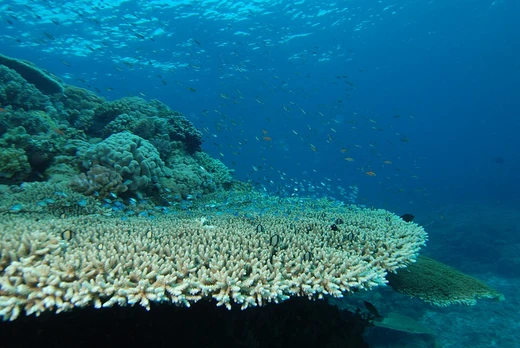
Acropora donei
Endangered acroporid coral found in shallow tropical reefs.

Acropora donei, an acroporid coral, was first documented by J. Veron and Carden Wallace in 1984. It forms colonies up to 2 meters wide, composed of many fused branches. The coral appears in cream, white, green, or occasionally pale brown, with flat branches that curve upward at the center. Branch tips are blunt and neat; larger radial corallites on the branch sides have flaring lips, while smaller ones lack them. A bristly coenosteum gives the species a rough texture, and no other Acropora species resembles it. It inhabits tropical, shallow reefs, particularly fringing reefs and upper reef slopes, at depths of 5 to 20 meters.
The species is uncommon but widely distributed across the Indian Ocean, Australia, the western Pacific, Southeast Asia, the Indo-Pacific, Yemen, and Japan. It appears in all six regions of Indonesia and at seven locations in the Marshall Islands, along with many other countries. No population estimate exists, but threats include coral reef decline, rising water temperatures causing bleaching, disease, climate change, fishing, ocean acidification, pollution, invasive species, and the crown-of-thorns starfish *Acanthaster planci*. It occurs in water temperatures between 25.48 and 27.43 °C and is thought to have existed for about 0.13 million years. Some specimens may fall within Marine Protected Areas. The species is rated endangered on the IUCN Red List due to a decreasing population and is listed under CITES Appendix II.
Taxonomically, it was first described in 1984 by Jen Veron and C. C. Wallace from East Australia.
Quick Facts
- Taxon
- Acropora donei
Facts from the source article.
Lore & Background
Acropora donei forms colonies up to 2 m wide, composed of many fused branches. The branches are flat with upward-facing ends toward the center; all branch ends are blunt and neat. Larger radial corallites on the sides of branches have flaring lips, while smaller corallites lack these. The coenosteum is bristly, giving the species a rough appearance, and no similar species exist within genus Acropora. It occurs in tropical, shallow reefs, typically in fringing reefs and upper slopes of other reefs, at depths of 5 to 20 m. The species is cream, white, green, and sometimes pale brown in color.
It is not common but found over a large range including the Indian Ocean, Australia, western Pacific, Southeast Asia, the Indo-Pacific, Yemen, and Japan. It occurs in all six regions of Indonesia and at the Marshall Islands in seven locations, and also in a large number of countries. There is no known population size, but the species is threatened by decline of coral reefs, increasing water temperatures causing bleaching, disease, climate change, fishing, ocean acidification, pollution, invasive species, and Acanthaster planci. It is thought to have existed for 0.13 million years.
Reader's Guide
Acropora donei is significant as an endangered species on the IUCN Red List with a decreasing population, affected by disease and multiple environmental threats. Its listing under CITES Appendix II indicates international concern over its trade and conservation. The species is notable for its distinctive morphology—flat branches with blunt ends, flaring lips on larger radial corallites, and a bristly coenosteum—which makes it unique within the genus Acropora. It occurs over a large geographic range from the Indian Ocean to Japan and the Marshall Islands, though it is not common anywhere. The species is found in fringing reefs and upper reef slopes at depths of 5 to 20 m, and its existence at temperatures between 25.48 and 27.43 °C suggests sensitivity to thermal changes. Threats include bleaching, disease, climate change, fishing, ocean acidification, pollution, invasive species, and predation by Acanthaster planci. Some specimens may occur in Marine Protected Areas, but no population data exist. Its description in 1984 by Veron and Wallace established it as a distinct taxon, and its estimated age of 0.13 million years places it in a relatively recent evolutionary context.
Did You Know?
- Acropora donei was first described in 1984 by J. Veron and Carden Wallace.
- Its coenosteum is bristly, making the species appear rough, and no similar species exist within genus Acropora.
- The species occurs at depths of 5 to 20 m (16 to 66 ft) in fringing reefs and upper slopes of shallow reefs.
- It is listed as endangered on the IUCN Red List with a decreasing population and is affected by disease.
More in Acropora Corals 1-24
Spotted an error? Know more?
Reader corrections go straight into our review queue. Suggest an edit · How this site is sourced