Acropora desalwii
A vulnerable acroporid coral from sheltered tropical reefs.

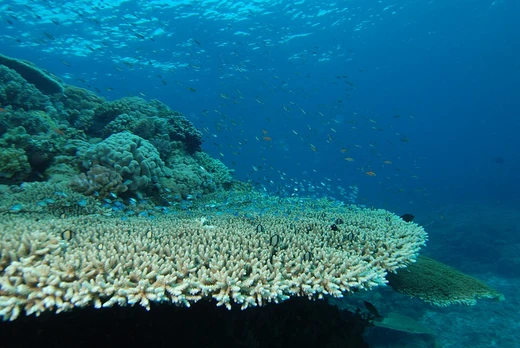
Acropora desalwii is a type of acroporid coral that Dr Carden Wallace first described in 1994. It grows in corymbose colonies with crowded branches. The branchlets at the colony edges are upward-facing and obvious, sometimes with more than one long, tube-shaped axial corallite pointing upward. Radial corallites appear along the sides of the branchlets. The coral can be green, brown, or blue. It looks similar to Acropora parapharaonis and Acropora willisae.
This species lives in marine environments on sheltered, tropical, shallow reefs, usually on slopes. It is generally found below 15 metres (49 feet) deep, but can occur as low as 30 metres (98 feet). In aquariums, it can reach diameters of up to 25 centimetres.
Acropora desalwii is common across a large area, including the Solomon Islands and the Indo-Pacific. It mainly occurs in two regions of Indonesia, Pohnpei, and the Philippines. It is native to Micronesia, Thailand, Australia, Malaysia, Indonesia, Papua New Guinea, the Solomon Islands, and Singapore. No population size is known. The species is threatened by coral reef decline, rising water temperatures causing bleaching, disease, climate change, fishing, ocean acidification, pollution, invasive species, and the crown-of-thorns starfish (Acanthaster planci). Some specimens may be found in Marine Protected Areas. The IUCN Red List rates it as vulnerable with a decreasing population, and it is listed under CITES Appendix II.
Quick Facts
- Taxon
- Acropora desalwii
Facts from the source article.
Lore & Background
Acropora desalwii forms corymbose colonies with crowded branches. The branchlets at the edge are obvious, upward-facing, and can have over a single axial corallite, which are tube-shaped, long, and facing upwards. It is green, brown or blue in colour, with radial corallites on the sides of the branchlets. It resembles Acropora parapharaonis and Acropora willisae. It exists in a marine environment in tropical, shallow, sheltered reefs, generally at depths less than 15 m (49 ft), but can be found between 10 and 30 m (33 and 98 ft). It is often kept in aquariums, where it reaches diameters of up to 25 cm.
Reader's Guide
Acropora desalwii is common and found over a large area, including the Solomon Islands and the Indo-Pacific, mainly in Indonesia (two regions), Pohnpei, and the Philippines. It is native to Micronesia, Thailand, Australia, Malaysia, Indonesia, Papua New Guinea, the Solomon Islands, and Singapore. There is no known population for it, but the species is threatened by the decline of coral reefs, increasing water temperatures causing bleaching, disease, climate change, fishing, ocean acidification, pollution, invasive species, and Acanthaster planci. Some specimens may occur within Marine Protected Areas. It is listed as vulnerable on the IUCN Red List with a decreasing population and is listed under Appendix II of CITES. Its significance lies in its wide distribution and the multiple threats it faces, highlighting the vulnerability of reef ecosystems.
Did You Know?
- Acropora desalwii was first described by Dr Carden Wallace in 1994.
- The species is threatened by Acanthaster planci (crown-of-thorns starfish).
More in Acropora Corals 1-24
Spotted an error? Know more?
Reader corrections go straight into our review queue. Suggest an edit · How this site is sourced