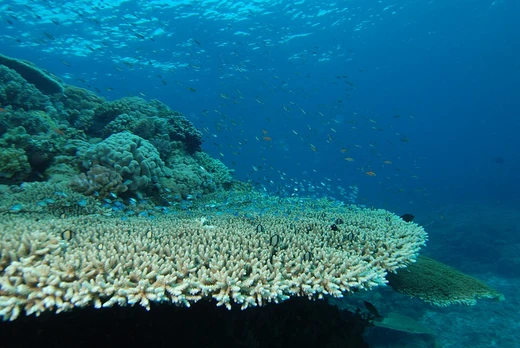
Acropora derawanensis
A vulnerable, easily damaged acroporid coral from sheltered tropical reefs.

Acropora derawanensis is a species of acroporid coral first described by Carden Wallace in 1997. It is found in tropical, shallow reefs sheltered from waves, at depths of 10 to 25 m on reef slopes. The species is rated as vulnerable on the IUCN Red List with a decreasing population, is listed on CITES Appendix II, and is easily damaged.
Quick Facts
- Taxon
- Acropora derawanensis
Facts from the source article.
Lore & Background
Acropora derawanensis forms colonies of upward-facing or flat collections of thin, easily damaged branches up to 1 m wide. The branches reach lengths of up to 80 mm, with long, tube-like axial corallites at the tips that are blue and white, while the overall coral is red-brown. The radial corallites on the sides are small and tube-shaped, some being sharp and pocket-shaped. This uncommon coral resembles Acropora filiformis and Acropora kirstyae.
It is found in a marine environment in tropical, shallow reefs sheltered from waves, at depths of 10 to 25 m. The species reaches maturity at over eight years. It is not common but occurs over a large area of the central Indo-Pacific, including Micronesia, Philippines, Pohnpei, Southeast Asia, Singapore, Papua New Guinea, Indonesia, Australia, Malaysia, and Thailand. There is no population estimate, but it is threatened by coral reef decline, rising water temperatures causing bleaching, coral disease, climate change, fishing, ocean acidification, pollution, and invasive species. Unlike some other Acropora, it is not threatened by Acanthaster planci because it is too fragile. Some specimens occur within Marine Protected Areas.
Reader's Guide
Acropora derawanensis is notable for its vulnerability and fragility, being easily damaged and rated as vulnerable on the IUCN Red List with a decreasing population. Its listing on CITES Appendix II reflects international concern over its trade and conservation status. The species was first described by Carden Wallace in 1997 from Indonesia, and its distribution spans a large area of the central Indo-Pacific, though it remains uncommon. Key threats include climate change, coral disease, pollution, and ocean acidification, while it is uniquely not threatened by the crown-of-thorns starfish due to its fragility. Its presence in Marine Protected Areas offers some protection, but the overall population trend is decreasing. The coral's thin, easily broken branches and slow maturation (over eight years) make it particularly susceptible to environmental stressors and physical damage.
More in Acropora Corals 1-24
Spotted an error? Know more?
Reader corrections go straight into our review queue. Suggest an edit · How this site is sourced