Acropora dendrum
Endangered acroporid coral found in shallow, wave-exposed tropical reefs.

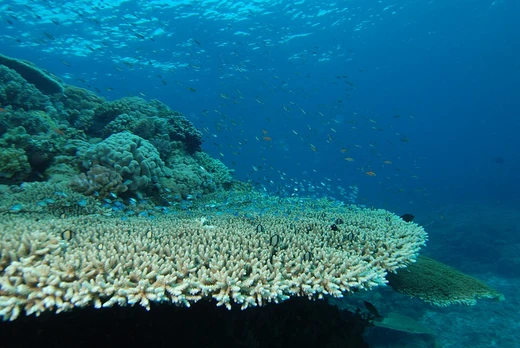
Acropora dendrum is an acroporid coral species first described by Bassett-Smith in 1890. It forms corymbose structures 0.5 to 1 meter wide that taper at the ends, with wide gaps between neighboring corals. The radial corallites are nearly flush with the branches, giving a smooth texture, while small axial corallites sit at the tips of each branchlet. These axial corallites have outer diameters of 1.4 to 2.2 millimeters and inner diameters of 0.5 to 1.2 millimeters; branches can grow up to 30 millimeters long. The coral is cream or pale brown, has no look-alike species, and is rare. It inhabits tropical, shallow reefs exposed to strong wave action and reef slopes, at depths of 5 to 20 meters, reaching maturity after more than eight years.
The species has a broad but sparse distribution across the East China Sea, Indian Ocean, Indo-Pacific, Southeast Asia, Australia, Japan, Vanuatu, Samoa, and Tonga. It occurs at an average temperature of about 22.22 °C, with silicate levels of 2.74 micromoles per liter, nitrate at 0.35 micromoles per liter, and salinity of 35.51 PSU. Threats include the global decline of coral reefs, rising temperatures causing bleaching, disease, coral harvesting, climate change, fishing, human development, pollution, and predation by the crown-of-thorns starfish *Acanthaster planci*. It is occasionally found within Marine Protected Areas. The population is decreasing, leading to its endangered status on the IUCN Red List and its inclusion in CITES Appendix II.
Taxonomically, P.W. Bassett-Smith first described *Acropora dendrum* in 1890 from the South China Sea.
Quick Facts
- Taxon
- Acropora dendrum
Facts from the source article.
Lore & Background
Acropora dendrum was first described by P.W. Bassett-Smith in 1890 in the South China Sea. It forms corymbose structures 0.5 to 1 m wide, with branches that narrow at the ends and large gaps between corals. The radial corallites are almost submerged into the branches, giving a smooth feel, and small axial corallites sit at the end of each branchlet. The axial corallites have outer diameters of 1.4 to 2.2 mm and inner diameters of 0.5 to 1.2 mm, and branches can reach 30 mm in length. The coral is cream or pale brown in colour, with no similar-looking species, and is considered rare.
The species is found in tropical, shallow reefs in areas exposed to powerful waves, and on reef slopes, at depths of 5 to 20 m. It reaches maturity at over eight years. Its distribution is large but not common, spanning the East China Sea, the Indian Ocean, the Indo-Pacific, Southeast Asia, Australia, Japan, Vanuatu, Samoa, and Tonga. It occurs at temperatures around 22.22 °C, silicate concentration of 2.74 µmol/L, nitrate concentration of 0.35 µmol/L, and salinity of 35.51 PSU.
Reader's Guide
Acropora dendrum is significant as an endangered species with a decreasing population, threatened by disease, global coral reef reduction, temperature-induced bleaching, coral harvesting, climate change, fishing, human development, pollution, and predation by the starfish Acanthaster planci. It is sometimes found in Marine Protected Areas. Its listing on CITES Appendix II and the IUCN Red List underscores its conservation concern. The species is notable for its rarity despite a large geographic range, and its smooth branches with submerged radial corallites distinguish it from other acroporids. Its maturity at over eight years and specific habitat requirements—shallow, wave-exposed reefs—highlight its vulnerability to environmental changes. The species was first described in 1890, and its presence across the Indo-Pacific and parts of the Pacific Ocean indicates a broad but fragmented distribution.
Did You Know?
- It is rated as endangered on the IUCN Red List with a decreasing population.
- The species is preyed upon by the starfish Acanthaster planci.
More in Acropora Corals 1-24
Spotted an error? Know more?
Reader corrections go straight into our review queue. Suggest an edit · How this site is sourced