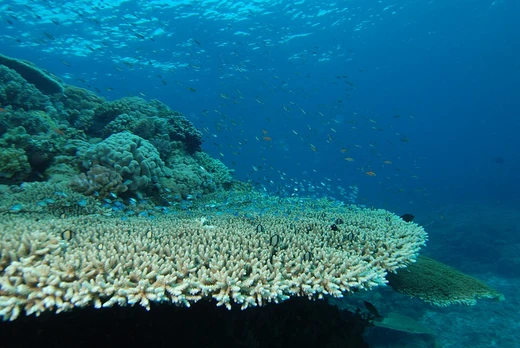
Acropora cytherea
A table-forming stony coral of Indo-Pacific back reefs.

Acropora cytherea is a stony coral that grows into broad, flat, table-like shapes. It is a common species within its genus and lives in the Indo-Pacific Ocean, typically in calm, clear waters with minimal wave action, such as back reef zones, at depths between 3 and 20 meters.
The coral is colonial, building its structure from countless tiny branchlets. Some of these grow upward or at an angle, while others extend sideways to expand the colony. These branchlets often branch and fuse together, and near the center of the plate they can form a solid, interconnected mass. A thin layer of living tissue covers the skeleton, giving it a rough texture. This tissue contains zooxanthellae—single-celled, photosynthetic algae—that lend the coral its cream, pale brown, or occasionally pale blue color. The hard calcium carbonate skeleton is secreted by numerous small polyps, which are linked by an internal network of channels. At night, and sometimes during the day, the polyps extend their tentacles out of the skeleton to feed; otherwise, they retract for safety. In older specimens, especially those over 2 meters in diameter, the regular structure can break down near the center, leading to growth anomalies. These anomalies do not threaten the coral’s survival and may be triggered by stressors like elevated sea temperatures.
This species is widespread across the Indo-Pacific, from the Red Sea and eastern Africa to India, the China Sea, Japan, Australia, Micronesia, and Hawaii. It lives below the low tide mark in clear, shallow water with little wave action, often in lagoons, upper reef slopes, and back reef slopes.
Several small crab species live obligately with corals, feeding on coral tissue while defending the coral from predators like the crown-of-thorns starfish. One such crab, *Cymo melanodactylus*, associates with *Acropora cytherea*. Usually, fewer than three crabs inhabit a single coral head, causing little harm. However, in the Chagos Archipelago in 2010, these crabs were observed in unusually large numbers—over 45 on individual coral heads—infesting diseased and dying *A. cytherea*. The crabs clustered near damaged tissue, but it remains unclear whether they caused the damage or simply moved in to exploit the already dying tissue.
Quick Facts
- Taxon
- Acropora cytherea
Facts from the source article.
Lore & Background
Acropora cytherea is a colonial species that grows in large horizontal plates composed of many tiny branchlets growing vertically or at an angle, with others extending horizontally to enlarge the colony. These branchlets may branch and link together, and near the center the plates can become a solid mass of joined branchlets. The surface is covered by a thin layer of living tissue containing zooxanthella, symbiotic photosynthetic algae that give the coral its cream or pale brown color, occasionally pale blue. The calcium carbonate skeleton is secreted by many small polyps connected through an interconnecting network of channels. At night, and sometimes during the day, the polyps protrude to feed; otherwise they contract back into the skeleton.
In older specimens exceeding 2 metres in diameter, the regular structure sometimes breaks down near the center, showing growth anomalies. These anomalies are not deleterious to the coral's survival and may be caused by stress factors such as raised sea temperatures. The coral is found below the low tide mark in clear shallow water with little wave action, in lagoons, upper reef slopes, and back reef slopes across the Indo-Pacific from the Red Sea and east Africa to India, the China Sea, Japan, Australia, Micronesia, and Hawaii.
Several small crabs are obligate associates of corals. One, Cymo melanodactylus, lives in association with Acropora cytherea but typically in low numbers (fewer than three per coral), causing little harm. However, in the Chagos Archipelago, these crabs have shown changed behavior, infesting diseased and dying corals in large numbers—over 45 crabs on individual heads exhibiting dead and dying tissue. It remains unclear whether the crabs caused the damage or moved in to exploit already dying tissues.
Reader's Guide
Acropora cytherea is notable as one of the most plentiful members of the genus Acropora, forming extensive horizontal plates that characterize back reef environments across the Indo-Pacific. Its growth form—large tables built from tiny branchlets—makes it a key structural component of shallow, low-wave-action reefs. The coral's symbiotic relationship with zooxanthella provides its coloration and energy, while its polyps feed at night. The species' resilience is suggested by the observation that growth anomalies in older, large specimens are not deleterious and may relate to stress like raised sea temperatures. Ecologically, Acropora cytherea hosts the obligate crab Cymo melanodactylus, typically in harmless low numbers. However, anomalous infestations in the Chagos Archipelago, with over 45 crabs on individual diseased corals, highlight an unresolved dynamic: whether the crabs initiate damage or exploit existing tissue death. This uncertainty underscores the complexity of coral-associated species interactions under environmental stress. The species' wide distribution and abundance make it a significant subject for studying reef health and the impacts of changing ocean conditions.
Did You Know?
- Acropora cytherea grows in large horizontal plates that can exceed 2 metres in diameter.
- The crab Cymo melanodactylus lives in association with Acropora cytherea, typically in numbers fewer than three per coral.
- In the Chagos Archipelago, infestations of over 45 Cymo melanodactylus crabs were found on individual heads of Acropora cytherea exhibiting dead and dying tissue.
More in Acropora Corals 1-24
Spotted an error? Know more?
Reader corrections go straight into our review queue. Suggest an edit · How this site is sourced