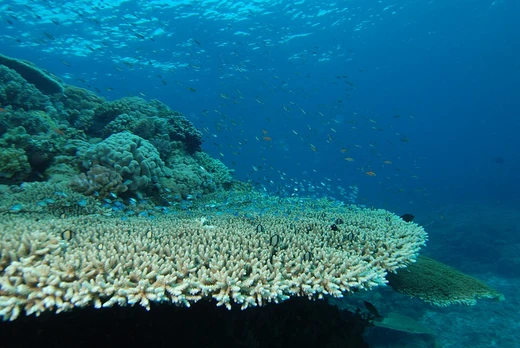
Acropora clathrata
A zooxanthellate coral widespread in Indo-Central Pacific reefs.

The lattice table coral, *Acropora clathrata*, is a stony coral from the Acroporidae family. It hosts symbiotic zooxanthellae and lives in fringing, sheltered, and back reef environments at depths of 5 to 40 meters. Its size depends on depth—individuals with larger surface areas tend to be found deeper. This species is native to the Indo-Central Pacific, ranging from Madagascar and the Red Sea to Western Australia.
The coral is a key habitat for the feather duster worm *Spirobranchus giganteus*, which settles on it in much higher numbers than on other stony corals. Bacteria living in the coral’s tissues—from the groups Gammaproteobacteria, Actinobacteria, and Firmicutes—help it survive by breaking down oil as concentrations in the water shift.
The IUCN lists *Acropora clathrata* as least concern. During development, its eggs pass through five color stages: white, light-cream, cream, light-pink, and finally pink when mature.
Quick Facts
- Genus
- Acropora
- Species
- clathrata
Facts from the source article.
Lore & Background
Acropora clathrata is a stony coral that hosts symbiotic zooxanthellae. Its size varies according to depth, with members having larger surface areas typically found at greater depths. The species is an important resource for the polychaete worm Spirobranchus giganteus, which is found embedded in Acropora clathrata in much higher densities than in other stony corals. Additionally, oil-degrading bacteria affiliated with Gammaproteobacteria, Actinobacteria and Firmicutes are harbored in the tissue of Acropora clathrata, aiding the species' survival as oil concentrations in their environment change.
Reader's Guide
Acropora clathrata is notable for its ecological roles within reef systems. It provides a substrate for Spirobranchus giganteus, which occurs in higher densities on this coral than on other stony corals, indicating a specific association. The presence of oil-degrading bacteria in its tissue suggests a capacity to tolerate or respond to environmental oil fluctuations, which may contribute to its persistence in impacted habitats. The species is listed as 'least concern' by the IUCN, reflecting a relatively stable population across its wide range from Madagascar to the Red Sea to Western Australia. Its depth-related variation in surface area illustrates an adaptive response to light availability, with larger colonies found in deeper waters. These characteristics underscore its significance as a resilient and ecologically integrated component of Indo-Central Pacific reefs.
Did You Know?
- Acropora clathrata is commonly known as lattice table coral.
- Its size varies with depth; larger surface areas are typically found at greater depths.
- Spirobranchus giganteus is found embedded in Acropora clathrata in higher densities than in other stony corals.
- Oil-degrading bacteria from Gammaproteobacteria, Actinobacteria and Firmicutes live in its tissue.
Frequently Asked Questions
What is Acropora clathrata?
Acropora clathrata, commonly known as the lattice table coral, is a stony reef-building coral in the family Acroporidae. It is a photosynthetic (zooxanthellate) species native to tropical waters of the Indo-Central Pacific.
Where does Acropora clathrata live in the wild?
This coral inhabits fringing, sheltered, and back reef zones across a broad stretch of the Indo-Central Pacific, stretching from Madagascar and the Red Sea to Western Australia. It is typically found at depths between 5 and 40 meters.
What makes Acropora clathrata ecologically unique?
The lattice table coral is a notably favored settlement substrate for the feather duster worm Spirobranchus giganteus, which attaches to it in significantly higher numbers than on most other stony coral species. This makes it an important microhabitat within reef communities.
How does depth influence Acropora clathrata's size?
Individuals growing at deeper parts of its range tend to develop larger surface areas, while those in shallower water (as little as 5 meters) are generally smaller. This size-depth relationship is a recognized pattern for the species.
What is the conservation status of Acropora clathrata?
The species is currently classified as Least Concern on the IUCN Red List, reflecting its wide distribution across Indo-Central Pacific reef systems.
More in Acropora Corals 1-24
Spotted an error? Know more?
Reader corrections go straight into our review queue. Suggest an edit · How this site is sourced