
Hebrew script
An abjad script used for Hebrew and Jewish languages.

Treehill · CC BY-SA 4.0
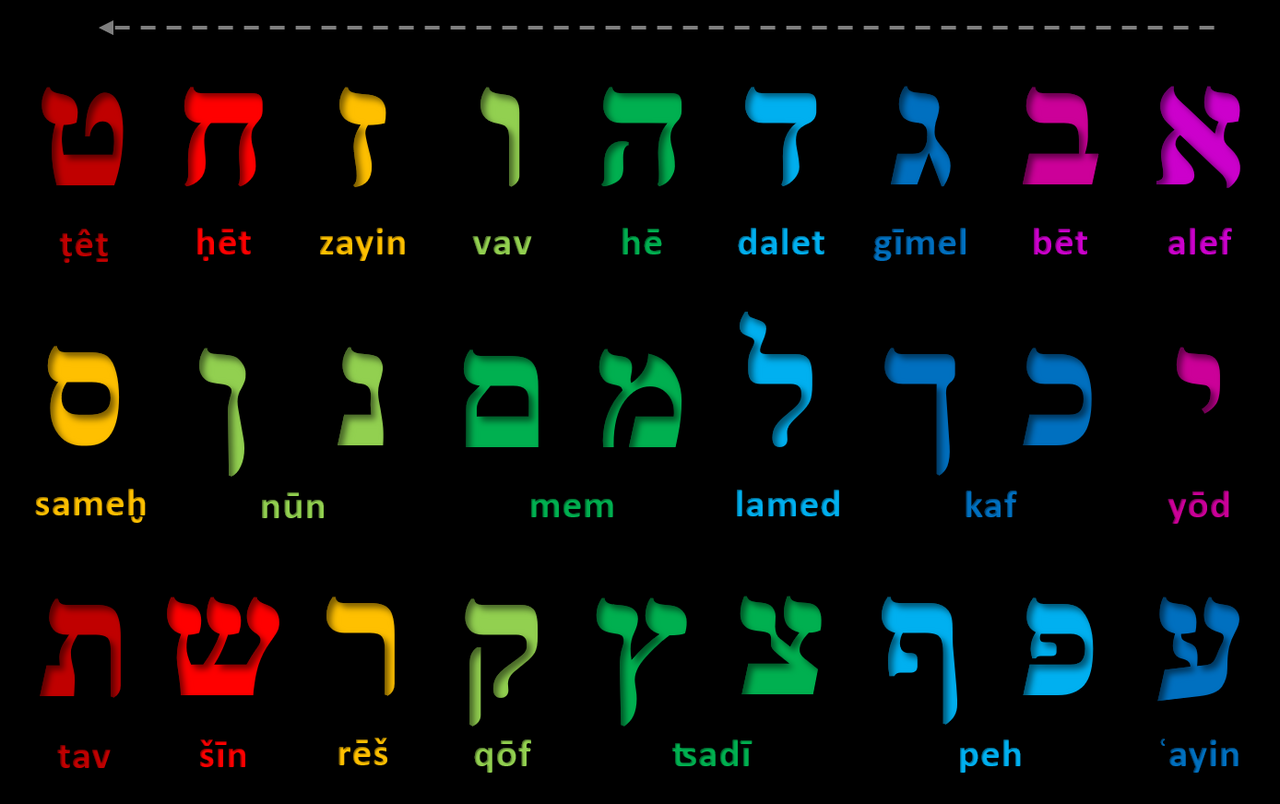
The Hebrew script, also known as the Jewish script, square script, or block script, is a unicameral abjad used for writing Hebrew and other Jewish languages. It is an offshoot of the Imperial Aramaic alphabet, which flourished during the Achaemenid Empire and derives from the Phoenician alphabet. The script is written from right to left and has 22 letters, with five letters taking different forms at the end of a word.
Quick Facts
- Languages
- Hebrew; derivations used for Yiddish, Ladino, Mozarabic, Levantine Arabic, Aramaic, Knaanic, other Jewish languages
- Time
- 2nd–1st century BCE to present
- Direction
- Right-to-left
- Sisters
- Nabataean / Syriac / Palmyrene / Edessan / Hatran / Elymaic / Mandaic / Pahlavi / Kharosthi
- Children
- Yiddish alphabet / Square Maalouli alphabet
- Unicode
- [https: · www.unicode.org/charts/PDF/U0590.pdf U+0590 to U+05FF] / Hebrew, / [https: · www.unicode.org/charts/PDF/UFB00.pdf U+FB1D to U+FB4F] / Alphabetic Presentation Forms
Facts from the source article.
Lore & Background
The Hebrew script originated as a stylized form of the Imperial Aramaic alphabet, adopted by Jews after the Babylonian exile of the Kingdom of Judah in the 6th century BCE. Before that, the Paleo-Hebrew alphabet was used in the ancient kingdoms of Israel and Judah. The Samaritans continued to use a variant of Paleo-Hebrew, known as the Samaritan alphabet. During the 3rd century BCE, Jews began using the square form of the Imperial Aramaic alphabet, which eventually became the standard Jewish script after the 1st century BCE.
Reader's Guide
The Hebrew script is significant as the writing system for Hebrew, the language of the Hebrew Bible and modern Israel, as well as for other Jewish diaspora languages such as Yiddish, Ladino, Judeo-Arabic, and Judeo-Persian. Originally an abjad consisting only of consonants, it developed vowel indication through matres lectionis (letters א ה ו י) and later through a system of diacritical vowel points called niqqud. In modern Hebrew, there is a trend toward full spelling using matres lectionis to indicate vowels. The script is also used informally in Israel for writing Levantine Arabic, especially among Druze. Its legacy includes the preservation of biblical texts and the revival of Hebrew as a spoken language in the 18th and 19th centuries, particularly in Israel.
Did You Know?
- The Hebrew alphabet has 22 letters and does not have case.
- Five letters have different forms when used at the end of a word.
- The Yiddish alphabet, a modified version of the Hebrew alphabet, is a true alphabet with all vowels rendered in spelling.
The Great Linguistic Displacement
Long before the rise of empires, the Aramaic alphabet served the Aramean peoples scattered across the Fertile Crescent, recording their spoken languages in a script that would eventually reshape the linguistic landscape of the ancient Near East. The true turning point came when successive empires drove a sweeping language shift: Assyrians and Babylonians permanently abandoned their Akkadian tongue and its cuneiform writing in favor of Aramaic and its alphabetic script, a transformation driven by the practical needs of governance. Jewish communities followed a parallel path, embracing Aramaic as their everyday vernacular and adopting its alphabet—whom they still call Ktav Ashuri—even for transcribing Hebrew, thereby displacing the older Paleo-Hebrew script they had used for generations. The Samaritans, however, rejected this shift and preserved their ancestral Paleo-Hebrew lineage. The consequence endures to this day: the Hebrew alphabet in common use today is, in its very letter forms, a descendant of the Aramaic script, while the Samaritan script remains a living thread connecting back to the pre-Aramaic, Phoenician-era alphabet. This single administrative and cultural realignment effectively split the Hebrew-speaking world into two distinct scribal traditions.
Imperial Aramaic and the Persian Administrative Machine
Following Darius I's conquest of Mesopotamia around 500 BC, the Achaemenid Persian state made a decisive administrative choice: Old Aramaic would become the written medium binding together a vast, multilingual empire stretching across the known world. Scholars have labeled this standardized variety Official Aramaic, Imperial Aramaic, or Achaemenid Aramaic, and its uniformity was remarkable. Its spelling conventions leaned heavily on etymological roots rather than any single spoken dialect, and it absorbed influences from Old Persian. Two distinct visual styles coexisted during this era. The lapidary form, carved into stone monuments, retained a conservative appearance closely resembling earlier Phoenician and early Aramaic letter shapes. The cursive form, used for everyday documentation, gradually outcompeted its rigid counterpart and had largely supplanted it by the third century BC. Even after the empire's collapse in 331 BC, the Aramaic script left an indelible mark on Iranian writing, surviving in the essential structure of the Pahlavi system. A remarkable cache of thirty Aramaic documents on leather, discovered in Bactria and analyzed in 2006, confirms that this administrative language was actively deployed in the provincial governance of Bactria and Sogdiana as late as the fourth century BC.
The Abjad — A Category of Its Own
For centuries, scholars struggled to classify writing systems like the Aramaic alphabet, which encode every consonant but leave most vowels unmarked except through a handful of letters repurposed as matres lectionis to signal long vowel sounds. The prevailing view, articulated most forcefully by Ignace Gelb, was that such a system could only be a syllabary. Most other writers, unable to accept that label, dismissed it as an incomplete or deficient alphabet. Peter T. Daniels broke from both camps by coining the term abjad, a word that deliberately sidesteps the false binary between syllabaries and full alphabets. In Daniels' framework, a script like Aramaic occupies a distinct structural position: it is neither a syllabary that maps one symbol to an entire syllable, nor a full alphabet in the Greek sense where vowels receive their own dedicated letter shapes. Instead, it sits in an intermediate zone, representing consonantal phonemes systematically while handling vowels through a secondary, optional mechanism. The term abjad thus names a genuinely different type of writing system rather than forcing it into a category where it does not naturally belong.
The Descent Tree — From One Script to the World
The Aramaic alphabet stands at the root of an extraordinary scribal family tree. Because it was elevated to the status of a lingua franca and the official administrative language of the Neo-Assyrian, Neo-Babylonian, and Achaemenid empires, its letter forms spread across the ancient world and seeded new writing systems on three continents. In the Jewish tradition, the modern Hebrew alphabet retains the closest relationship to the Imperial Aramaic script of the fifth century BC, sharing an identical inventory of letters and, for the most part, nearly identical shapes. The Samaritan script, by contrast, traces its lineage directly to the older Proto-Hebrew and Phoenician forms that preceded Aramaic. Beyond the Levant, the Aramaic alphabet gave rise to the Syriac script, the Mongolian script, the Kharosthi and Brahmi scripts of South Asia, and the Nabataean alphabet, which in turn is the direct ancestor of the Arabic script. Scholars generally divide the world's alphabets into two broad streams: those of the Mediterranean basin, adapted from Phoenician around the eighth century BC, and those of the East—spanning the Levant, Persia, Central Asia, and India—adapted from Imperial Aramaic around the sixth century BC.
Gallery



Frequently Asked Questions
What is the Hebrew script and what type of writing system is it?
The Hebrew script is a unicameral abjad, meaning it encodes consonants without dedicated vowel letters, and it is used to write Hebrew along with several other Jewish languages. It is also commonly called the square script or block script because of the angular, geometric shape of its letterforms.
How many letters does the Hebrew script have?
The Hebrew script contains 22 base letters, and five of those letters adopt a distinct modified shape when they close a word. These so-called final forms are the only visual variants the script uses beyond its core 22.
Which direction do you write the Hebrew script?
The Hebrew script is written from right to left, a direction that applies to every letter, word, and line of text. This right-to-left flow has been a consistent feature of the script's modern usage.
What languages can be written with the Hebrew script?
In addition to Hebrew, the script serves as the writing system for Yiddish, Ladino, Judeo-Arabic, and Judeo-Persian. It acts as a shared written vehicle for a family of languages historically used by Jewish-speaking communities.
Where did the Hebrew script originate?
The Hebrew script descends from the Imperial Aramaic alphabet that was widely used during the Achaemenid Persian Empire. That Aramaic form itself traces back to the older Phoenician alphabet, placing the Hebrew script within a long lineage of Semitic writing traditions.
More in Writing Systems 1-24
Spotted an error? Know more?
Reader corrections go straight into our review queue. Suggest an edit · How this site is sourced