
Alphabet
A writing system where letters represent phonemes.

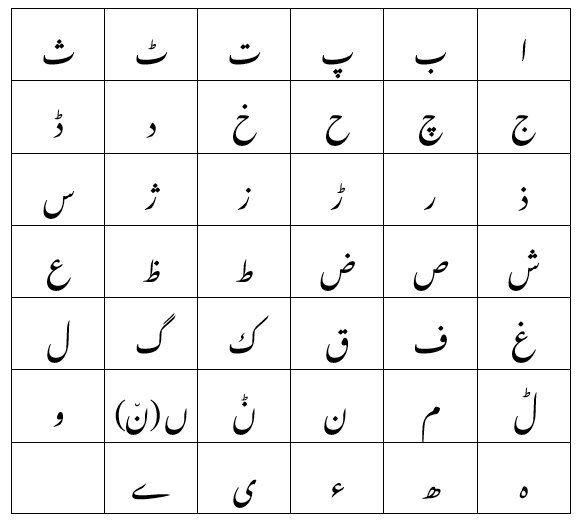
MS Sakib · CC BY-SA 4.0
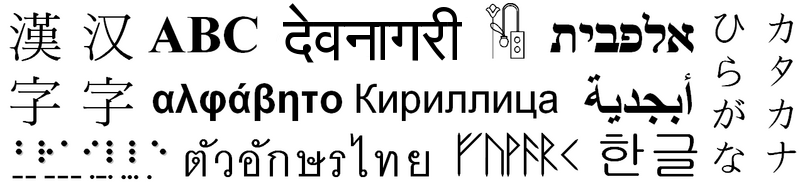
An alphabet is a writing system built from a standard set of symbols—letters—that roughly correspond to the individual sounds of a spoken language. More precisely, these letters map onto phonemes, the smallest sound units that can change a word’s meaning. This sets alphabets apart from other writing systems: syllabaries assign symbols to whole syllables, while logographies use symbols for words, morphemes, or other meaning-based units.
The earliest letters emerged in Ancient Egypt, where they were called uniliteral signs and served as pronunciation aids for hieroglyphs. Unlike earlier hieroglyphs, which carried no sound information, these signs added phonetic hints. They were used from around the 24th century BC and later helped transcribe foreign words. The first fully phonemic script was the Proto-Sinaitic script, also descended from Egyptian hieroglyphs. This evolved into the Phoenician alphabet, widely regarded as the first true alphabet and the ultimate ancestor of many modern scripts, including Arabic, Cyrillic, Greek, Hebrew, Latin, and possibly Brahmic.
Scholar Peter T. Daniels draws a distinction between true alphabets—which use letters for both consonants and vowels—and abugidas and abjads. Abugidas represent vowels with diacritics attached to consonant letters, while abjads generally lack vowel indicators. By this narrower definition, the Greek alphabet was the first true alphabet, derived from the Phoenician alphabet, which was an abjad.
Alphabets typically follow a standard letter order, making them useful for collation—arranging words in alphabetical order. This ordering also allows letters to serve as a numbering system for ordered items. Some alphabets exhibit acrophony, where letters have names distinct from their sounds; examples include Greek, Arabic, Hebrew, and Syriac, while the Latin alphabet does not.
**Etymology** The English word *alphabet* came from Late Latin *alphabetum*, which itself came from the Greek *alphábētos*, formed from the first two Greek letters: *alpha* and *beta*. Those Greek letter names, in turn, came from the first two letters of the Phoenician alphabet: *aleph* (meaning “ox”) and *bet* (meaning “house”).
**History** The Ancient Egyptian writing system included about 24 uniliteral hieroglyphs—glyphs representing a single sound.
- First letters invented
- Ancient Egypt
- First fully phonemic script
- Proto-Sinaitic script (c. 1840 BC)
- First true alphabet
- Phoenician alphabet (c. 1050 BC)
- First alphabet with vowels
- Greek alphabet
- Most widely used script today
- Latin alphabet
- Key distinction
- True alphabets vs. abjads and abugidas (per Peter T. Daniels)
Lore & Background
The earliest alphabetic precursors were Egyptian uniliteral signs, used from around the 24th century BC until the 5th century AD, when they were forgotten. The Proto-Sinaitic script emerged c. 1840 BC in Egyptian turquoise mines, likely created by Canaanite workers, and an earlier version was discovered at Wadi el-Hol dating to c. 1800 BC. This script had no vowel characters and was originally an abjad. The best-attested Bronze Age alphabet is Ugaritic, invented before the 15th century BC, with 30 signs including three vowel indicators, but it fell out of use after 1178 BC.
The Proto-Sinaitic script evolved into the Phoenician alphabet by c.
Reader's Guide
The alphabet fundamentally changed human communication by reducing writing to a small set of symbols representing sounds, making literacy more accessible than logographic or syllabic systems. The Phoenician alphabet's simplicity allowed traders to learn it easily and adapt it to different languages, leading to its spread across the Mediterranean. Its descendants include the Greek, Latin, Arabic, Hebrew, Cyrillic, and possibly Brahmic scripts. The Greek alphabet's innovation of representing vowels independently created the model for true alphabets, as defined by Peter T. Daniels, distinguishing them from abjads and abugidas. The Latin alphabet, after the fall of the Western Roman Empire, survived in intellectual and religious works and became the most widely used script globally, adapted for Romance languages and most western and central European languages. Alphabets also enabled standardized ordering (alphabetical order) for collation and numbering, and some systems developed acrophony, where letter names differ from their pronunciations. The English word 'alphabet' itself traces back to the first two Greek letters, alpha and beta, which came from the Phoenician aleph and bet.
Did You Know?
- The first letters were invented in Ancient Egypt as uniliteral signs to aid in writing hieroglyphs.
- The Proto-Sinaitic script, discovered at Wadi el-Hol, dates to c. 1800 BC and had no characters representing vowels.
- The Greek alphabet was the first to give vowels independent letterforms, derived from the Phoenician abjad.
- The Latin alphabet is the most widely used script in the world today.
Gallery

Frequently Asked Questions
What exactly is an Alphabet?
An Alphabet is a writing system in which a fixed set of letters each maps onto a single phoneme, the smallest sound unit capable of changing a word's meaning. This phoneme-based design is what sets it apart from syllabaries (one symbol per syllable) and logographies (one symbol per word or morpheme).
Where did the Alphabet first appear?
The earliest letter-like symbols surfaced in Ancient Egypt as uniliteral signs that served as pronunciation aids alongside hieroglyphs. The Proto-Sinaitic script (c. 1840 BC) is generally regarded as the first fully phonemic writing system, while the Phoenician alphabet (c. 1050 BC) is credited as the first true alphabet.
How does a true Alphabet differ from an abjad or abugida?
Following the classification framework of linguist Peter T. Daniels, a true alphabet assigns independent symbols to both consonants and vowels, whereas abjads (such as early Arabic) largely omit vowel letters and abugidas (such as Devanagari) bundle vowel marks into consonant glyphs. The Greek alphabet was the first script to give vowels their own dedicated letters.
Which Alphabet is used the most around the world today?
The Latin alphabet is by far the most widely used script on the planet, underpinning English, Spanish, French, Indonesian, and dozens of other languages. Its global dominance traces back to the Roman Empire's spread of Greek-derived letter forms across Europe and, later, through colonialism and trade.
Why is the Alphabet considered a turning point in writing history?
By compressing an entire language's sound inventory into a small, learnable set of symbols, it dramatically lowered the barrier to literacy compared to systems requiring thousands of logographic or syllabic signs. This accessibility is a major reason alphabetic scripts spread so rapidly from the Mediterranean to Southeast Asia and beyond.
More in Writing Systems 1-24
Spotted an error? Know more?
Reader corrections go straight into our review queue. Suggest an edit · How this site is sourced