
Cyrillic script
Third official script of the European Union.

Crissov , Gojdo · CC BY-SA 4.0
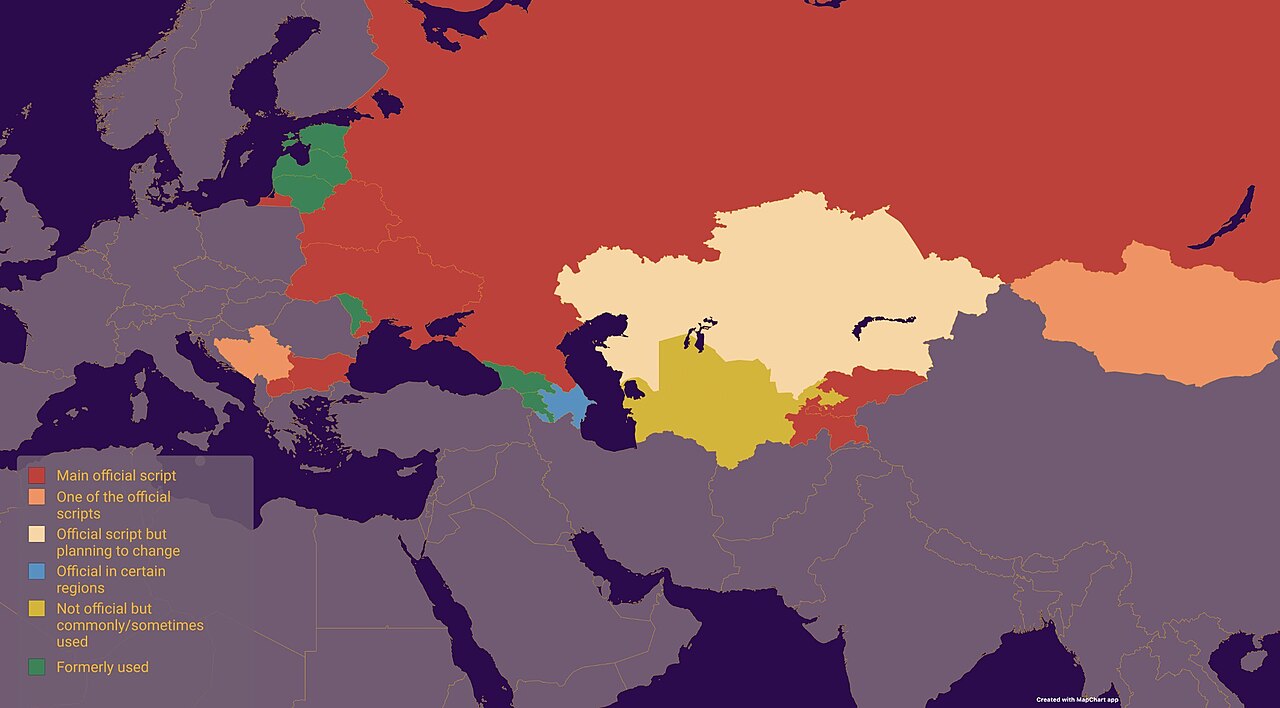
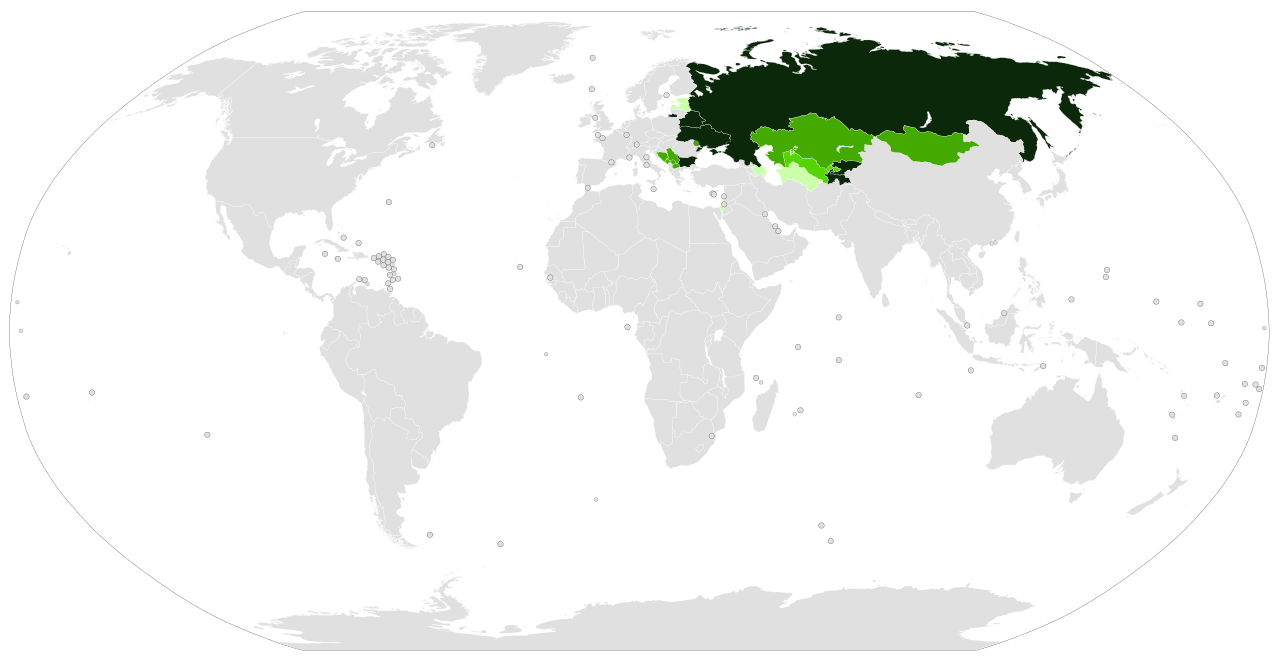
The Cyrillic script is a writing system employed across Eurasia for numerous languages. It serves as the official national script in countries spanning Southeastern Europe, Eastern Europe, the Caucasus, Central Asia, North Asia, and East Asia, including those with Slavic, Turkic, Mongolic, Uralic, Caucasian, and Iranic language families, and it is also utilized for many minority languages. By 2019, roughly 250 million people in Eurasia used Cyrillic for their national languages, with Russia representing about half of that total. Following Bulgaria's entry into the European Union in 2007, Cyrillic became the EU's third official script, after Latin and Greek.
The script's name honors Saint Cyril, though it was not created by Cyril and Methodius themselves. Instead, their followers in Bulgaria developed it, making the name a tribute rather than a claim of authorship. The Early Cyrillic alphabet was devised in the late 9th to early 10th century AD (circa 893–900 AD) at the Preslav Literary School in the First Bulgarian Empire, under Tsar Simeon I the Great. Scholars there, including Clement of Ohrid, Naum of Preslav, Constantine of Preslav, Joan Ekzarh, Chernorizets Hrabar, and others—disciples of the Byzantine brothers Cyril and Methodius, who had earlier created the Glagolitic script—likely created it. Unlike the Ohrid scholars, those at Preslav relied more heavily on Greek models, quickly adapting Greek uncial letters to Slavic needs and abandoning Glagolitic. The resulting alphabet combined Greek uncial letters with ligatures and consonants from Glagolitic for sounds absent in Greek. Paul Cubberley suggests that while Cyril may have formalized Glagolitic, his students in Bulgaria under Simeon I developed Cyrillic from Greek letters in the 890s for church books.
The script spread among other Slavic peoples and non-Slavic Romanians. The earliest datable Cyrillic inscriptions appear in the Preslav area, including the medieval city itself, the Patleina Monastery, the Ravna Monastery, and the Varna Monastery, all in present-day Shumen Province. Cyrillic became the basis for alphabets in various languages across Orthodox Church-dominated Eastern Europe, including both Slavic and non-Slavic tongues like Romanian (used until the 1860s). For centuries, Catholic and Muslim Slavs also used it.
Quick Facts
- Time
- Earliest variants exist c. 893 – c. 940
- Direction
- Left-to-right
- Sisters
- Armenian / Coptic / Latin
- Children
- Old Permic script
Facts from the source article.
Lore & Background
The Early Cyrillic alphabet was developed during the late 9th to early 10th century AD (circa 893–900 AD) at the Preslav Literary School in the First Bulgarian Empire during the reign of Tsar Simeon I the Great, probably by the disciples of the two Byzantine brothers Cyril and Methodius, who had previously created the Glagolitic script. Among them were Clement of Ohrid, Naum of Preslav, Constantine of Preslav, Joan Ekzarh, Chernorizets Hrabar, and other scholars. The script is named in honor of Saint Cyril. Modern scholars believe that the Early Cyrillic alphabet was created at the Preslav Literary School.
Reader's Guide
The Cyrillic script originated in the First Bulgarian Empire as an adaptation of the Greek uncial alphabet, augmented by letters from the Glagolitic script for sounds not found in Greek. It was developed by disciples of Cyril and Methodius at the Preslav Literary School, and its name denotes homage to Saint Cyril rather than authorship. The script spread among Slavic peoples and non-Slavic Romanians, becoming the basis for alphabets used in various languages in Orthodox Church-dominated Eastern Europe. It came to dominate Glagolitic in the 12th century. The literature produced in Old Church Slavonic soon spread north from Bulgaria and became the lingua franca of the Balkans and Eastern Europe. Over the centuries, Cyrillic adapted to changes in spoken language, developed regional variations, and was subjected to academic reform and political decrees. Notable reforms include Peter the Great's civil script in 1708–10, which introduced letterforms closer to the Latin alphabet, and Vuk Stefanović Karadžić's update of Serbian Cyrillic. Today, many languages in the Balkans, Eastern Europe, and northern Eurasia are written in Cyrillic alphabets.
Did You Know?
- The Cyrillic script is named in honor of Saint Cyril, though it was developed by his disciples rather than by Cyril himself.
- The earliest datable Cyrillic inscriptions have been found in the area of Preslav, in the medieval city itself and at nearby Patleina Monastery, both in present-day Shumen Province.
- Cyrillic became the third official script of the European Union after Bulgaria's accession in 2007.
- The Russian ruble sign (₽) is derived from the majuscule Cyrillic letter Р.
Gallery

Frequently Asked Questions
Who is credited with creating the Cyrillic script?
The script is traditionally attributed to disciples of Saints Cyril and Methodius, especially Clement of Ohrid and Naum of Preslav, who shaped it in the late 9th to early 10th century. It was developed at the Preslav Literary School within the First Bulgarian Empire.
Which languages does the Cyrillic script serve today?
Cyrillic is the official national script for languages belonging to the Slavic, Turkic, Mongolic, Uralic, Caucasian, and Iranic families, spanning countries from Southeastern Europe to East Asia. It also supports a wide range of minority languages across Eurasia.
Where and when did the Cyrillic script originate?
It was developed around 893–900 AD at the Preslav Literary School in the First Bulgarian Empire. The letterforms were primarily adapted from Greek uncial script, with additional ligatures and consonant signs drawn from the older Glagolitic alphabet.
How many people use the Cyrillic script?
By 2019, roughly 250 million people across Eurasia relied on Cyrillic for their national languages. Russia alone accounts for about half of that total user base.
What writing systems did the Cyrillic script evolve from?
Cyrillic was built on the foundation of Greek uncial letterforms, supplemented by specific ligatures and consonant characters borrowed from the Glagolitic script. This hybrid origin gave it a flexible set of signs capable of representing the phonologies of Slavic and many non-Slavic languages.
More in Writing Systems 1-24
Spotted an error? Know more?
Reader corrections go straight into our review queue. Suggest an edit · How this site is sourced