
Egyptian hieroglyphs
Ancient Egyptian sacred writing system, influential on later scripts through intermediaries.

Gtoffoletto · CC BY-SA 4.0
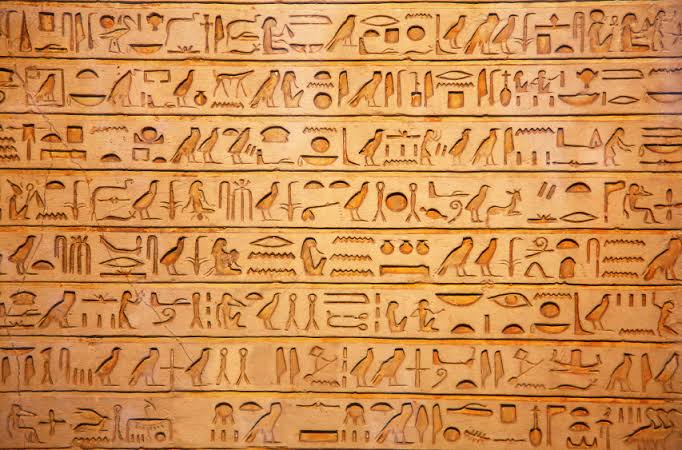
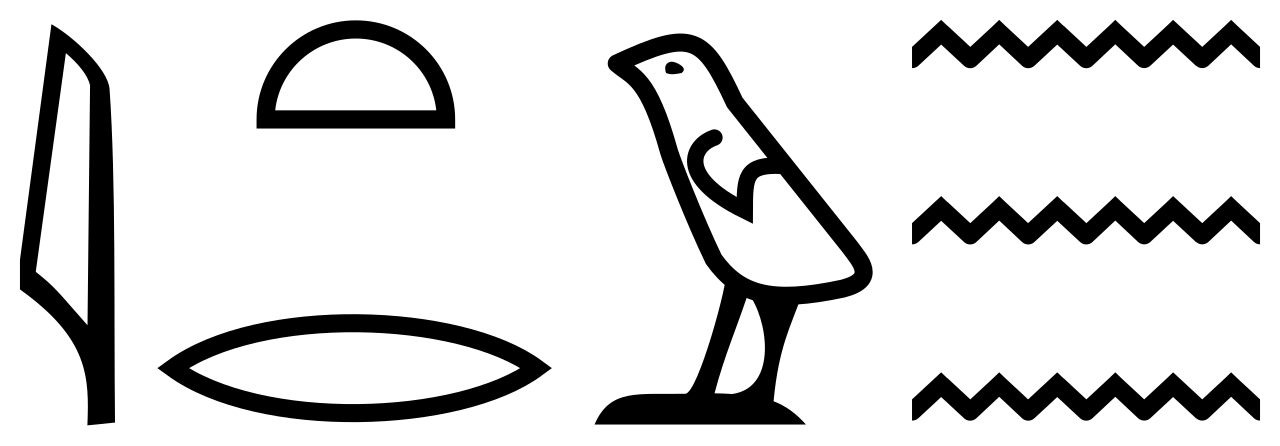
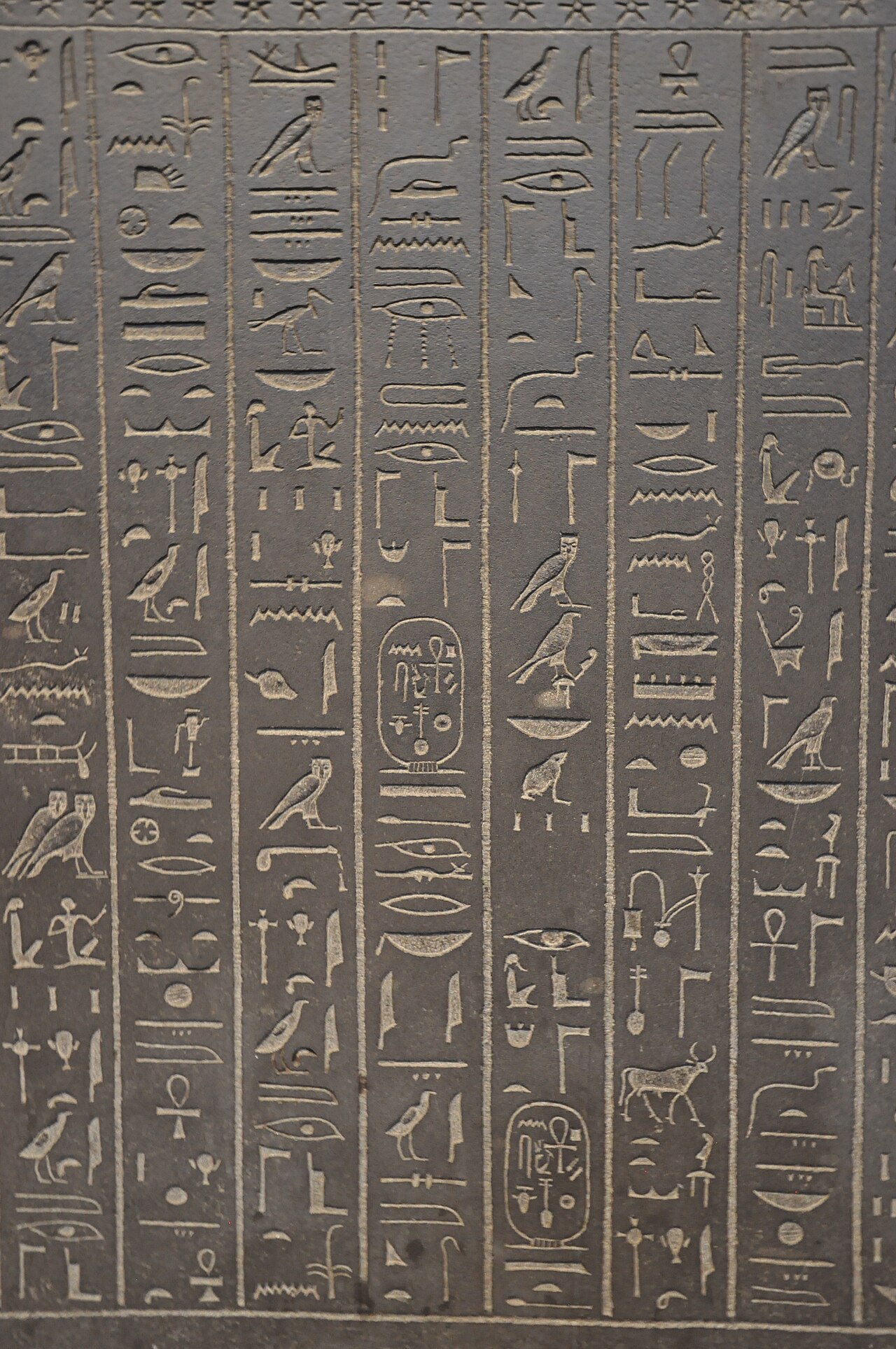
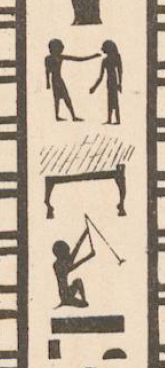
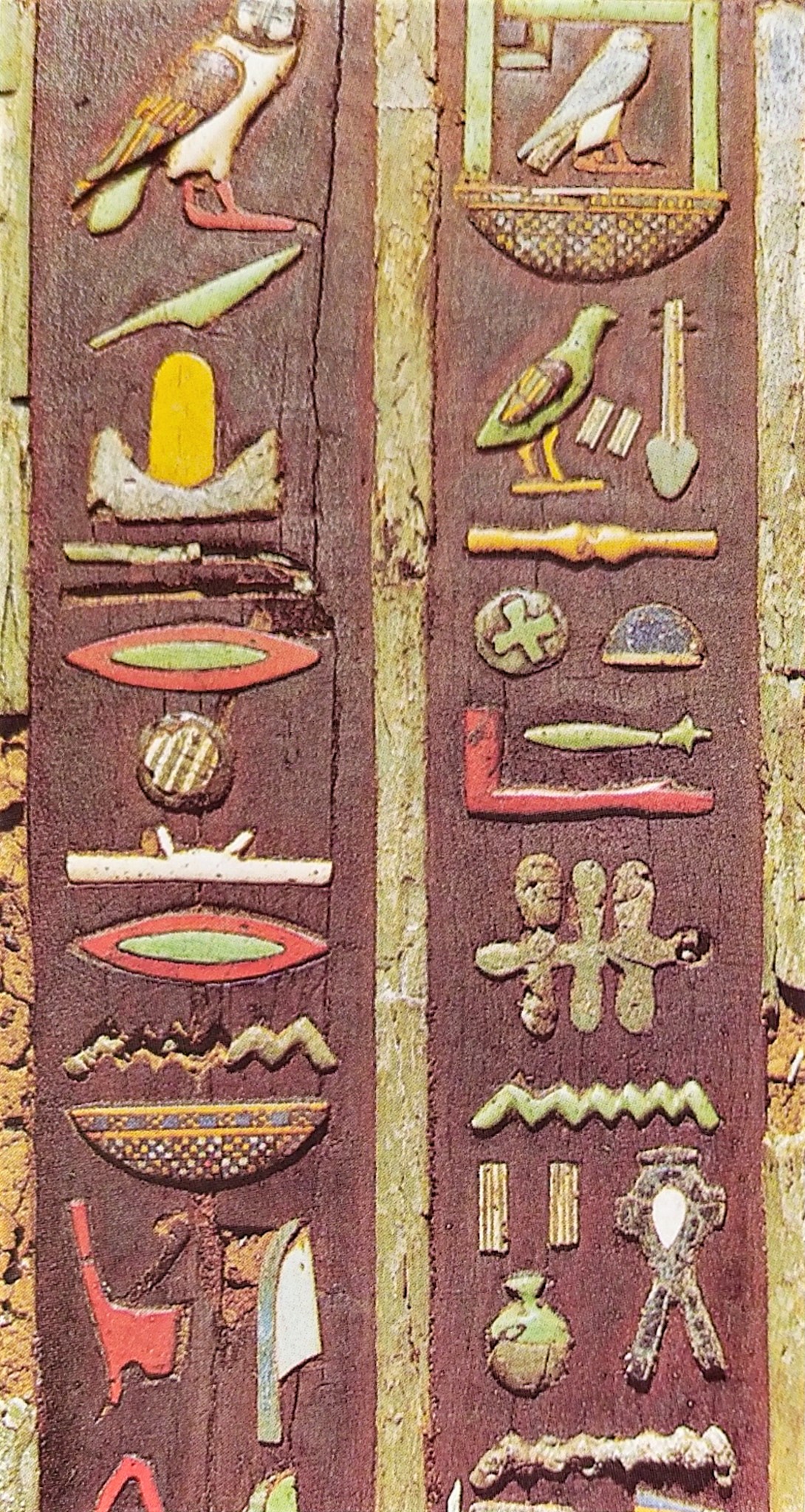
Ancient Egyptian hieroglyphs served as the official writing system for the Egyptian language. These symbols blended several functions—they could represent ideas, whole words, syllables, or individual sounds—and the system included over 1,000 different signs. Hieroglyphs are sometimes considered one of the few writing systems thought to have been created independently, though the exact number of such systems is debated. While they may have influenced the development of the Proto-Sinaitic and Proto-Canaanite scripts, they are not a direct ancestor of the Phoenician alphabet; instead, most modern scripts—including Latin, Cyrillic, Arabic, and Brahmic scripts—trace their roots through later intermediaries like Phoenician, Greek, and Aramaic.
Quick Facts
- Typedesc
- (logoconsonantal)
- Direction
- right-to-left, left-to-right, boustrophedon
- Time
- c. 3250 BC · 400 AD
- Languages
- Egyptian language
- Family
- Proto-writing
- Children
- Hieratic / Proto-Sinaitic
Facts from the source article.
Lore & Background
Hieroglyphs may have emerged from preliterate artistic traditions, with proto-writing systems developing in the second half of the 4th millennium BC. The first full sentence in mature hieroglyphs was found on a seal impression in the tomb of Seth-Peribsen, dating to the Second Dynasty. By the Greco-Roman period, there were more than 5,000 distinct characters. Scholars debate whether hieroglyphs were developed independently or under influence from Sumerian cuneiform, but discoveries at Abydos dating to c. 3400–3200 BC challenge the hypothesis of diffusion from Mesopotamia.
Reader's Guide
Egyptian hieroglyphs are significant as one of the earliest writing systems and the ultimate ancestor of the Phoenician alphabet, which gave rise to Greek, Aramaic, and subsequently the Latin, Cyrillic, Arabic, and Brahmic scripts. Their use spanned over three millennia, from the Early Bronze Age through the Roman period. The system combined phonetic glyphs, logographs, and determinatives, and evolved into cursive forms (hieratic and demotic) for everyday use. The decipherment by Champollion unlocked the history and literature of ancient Egypt. The entire corpus of hieroglyphic and hieratic texts is approximately 5 million words, with the most complete compendium containing 1.5–1.7 million words. Hieroglyphs remain a subject of fascination and study, representing a key milestone in human communication.
Did You Know?
- Hieroglyphs are one of only four writing systems thought to have been developed without outside influence, alongside cuneiform, Chinese characters, and Mayan script.
- The last known hieroglyphic inscription, the Graffito of Esmet-Akhom, dates to 394 AD at Philae.
- The Rosetta Stone contains three parallel scripts: hieroglyphs, demotic, and Greek, which enabled decipherment.
- The word 'hieroglyph' derives from Ancient Greek meaning 'sacred carving'.
A Multilayered Script of Extraordinary Complexity
The formal writing system of Ancient Egypt was not a single uniform code but a layered one, weaving together ideographic, logographic, syllabic, and alphabetic elements into a single script. At its peak, the system employed more than a thousand distinct characters, with cursive hieroglyphs reserved for religious literature inscribed on papyrus and wood. The script's roots stretch back to proto-literate symbol systems of the Early Bronze Age, around the 33rd century BC during the Naqada III period. The earliest decipherable sentence in the Egyptian language dates to the 28th century BC, the Second Dynasty, found on a seal impression in the tomb of Seth-Peribsen at Umm el-Qa'ab. By the Middle Kingdom, the system had matured into a tool for monumental inscription, using roughly 900 distinct signs. That number would swell dramatically over the centuries; by the Greco-Roman period, more than 5,000 hieroglyphs were in active use. The script endured through the New Kingdom, the Late Period, the Persian and Ptolemaic eras, and even into the 4th century AD under Roman rule.
The Ancestral Thread Behind Most of the World's Writing
Few ancient inventions have cast as long a shadow as Egyptian hieroglyphs in the realm of written communication. The later hieratic and demotic scripts grew directly out of hieroglyphic writing, and so did the Proto-Sinaitic script, which in turn evolved into the Phoenician alphabet—the first widely adopted phonetic writing system in history. From Phoenician, the Greek and Aramaic scripts branched outward. Greek gave rise to the Latin and Cyrillic alphabets, while Aramaic seeded the Arabic and Brahmic scripts. In practical terms, the vast majority of the world's living writing systems trace their lineage, however distant, back to those carved Egyptian signs. Hieroglyphs are also considered one of only four writing systems developed without outside influence, alongside cuneiform, Chinese characters, and the Mayan script. The very word "hieroglyph" carries the weight of this legacy: from the Ancient Greek hieroglyphikos, meaning "sacred carving," a compound of hierós (sacred) and glýphō (to carve, engrave). In the Ptolemaic period, Egyptians themselves called the glyphs mdw.w-nṯr, "words of gods," a phrase the Greeks rendered as "the sacred engraved letters."
Silence, Mystery, and the Long Road to Decipherment
For nearly a millennium after the last hieroglyphs were carved, the script lay locked in silence. During the 5th century, the permanent closing of pagan temples across Roman Egypt severed the chain of scribes who could fluently read and write the system. The knowledge did not simply evaporate; it faded, generation by generation, until the script became an enigma. Throughout the Middle Ages and into the early modern period, the true nature of the writing remained unknown to the outside world. Yet the fascination never fully died. A mixture of medieval Arab and Egyptian communities kept the mystery alive, and scholars, spiritualists, and treasure hunters pursued artifacts with an eye toward decoding the language, often relying on the phonetic and alphabetical parallels between Coptic and hieroglyphic. The breakthrough finally came in the 1820s, when Jean-François Champollion, working with the Rosetta Stone, accomplished the decipherment that had eluded centuries of prior effort.
The Vast Written Corpus and the Debate Over Origins
The sheer volume of what the Egyptians committed to their script is staggering. The entire Ancient Egyptian corpus, encompassing both hieroglyphic and hieratic texts, runs to approximately five million words. If one counts repeated works such as the Book of the Dead and the Coffin Texts as separate entries rather than duplicates, the figure climbs closer to ten million. Modern scholarship has attempted to capture this vast linguistic heritage in reference works. The most complete compendium to date, the Wörterbuch der ägyptischen Sprache, contains between 1.5 and 1.7 million words, a testament to the depth and breadth of the language as it was recorded across millennia. The script's origins themselves remain a subject of active scholarly debate. Some researchers, including Geoffrey Sampson, have suggested that the general concept of writing may have traveled from Sumerian Mesopotamia to Egypt, noting that Egyptian writing appeared suddenly while Mesopotamia had a long evolutionary history of accounting tokens dating to around 8000 BC. However, discoveries of glyphs at Abydos dated between 3400 and 3200 BC have cast doubt on that diffusion hypothesis, pointing instead toward an independent Egyptian origin.
Gallery

Frequently Asked Questions
What are Egyptian hieroglyphs?
Egyptian hieroglyphs were the formal, sacred script used to write the Egyptian language across thousands of years of ancient civilization. The system combined ideographic, logographic, and phonetic elements into a single repertoire of more than 1,000 distinct signs.
How many symbols does Egyptian hieroglyphs use?
The full repertoire exceeded 1,000 signs, though during the Middle Kingdom the most commonly active set ranged around 700 to 800 distinct characters. Not every scribe deployed the entire inventory at once; the number in daily circulation shifted across dynasties.
Did Egyptian hieroglyphs directly create the modern alphabet?
No—hieroglyphs are not the direct ancestor of the Phoenician alphabet or, by extension, most modern scripts. They may have nudged the development of Proto-Sinaitic and Proto-Canaanite scripts, but the lineage to today's alphabets runs through those intermediary systems rather than straight from the Egyptian signs.
When did Egyptian hieroglyphs first appear?
The earliest decipherable hieroglyphic inscriptions date to the 27th century BC, during Egypt's Second Dynasty. The script then evolved and reached a particularly rich and stable form during the Middle Kingdom before continuing to be used for millennia afterward.
Why are Egyptian hieroglyphs considered special among writing systems?
They are frequently cited as one of the handful of scripts believed to have originated independently, without being borrowed from a pre-existing writing tradition, though scholars still debate exactly how many such independent inventions occurred. Their layered design, where a single sign can encode a concept, a whole word, a syllable, or a single sound, makes them a unique hybrid in the history of writing.
More in Writing Systems 1-24
Spotted an error? Know more?
Reader corrections go straight into our review queue. Suggest an edit · How this site is sourced