
Greek alphabet
Earliest alphabet to systematically write vowels and consonants.

Unknown author · Public domain
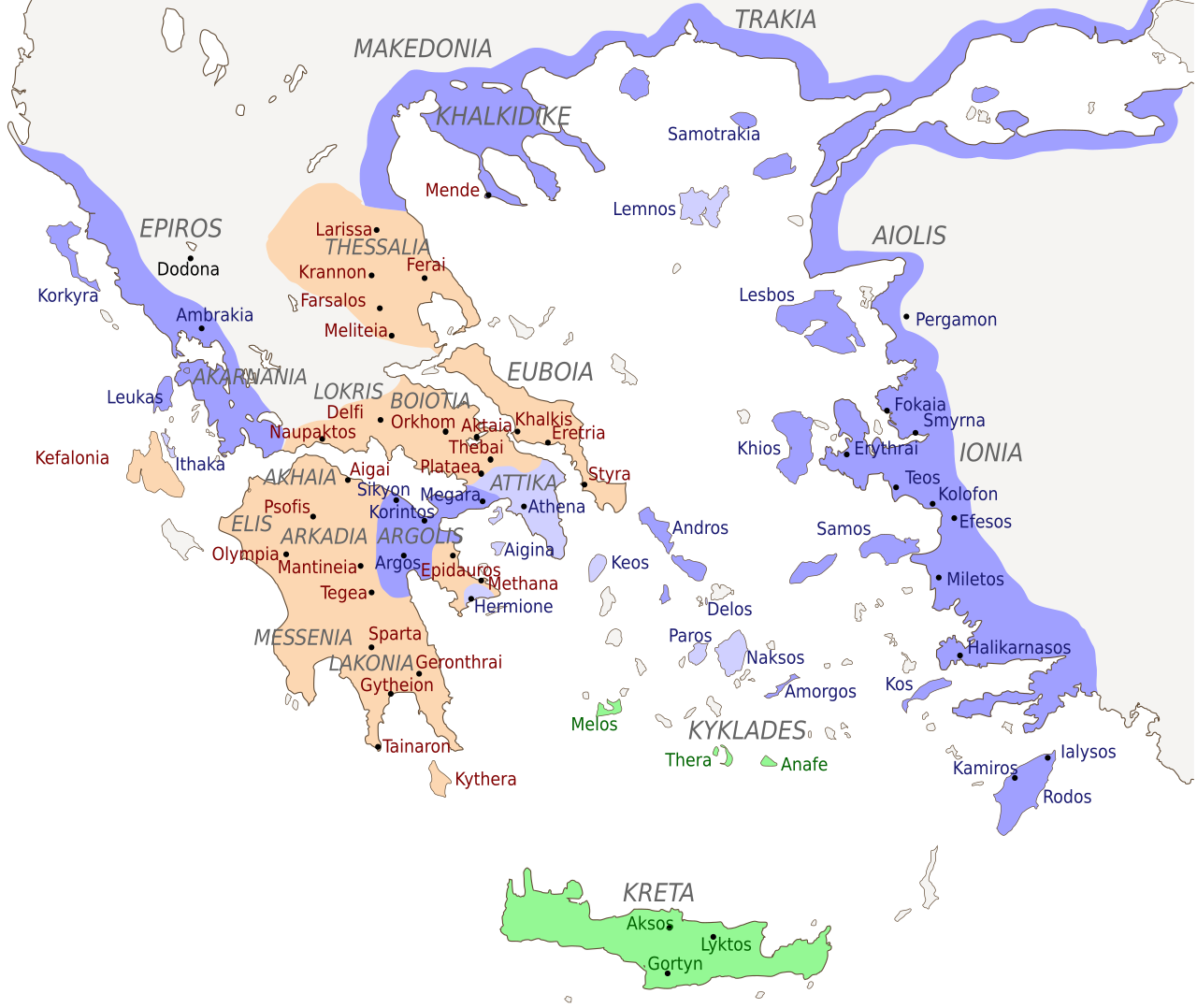
The Greek alphabet has been used for writing Greek since the late 9th or early 8th century BC. It came from the Phoenician alphabet and is the first known script to consistently include letters for both vowels and consonants. During the Archaic and early Classical periods, many local versions existed, but by the end of the 4th century BC, the Ionic-based Euclidean alphabet—with 24 letters running from alpha to omega—became the standard across the Greek-speaking world. That same version is still used for Greek today.
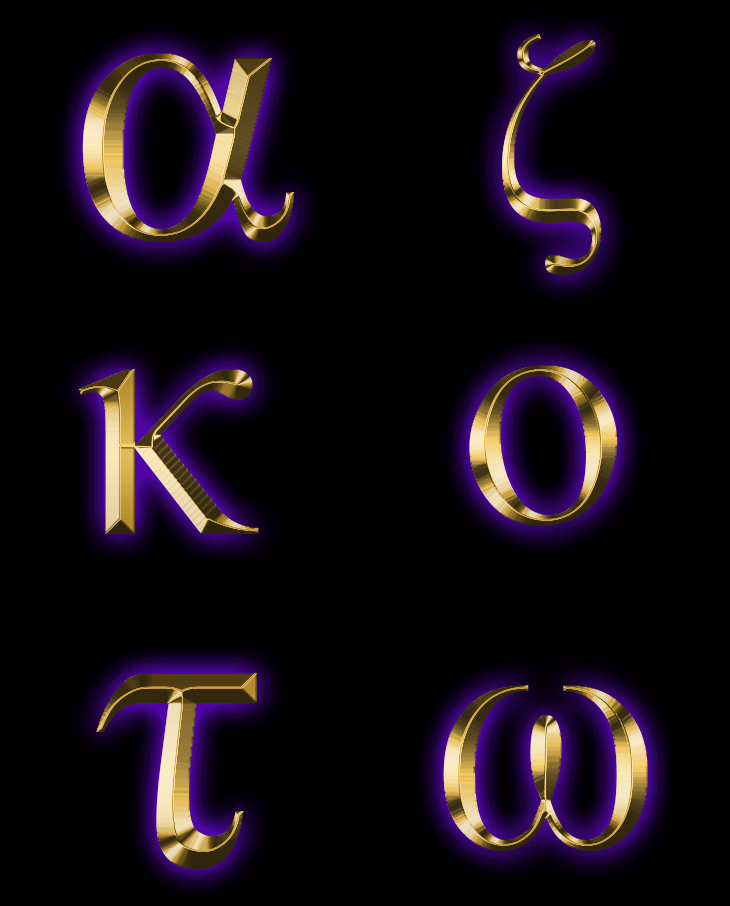
The 24 letters, in uppercase and lowercase, are: Α α, Β β, Γ γ, Δ δ, Ε ε, Ζ ζ, Η η, Θ θ, Ι ι, Κ κ, Λ λ, Μ μ, Ν ν, Ξ ξ, Ο ο, Π π, Ρ ρ, Σ σ ς, Τ τ, Υ υ, Φ φ, Χ χ, Ψ ψ, Ω ω. This alphabet is the ancestor of scripts like Latin, Gothic, Coptic, and Cyrillic. In ancient times, Greek had only uppercase letters, was written without diacritics, and used little punctuation. By the 9th century, Byzantine scribes started using lowercase forms, which they developed from cursive uppercase styles. Sound values and conventional transcriptions for some letters differ between Ancient and Modern Greek because pronunciation changed significantly from the 5th century BC onward. Ancient Greek uses polytonic orthography, while Modern Greek uses only the acute accent for stress and the diaeresis.
Beyond writing Greek in its ancient and modern forms, the alphabet today provides many technical symbols and labels in mathematics, science, and other fields.
**Letters**
**Sound values**
In both Ancient and Modern Greek, the letters have fairly stable and consistent sound mappings, making pronunciation largely predictable. Ancient Greek spelling was nearly phonemic. For several letters, sound values differ considerably between the two stages due to systematic phonological shifts after the classical period.
**Examples**
**Notes**
Among consonants, letters that stood for voiced plosives (/b, d, g/) and aspirated plosives (/pʰ, tʰ, kʰ/) in Ancient Greek now represent fricative sounds in Modern Greek. Among vowels, Modern Greek sound values reflect a major simplification of the vowel system, merging many formerly distinct vowel phonemes into fewer sounds. This leads to several groups of vowel letters that sound identical today.
Quick Facts
- Languages
- Greek
- Official Script
- Greece · Cyprus · European Union
- Time
- c. 800 BC – present
- Direction
- Left-to-right
- Note
- none
Facts from the source article.
Lore & Background
The Greek alphabet was derived from the earlier Phoenician alphabet and is the earliest known alphabetic script to systematically write vowels as well as consonants. In Archaic and early Classical times, it existed in many local variants, but by the end of the 4th century BC, the Ionic-based Euclidean alphabet, with 24 letters ordered from alpha to omega, became standard throughout the Greek-speaking world and remains in use today. Throughout antiquity, Greek had only a single uppercase form of each letter, written without diacritics and with little punctuation. By the 9th century, Byzantine scribes began to employ the lowercase form, derived from cursive styles of the uppercase letters.
Reader's Guide
The Greek alphabet's significance lies in its foundational role for multiple modern scripts and its enduring use in both ancient and modern Greek writing. It is the ancestor of the Latin, Gothic, Coptic, and Cyrillic scripts, making it a key link in the history of writing. Its systematic inclusion of vowels was a major innovation. Today, apart from writing Greek, the alphabet serves as a source of international technical symbols and labels in mathematics, science, and other fields. Sound values for some letters differ between Ancient and Modern Greek due to systematic phonological shifts. The orthography has evolved: ancient Greek used polytonic diacritics (accents and breathing marks), while modern Greek adopted a simplified monotonic system in 1982, using only the acute accent and diaeresis. The alphabet's legacy includes its influence on scholarly transliteration and transcription systems for both ancient and modern Greek.
From Hieroglyphs to a Fixed Script
The Phoenician alphabet traces its lineage back through several earlier writing traditions. Its ultimate ancestor was Egyptian hieroglyphs, which gave rise to the Proto-Sinaitic script found sporadically in the Sinai Peninsula and Canaan during the late Middle and Late Bronze Age. That proto-alphabetic system did not achieve broad use until the Syro-Hittite states emerged in the thirteenth and twelfth centuries BC. The Phoenician script itself is a direct continuation of the Proto-Canaanite writing of the Bronze Age collapse period. Epigraphers regard the arrowhead inscriptions discovered at al-Khader near Bethlehem, dating to roughly 1100 BC, as the crucial missing link connecting these two stages. The Ahiram epitaph, carved into the sarcophagus of a king in Byblos, Lebanon, presents what appears to be a fully matured Phoenician hand, though by scholarly convention the label "Phoenician" is reserved for inscriptions from the mid-eleventh century onward. The conventional starting date of 1050 BC was selected because the epigraphic record contains a gap, with no securely dated eleventh-century examples surviving.
Maritime Trade and the Democratization of Writing
The Phoenician alphabet's greatest strength was its radical simplicity. Where cuneiform and Egyptian hieroglyphs demanded years of professional training and employed hundreds of complex characters, the Phoenician system required learning only a few dozen symbols, each representing a single sound. This phonetic economy made it far easier for ordinary people to acquire literacy, breaking the long-standing monopoly that scribes, royal courts, and religious institutions had held over written knowledge. The vehicle for this transformation was the maritime trading culture of Phoenician merchants, who carried the script across the Mediterranean to North Africa and Southern Europe. Archaeological evidence confirms Phoenician inscriptions at sites including Byblos in present-day Lebanon and Carthage in North Africa, with later finds pointing to even earlier use in Egypt. Beginning in the ninth century BC, adaptations flourished in Greek, Old Italic, and Anatolian scripts. Herodotus credited the Phoenician prince Cadmus with introducing the letters to the Greeks, though his timeline places the event roughly 1600 years before his own era, while the historical adoption occurred barely 350 years prior.
A Consonantal Blueprint in Angular Form
The Phoenician alphabet proper consisted of exactly twenty-two consonant letters, reflecting its nature as an abjad designed for a Semitic language in which vowel sounds were left implicit. In later varieties, however, scribes occasionally employed matres lectionis, consonant letters repurposed to mark certain vowels. Because the original letters were incised with a stylus, their shapes are predominantly angular and straight-lined. Over time, cursive handwriting grew more common, eventually culminating in the Neo-Punic alphabet found in Roman North Africa. A distinctive innovation was the script's fixed writing direction: horizontal, from right to left. Earlier writing systems had been multi-directional, making Phoenician the first to establish a consistent orientation. The alphabet was used to write the Canaanite languages of the Early Iron Age, which historians subdivide into Phoenician, Hebrew, Moabite, Ammonite, and Edomite. In Ancient Carthage, the script continued in service of the Punic language until the second century BC, by which point it had already spawned a family of descendant scripts including Aramaic, Samaritan, several Alphabets of Asia Minor, and the Archaic Greek alphabets.
Inscriptions, Rediscovery, and Global Recognition
The physical record of the Phoenician alphabet is preserved in a remarkable collection of inscribed objects spanning multiple centuries, assembled by the General Directorate of Antiquities of Lebanon and displayed in the National Museum of Beirut. The oldest piece is the Ahiram sarcophagus, dating to approximately 1000 BC, while other notable items include the Nora Stone from around 800 BC, the Karatepe bilingual of the eighth century, and the Pyrgi Tablets, a Phoenician-Etruscan bilingual from roughly 500 BC. This collection formed the basis for a nomination to UNESCO's Memory of the World International Register, which the organization accepted in 2005, recognizing the alphabet as documentary heritage of global importance. The script's modern decipherment came in 1758 through the work of Jean-Jacques Barthélemy, though its connection to the Phoenician people remained unknown until the nineteenth century. Initially, scholars assumed the writing was a direct variation of Egyptian hieroglyphs, a misconception that persisted until Champollion's hieroglyphic decipherment clarified the distinction. Jewish sages of the Second Temple era knew the script by the name "Old Hebrew," or Paleo-Hebrew.
Gallery
Frequently Asked Questions
Who is the Greek alphabet and where did it come from?
The Greek alphabet is an alphabetic script that emerged in the late 9th or early 8th century BC, adapted from the Phoenician writing system. It is the earliest known script to assign dedicated letters to both vowel and consonant sounds.
What makes the Greek alphabet special compared to other scripts?
Its defining achievement is being the first writing system to consistently represent both vowels and consonants with separate letters. This made it far more readable and flexible than earlier abjad-based scripts that only marked consonants.
How did the Greek alphabet's story settle into its final form?
For centuries, dozens of regional variants circulated across Greek city-states. By the end of the 4th century BC, the Ionic-based Euclidean version with its 24 letters won out and became the single standard used throughout the Greek-speaking world.
Why is the Greek alphabet still important today?
Beyond writing both Ancient and Modern Greek, its letters serve as the universal symbol set for mathematics, physics, and other sciences. Names like alpha, beta, gamma, and omega are instantly recognizable across virtually every technical discipline.
How many letters does the Greek alphabet have and what are its endpoints?
The standardized Greek alphabet contains exactly 24 letters, beginning with alpha (Α α) and ending with omega (Ω ω). This is the same 24-letter set locked in during the 4th-century BC standardization and still in use today.
More in Writing Systems 1-24
Spotted an error? Know more?
Reader corrections go straight into our review queue. Suggest an edit · How this site is sourced