
Abugida
A segmental writing system with consonant-based units and secondary vowel notation.

Paul Morrow, and enhance & edited by Melgazar Galvan · CC BY-SA 4.0
An abugida, also called an alphasyllabary, neosyllabary, or pseudo-alphabet, is a segmental writing system in which consonant–vowel sequences are written as units. Each unit is based on a consonant letter, with vowel notation secondary, often as a diacritical mark. This contrasts with alphabets, where vowels have equal status, and with abjads, where vowel marking is absent or optional. The term was proposed for linguistic typology in 1990 by Peter T. Daniels, drawing from the Geʽez word for the Ethiopic script. Abugidas include the extensive Brahmic family, Semitic Ethiopic scripts, and Canadian Aboriginal syllabics.
- Type
- Writing system classification
- Key proponents
- James Germain Février, David Diringer, Fred Householder, Peter T. Daniels, William O. Bright
- First use of term
- 1990 by Peter T. Daniels
- Related terms
- Alphasyllabary, neosyllabary, pseudo-alphabet, semisyllabary
- Major families
- Brahmic scripts, Ethiopic scripts, Canadian Aboriginal syllabics
Lore & Background
The concept of an abugida was independently introduced in 1948 by James Germain Février (using the term néosyllabisme) and David Diringer (using semisyllabary), and in 1959 by Fred Householder (pseudo-alphabet). However, Février's néosyllabisme referred to a broader category, and Diringer's semisyllabary was a different classification (e.g., for Japanese kana), not the modern abugida concept. The Ethiopic term 'abugida' was chosen as a designation for the concept in 1990 by Peter T. Daniels. Other scholars proposed alternative terms: Faber suggested 'segmentally coded syllabically linear phonographic script'; William O. Bright used 'alphasyllabary'; and Gnanadesikan and Rimzhim, Katz, & Fowler suggested 'aksara' or 'āksharik'.
Reader's Guide
The abugida concept is significant for understanding the diversity of writing systems worldwide. It provides a distinct category between alphabets, abjads, and syllabaries, clarifying how scripts like those of the Brahmic family and Ethiopic function. The formal definitions by Daniels and Bright differ: Daniels defines an abugida as having basic characters denoting consonants followed by a particular inherent vowel, with diacritics for other vowels. Bright defines an alphasyllabary as having vowels denoted by subsidiary symbols not necessarily in linear order congruent with speech. Some writing systems are abugidas but not alphasyllabaries (e.g., ʼPhags-pa), and some are alphasyllabaries but not abugidas (e.g., Modern Lao). The term has become standard in linguistics, helping to analyze scripts where vowel marking is secondary and inherent vowels exist. The Brahmic family, the largest group, uses diacritics for vowels and special marks for syllable-final consonants. The Geʽez script modifies consonant shapes for vowels. Canadian Aboriginal syllabics also follow abugida principles. Understanding abugidas aids in studying the historical spread of writing from South and Southeast Asia to Tibet and beyond.
Did You Know?
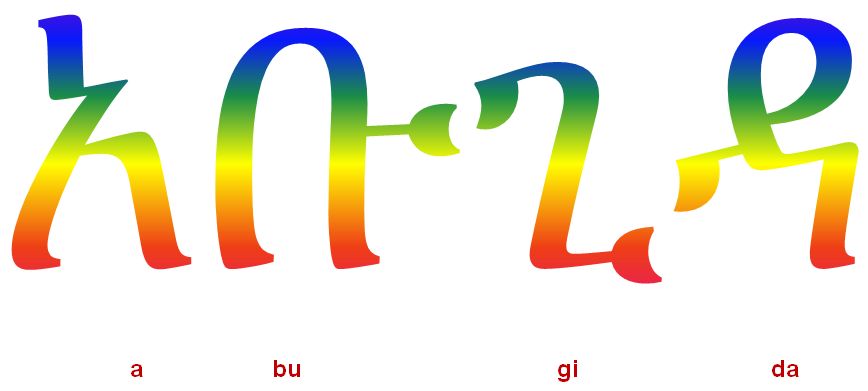
- The word 'abugida' derives from the first four letters of the Geʽez script: 'ä, bu, gi, da', similar to how 'alphabet' comes from Greek 'alpha, beta'.
- Peter T. Daniels proposed the term 'abugida' in his 1990 typology of writing systems.
- ʼPhags-pa is typically classified as an alphasyllabary (abugida) despite its linear vowel attachment, so it is both an abugida and an alphasyllabary.
- In the Brahmic family, the term 'akshara' is used for the units of the writing system.
Core Mechanics: The Consonant-Anchored Syllable
An abugida is a segmental writing system built around a single organizing principle: every written unit is anchored to a consonant, and the vowel that accompanies it is treated as secondary information. Rather than granting vowels the same independent status as consonants (as a full alphabet does) or omitting them entirely (as an abjad does), an abugida encodes consonant–vowel sequences as unified graphemes. The base letter carries an inherent or implicit vowel, and any deviation from that default is signaled through diacritical marks or subtle modifications to the letter's shape. This stands in clear contrast to a syllabary, where a single symbol represents an entire consonant-plus-vowel pairing without any hierarchical relationship between the two sounds. In everyday, less formal usage, people may lump abugidas, alphabets, and abjads together under the umbrella term "alphabet," but linguists draw sharp boundaries between these categories. The system's elegance lies in its economy: one consonant letter, a handful of diacritics, and a consistent rule for the default vowel together cover the full range of syllabic possibilities in a language.
A Contested Name: The Long Road to 'Abugida'
The label we now use for this script type was far from inevitable. In 1948, two scholars independently proposed related concepts: James Germain Février coined the French term néosyllabisme, while David Diringer introduced the English word semisyllabary. A decade later, in 1959, Fred Householder entered the conversation with the phrase pseudo-alphabet. It was not until 1990 that Peter T. Daniels settled on the Ge'ez-derived word abugida, drawn from the first four letters of the Ethiopic alphabet—ä, bu, gi, da—mirroring how "alphabet" comes from Greek and "abjad" from Arabic. Other proposed names include William O. Bright's alphasyllabary (1997), Faber's lengthy "segmentally coded syllabically linear phonographic script," and Gnanadesikan, Rimzhim, Katz, and Fowler's suggestion of aksara or āksharik. The terminology matters because Daniels' and Bright's formal definitions do not fully overlap: ʼPhags-pa qualifies as an abugida but not an alphasyllabary, while modern Lao is the reverse, having no inherent vowel and placing vowel marks in positions that do not follow the temporal order of speech.
Beyond the Simple Syllable: Handling Linguistic Complexity
The clean CV model breaks down quickly in real language. Syllables consisting of a lone vowel present the first challenge: some abugidas deploy a zero-consonant placeholder, while others—most Indic scripts—assign each vowel its own independent letter, which can look entirely different from the dependent diacritic used after a consonant. Through the spread of writing systems, these independent vowels have even come to mark syllables that begin with a glottal stop, even in non-initial positions. Consonant clusters before a vowel (CCV) and syllables ending in a consonant (CVC) introduce further complications. For final consonants, scripts may employ a virama to explicitly cancel the inherent vowel, simply omit vowel marking (risking ambiguity with the default vowel), mark a neutral schwa, or use a visually unrelated letter. In some cases, the apparent absence of a vowel reflects diachronic loss through syncope or apocope, as in Hindi. For CCV clusters, the earliest Indic solution was to stack the two consonants vertically, writing the second beneath the first.
Three Families, One Principle: The Geographic Reach of Abugidas
Despite their shared structural logic, abugidas appear in three geographically and historically distinct script families. The largest is the Brahmic family, spanning Tibet, South Asia, and Southeast Asia, where the individual units are traditionally called akshara. The second is the Semitic Ethiopic family, the very script from which the term abugida itself is drawn, and which serves as the writing system for numerous languages across Ethiopia and Eritrea. The third is the Canadian Aboriginal syllabics, a more recent development that nonetheless follows the same consonant-anchored, vowel-as-modification principle. In all three families, the written units may represent either full syllables or bare consonants, depending on the linguistic context. What unites them is the hierarchical relationship between consonant and vowel: the consonant is the primary, independent sign, while the vowel is a dependent, secondary element attached to it. This shared architecture, arising independently across different regions and eras, makes the abugida one of the most widespread and structurally coherent categories in the typology of writing systems.
Gallery
Frequently Asked Questions
What is an abugida?
An abugida is a segmental writing system in which each base character encodes a consonant together with a default vowel, and all other vowels are signaled through secondary marks attached to that consonant. It occupies a middle ground between full alphabets and abjads in terms of how explicitly vowels are represented.
How does an abugida differ from an alphabet?
In an alphabet every consonant and vowel is an independent, equally weighted letter, while in an abugida the consonant is the structural anchor and vowels are subordinate diacritical modifications. This gives abugidas a smaller core inventory but a richer positional system for marking vowel quality.
Who coined the term 'abugida' and when?
Peter T. Daniels introduced the label in 1990 as a typological category for classifying writing systems. The word is borrowed from Geʽez, the classical language associated with the Ethiopic script tradition.
Which major script families fall under the abugida classification?
The Brahmic family (encompassing Devanagari, Tamil, Burmese, and dozens of others) is by far the largest group, joined by the Semitic-derived Ethiopic scripts and the Canadian Aboriginal syllabics. Together these three lineages cover the overwhelming majority of scripts identified as abugidas.
Why is the abugida category useful for linguists?
It gives a precise typological slot for scripts where vowels are structurally secondary rather than fully independent, which clarifies how a writing system encodes phonological information. The label also helps trace historical development, such as how Brahmic scripts evolved from earlier abjad ancestors while adding systematic vowel marking.
More in Writing Systems 1-24
Spotted an error? Know more?
Reader corrections go straight into our review queue. Suggest an edit · How this site is sourced