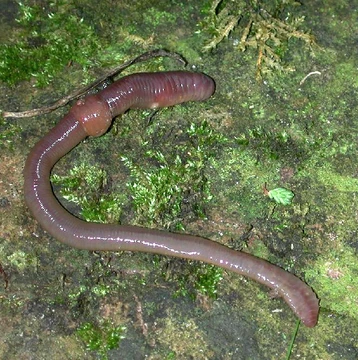
Onychophora
Velvet worms are terrestrial predators that capture prey with adhesive slime.

Internet Archive Book Images · No restrictions
Onychophora, commonly known as velvet worms, is a phylum of long, soft-bodied, many-legged animals. They are among the few animal phyla with exclusively terrestrial extant members, though other phyla such as Nematoda, Tardigrada, and Rotifera also have many terrestrial species. Velvet worms are considered close relatives of arthropods and tardigrades, forming the clade Panarthropoda, making them of paleontological interest for reconstructing the ancestral arthropod body plan.
Quick Facts
- Taxon
- Onychophora
Facts from the source article.
Lore & Background
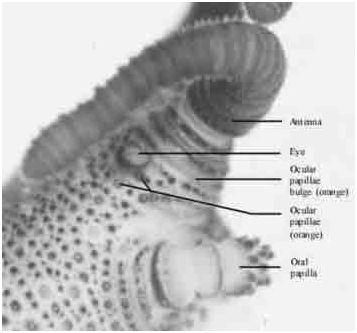
Velvet worms have a peculiar distribution: peripatids are predominantly equatorial and tropical, while peripatopsids are all found south of the equator. Their skin consists of numerous fine transverse rings and is often colored orange, red, or brown, but sometimes bright green, blue, gold, or white. They have a pair of slender antennae on the first head segment and a pair of simple eyes at their base, except in a few blind species. On the belly side of the second head segment is the labrum, a muscular outgrowth of the throat used for feeding. Deep within the oral cavity lie sharp, crescent-shaped jaws that move backward and forward to tear apart prey. On the third head segment are two oral papillae, each containing a large, branched slime gland that secretes a milky-white slime used to ensnare prey and for defense. The slime is ejected at speeds of 3 to 5 m/s, forming a net of threads about twenty microns in diameter. The slime can account for up to 11% of the organism's dry weight and is 90% water, with a dry residue mainly of proteins, including a collagen-type protein.
Reader's Guide
Velvet worms are significant as the only extant animal phylum entirely restricted to terrestrial environments, offering unique insights into the evolution of terrestrial life. Their close relationship to arthropods and tardigrades within Panarthropoda makes them crucial for understanding the ancestral body plan of arthropods, a major group that includes insects, crustaceans, and chelicerates. Only three fossil species are confidently assigned as onychophorans or close relatives: Antennacanthopodia from the Early Cambrian, Antennipatus from the Late Carboniferous, and Cretoperipatus from the Late Cretaceous. Their unusual distribution—peripatids in equatorial and tropical regions, peripatopsids south of the equator—raises questions about historical biogeography. The slime ejection mechanism, involving a geometric amplifier and passive oscillatory motion of the oral papillae, is a remarkable biological adaptation. Velvet worms are also notable for their mating behaviors and, in some species, bearing live young. Their segmented body plan, with unstructured lobopods, and the specification of segmentation by the same gene as in other animal groups, provide comparative developmental insights. The slime's composition, including the surfactant nonylphenol (which Onychophora are the only organisms known to produce), adds to their biochemical uniqueness.
Did You Know?
- They eject adhesive slime at speeds of 3 to 5 m/s, which forms a net of threads about twenty microns in diameter.
- Nonylphenol is a synthetic industrial compound, not naturally produced by velvet worms or any other organism.
Taxonomic Paradox and the 'Worm' Label
Onychophora occupy a peculiar position in the history of biological classification. In 1758, Carolus Linnaeus assembled his Systema Naturae and placed all non-arthropod invertebrates into a single class he called Vermes. Jean-Baptiste Lamarck, working in the 1790s, famously dismissed this catch-all as 'une espèce de chaos'—a sort of chaos—and began splitting it into separate phyla. Yet even after two centuries of taxonomic revision, Onychophora still find themselves lumped under the informal, polyphyletic banner of 'worms,' a term that traces back to the Old English word wyrm. The irony is sharp: these animals are called worms in a tradition that originally denoted serpents and mythical dragons, yet they are invertebrate, bilateral creatures whose informal relatives span flatworms, roundworms, and segmented annelids. The label persists not because of any shared ancestry but because of a shared body shape that, in Onychophora's case, is complicated by the very feature that sets them apart: their legs.
Morphological Distinction Among Worms
The defining image of a worm in biology is a long, cylindrical, tube-like body devoid of limbs and eyes. Onychophora, however, break that template. They are bilateral invertebrates, yes, and they are routinely slotted into the same informal 'worm' category as annelids, nematodes, and flatworms. But they carry stubby legs—short appendages that immediately distinguish them from the limbless majority of their namesakes. This legged quality links them, in taxonomic shorthand, to the lobopodians: an informal assemblage of extinct panarthropods that ranged from the Cambrian through the Carboniferous and were themselves described as 'worm-like animals' despite sporting their own stubby lobopods. The parallel is explicit in the literature; Onychophora are the extant echo of that ancient, legged, worm-like body plan. In a world where 'worm' implies smooth, legless, and eyeless, the velvet worm stands as a persistent exception, a creature that keeps the name while quietly defying its expectations.
Deep Time and the Lobopodian Thread
The lobopodians represent one of the most striking chapters in the story of worm-like animals. These extinct panarthropods lived from the Cambrian period through the Carboniferous, and they are routinely described in the literature as 'worm-like animals.' The description is paradoxical: these creatures possessed legs, specifically stubby lobopods, which contradicts the limbless stereotype the word 'worm' carries. Onychophora inherit this paradox directly. They are the extant counterpart to that ancient assemblage, the living reminder that the boundary between 'worm' and 'legged animal' was never as clean as the name suggests. Both groups—lobopodians and Onychophora—share the informal label, the bilateral body plan, and the stubby appendages that make them outliers in a category defined by the absence of such structures. In this sense, the velvet worm is not merely a worm with legs; it is a thread connecting a Cambrian body plan to the present day, a surviving expression of a morphological idea that the rest of the animal kingdom largely abandoned.
Cultural Sediment of the Name
The word that Onychophora carry in their common name—'velvet worm'—descends from the Old English wyrm, a term that originally referred to carnivorous reptiles, serpents, and the mythical dragons of folklore. Over centuries, the word drifted from a name for fearsome creatures into a catch-all for small, soft-bodied invertebrates, and eventually into a pejorative epithet for a cowardly, weak, or pitiable person. Onychophora inherit all of this cultural sediment. They are called worms in a language where 'worm' once meant dragon and now can mean a contemptible human being. In medical contexts, the related term 'helminth' narrows the focus to parasitic roundworms and tapeworms, and 'deworming' refers to killing off such parasites with anthelmintic drugs—a clinical vocabulary that has no bearing on the velvet worm. Yet the cultural weight of the word remains: a creature with stubby legs, bilateral symmetry, and a name that evokes everything from prehistoric monsters to the lowest rung of human insult.
Gallery
More in Worms And Worm-Like Invertebrates 1-23
Spotted an error? Know more?
Reader corrections go straight into our review queue. Suggest an edit · How this site is sourced