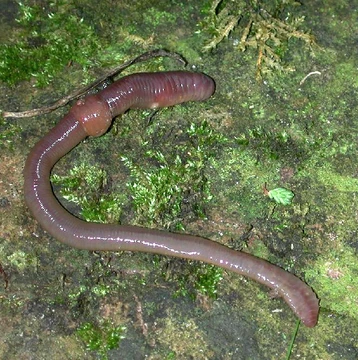
Nematode
Roundworms that dominate Earth's ecosystems in number and diversity.

DataBase Center for Life Science (DBCLS) · CC BY 4.0
Nematodes, also known as roundworms or eelworms, constitute the phylum Nematoda. They inhabit a broad range of environments, with most species free-living and feeding on microorganisms, though many are parasitic. Parasitic nematodes are the cause of soil-transmitted helminthiases. They are classified with arthropods, tardigrades, and other moulting animals in the clade Ecdysozoa. Nematodes have successfully adapted to nearly every ecosystem, from marine and fresh water to soils, polar regions, tropics, and even deep below the Earth's surface. They are ubiquitous and often outnumber other animals in both individual and species counts, representing a significant portion of all animals on the ocean floor and accounting for about 80% of all individual animals on Earth.
Quick Facts
- Taxon
- Nematoda
Facts from the source article.
Lore & Background
The name nematode comes from Modern Latin nema- 'thread' and -odes 'like', rendering 'threadlike'. In 1758, Carl Linnaeus described nematodes of a few genera including Ascaris and Dracunculus, then included in the Vermes. The group name Nematoda came from Nematoidea, defined by Karl Rudolphi in 1808. Initially, Nematoidea erroneously included both nematodes and Nematomorpha, attributed by Karl Theodor Ernst von Siebold in 1843. Along with Acanthocephala, Trematoda, and Cestoidea, it formed the obsolete group Entozoa. In 1861, Karl Moriz Diesing treated the group as order Nematoda. In 1877, the taxon Nematoidea was promoted to phylum by Ray Lankester. The first clear distinction between nemas and gordiids was made by František Vejdovsky in 1886, naming the horsehair worms order Nematomorpha.
Reader's Guide
Nematodes are of immense significance due to their numerical dominance, diversity, and ecological roles. They represent 90% of all animals on the ocean floor and account for about 80% of all individual animals on Earth. An estimated 4.4 × 10^20 nematodes inhabit the topsoil, or roughly 60 billion per human. Their presence at various trophic levels and in nearly every ecosystem—from polar regions to deep gold mines—points to crucial roles in nutrient cycling and ecosystem functioning. Many nematodes are parasitic, including pathogens in most plants and animals; about 35 species are human parasites, causing soil-transmitted helminthiases. The difficulty in distinguishing species leads to uncertain estimates: a 2013 survey suggested over 25,000 species, while a 1993 article estimated over a million. Later work using rarefaction curves and DNA barcoding places the figure closer to one million. Their study has advanced understanding of phylogeny, as they are part of Ecdysozoa, and their reduced Hox genes compared to sister phylum Nematomorpha provides insight into evolutionary development. The roughly 2,271 genera are placed in 256 families, with a third occurring as vertebrate parasites.
Did You Know?
- Nematodes are among the most abundant animals on the ocean floor, though their exact percentage varies by habitat and is not consistently 90% across all studies.
- An estimated 4.4 × 10^20 nematodes inhabit Earth's topsoil, approximately 60 billion for each human.
- Nematodes have been found 0.9–3.6 km below the Earth's surface in gold mines in South Africa.
- About 20–25 nematode species are human parasites.
Taxonomic Chaos and Reorganization
The very idea of a unified 'worm' category is one of taxonomy's most instructive failures. When Carl Linnaeus published his Systema Naturae in 1758, he laid out the first truly hierarchical animal classification, dividing creatures into kingdoms and then into classes. Among those classes sat Vermes—a catch-all bucket for every invertebrate that was not an arthropod. Jean-Baptiste Lamarck inherited this grouping and, by 1793, frankly called it 'une espèce de chaos,' a kind of chaos. He broke it apart into worms, echinoderms, and polyps. By 1809, in his Philosophie Zoologique, Lamarck had carved out nine phyla beyond vertebrates and molluscs, including annelids, crustaceans, arachnids, insects, radiates, polyps, and infusorians. Meanwhile, Linnaeus's other classes—Pisces, Amphibia, Aves, Mammalia—were eventually folded into a single phylum, Chordata, while his Insecta (which had swallowed crustaceans and arachnids) was itself split. The old Vermes, once a convenient label, is now recognized as paraphyletic, a reminder that early naturalists were sorting the animal kingdom by appearance rather than ancestry.
A Spectrum of Form and Scale
Worms are defined less by shared ancestry than by a shared silhouette: a long, cylindrical, tube-like body without limbs and, in most cases, without eyes. Yet the range of sizes within that silhouette is staggering. At one extreme sit microscopic vinegar eelworms; at the other, the marine bootlace worm Lineus longissimus stretches to a reported 58 metres. The African giant earthworm, Microchaetus rappi, reaches 6.7 metres, while marine bristle worms (polychaetes) exceed a metre. Free-living species avoid open land, instead inhabiting oceans, freshwater bodies, or burrowing beneath the soil. The three principal phyla each carry a distinct body plan: Platyhelminthes present a flat, ribbon-like form with a pair of frontal eyes; Nematoda produce slender threadworms, hookworms, and roundworms; Annelida build segmented bodies divided into visible rings, as seen in earthworms and sea bristle worms. Beyond these, the informal 'worm' label also covers nemerteans, chaetognaths, priapulids, and a host of insect larvae.
Parasitism and the Medical World
A significant slice of worm biology is devoted to living inside the bodies of other animals, a niche that has made these creatures central to medicine. In clinical language, the word 'helminth' is the preferred term for parasitic worms, most often pointing to roundworms (Nematoda) and tapeworms (Cestoda). The field dedicated to studying them is helminthology, while nematology focuses specifically on nematodes. A vivid example is the Guinea worm, which burrows beneath the skin of the feet and legs of people in tropical regions. When a person, a dog, or a horse is said to 'have worms,' the meaning is a parasitic infestation, typically by roundworms or tapeworms. The standard response is deworming: administering anthelmintic drugs to kill the parasites. It is worth noting a common confusion—ringworm, despite its name, is not a worm at all but a fungal skin condition. The parasitic lifestyle of certain nematodes and flatworms, including flukes, makes them persistent challenges in public health, particularly in warm, tropical climates.
Cultural Echoes and Everyday Language
The word 'worm' carries a long cultural shadow that stretches far beyond biology. In Old English, 'wyrm' referred not to soil-dwelling invertebrates but to carnivorous reptiles, serpents, and mythical dragons. By the 13th century, European naturalists like Vincent of Beauvais, in his Mirror of Nature, lumped worms into a broad reptile category alongside snakes, lizards, amphibians, and even 'various fantastic monsters.' In everyday speech, the term has become a catch-all: larvae of insects (railroad worms, woodworms, glowworms, bloodworms, butterworms, inchworms, mealworms, silkworms, woolly bear worms), millipedes, centipedes, shipworms, and even vertebrates such as caecilians and the legless slowworm lizard Anguis are all colloquially called worms. The word also serves as a pejorative for a cowardly or pitiable person. On a practical note, worms are farmed to produce nutrient-rich vermicompost. Even extinct lobopodians and the living velvet worms (Onychophora) are dubbed 'worm-like' despite possessing stubby legs.
Gallery




More in Worms And Worm-Like Invertebrates 1-23
Spotted an error? Know more?
Reader corrections go straight into our review queue. Suggest an edit · How this site is sourced