
Soviet invasion of Manchuria
Soviet offensive that helped end World War II in the Pacific.

Tazadeperla · CC BY-SA 3.0
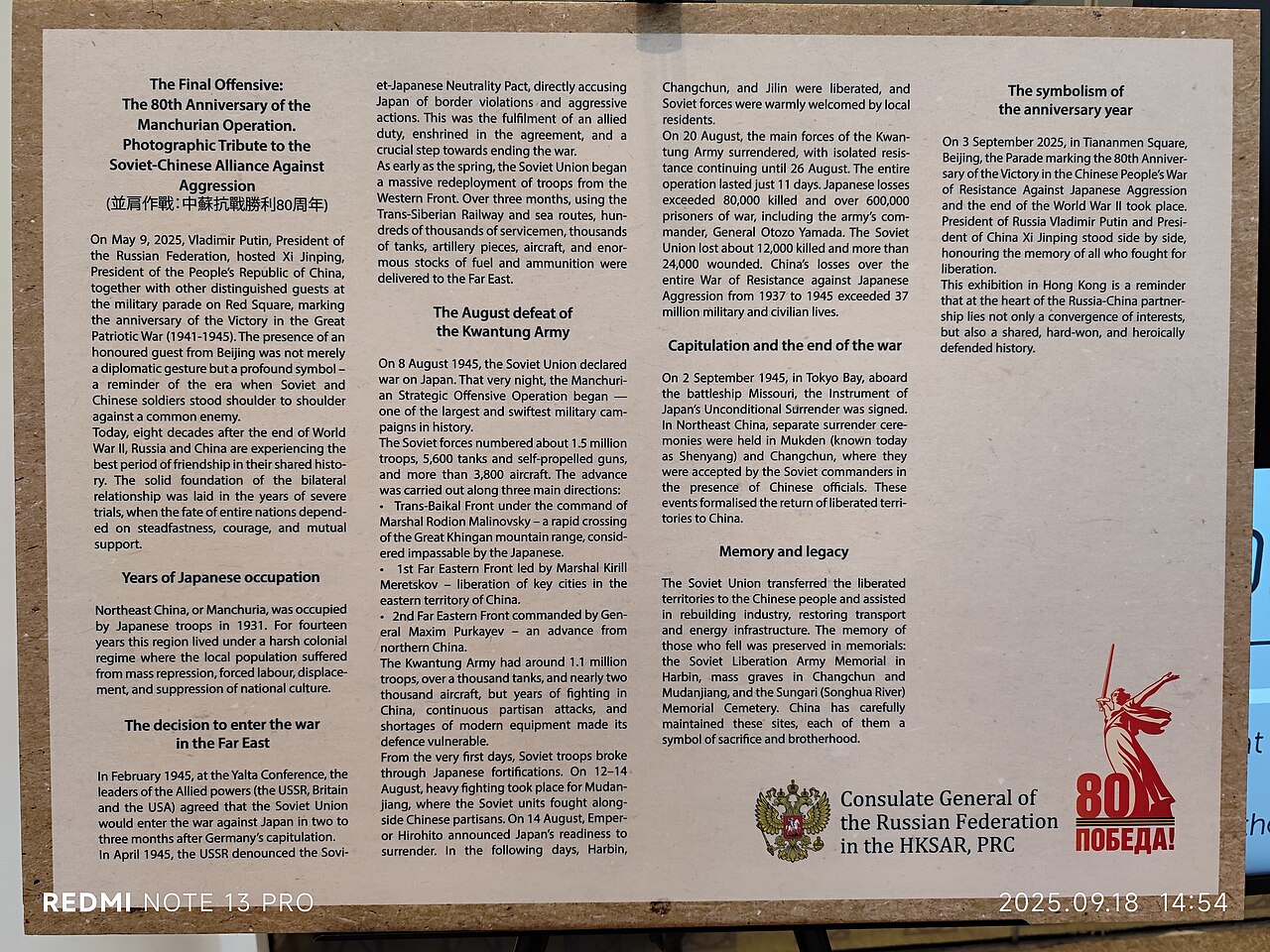
The Soviet invasion of Manchuria, formally known as the Manchurian Strategic Offensive Operation, began on 9 August 1945 with the Soviet Union's invasion of the Empire of Japan's puppet states of Manchukuo and Mengjiang. It was the largest campaign of the 1945 Soviet–Japanese War, resuming hostilities after almost six years of peace. The invasion is often considered a major factor, alongside the atomic bombings, in the Japanese government's decision to surrender unconditionally by 15 August.
Quick Facts
- Conflict
- Soviet invasion of Manchuria
- Part Of
- the Soviet–Japanese War of World War II
- Location
- Manchuria, Inner Mongolia, and northern Korea
- Result
- Soviet victory
Facts from the source article.
Lore & Background
The invasion began two days after the atomic bombing of Hiroshima and one day before the atomic bombing of Nagasaki. The Soviet entry into the war against Japan and the defeat of the Kwantung Army are often considered a major factor, alongside the atomic bombings, in the Japanese government's decision to surrender unconditionally by 15 August. The Japanese government had previously hoped the Soviet Union would act as a third party to negotiate a conditional surrender. The Kwantung Army officially surrendered on 16 August, though fighting continued until 2 September.
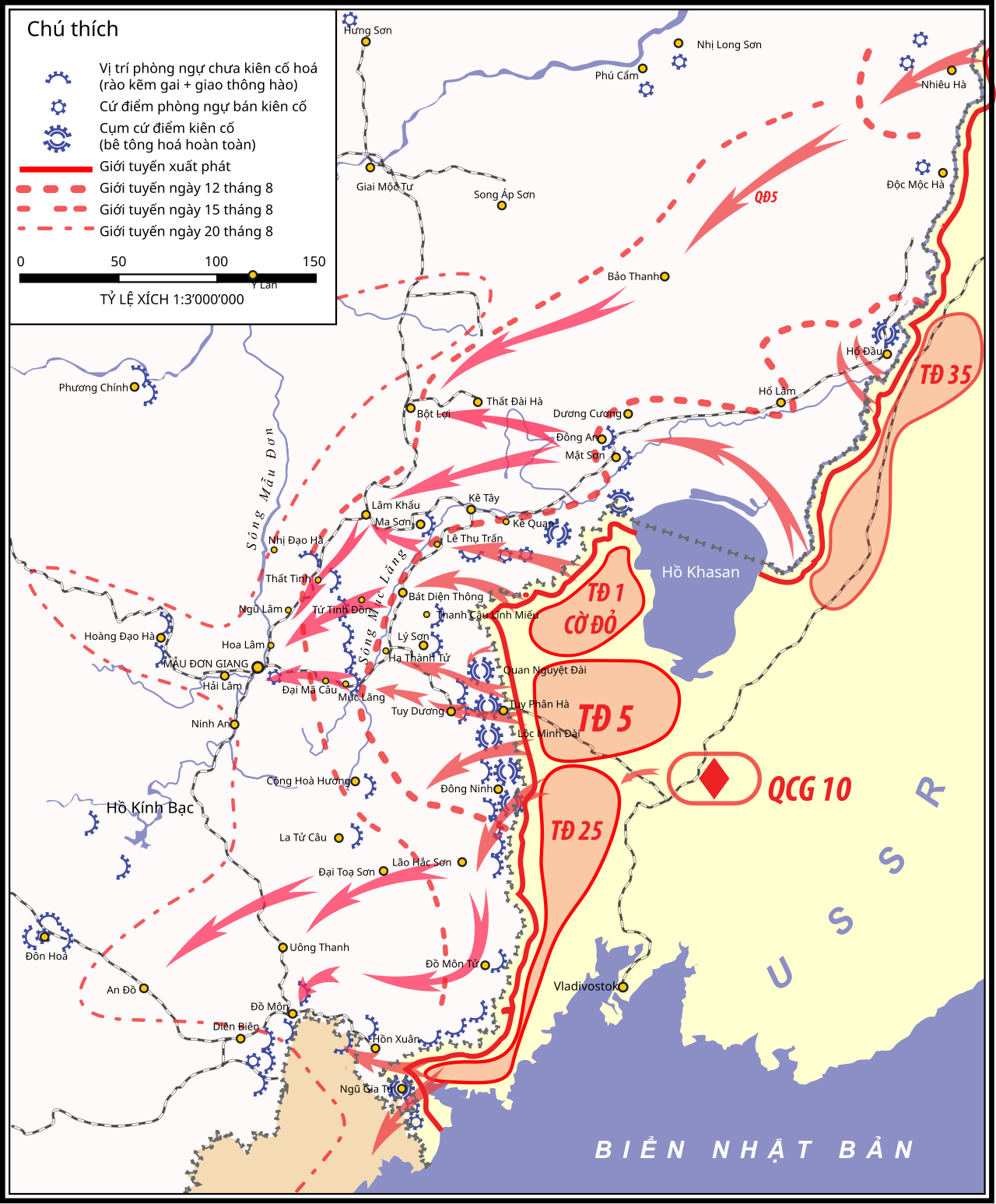
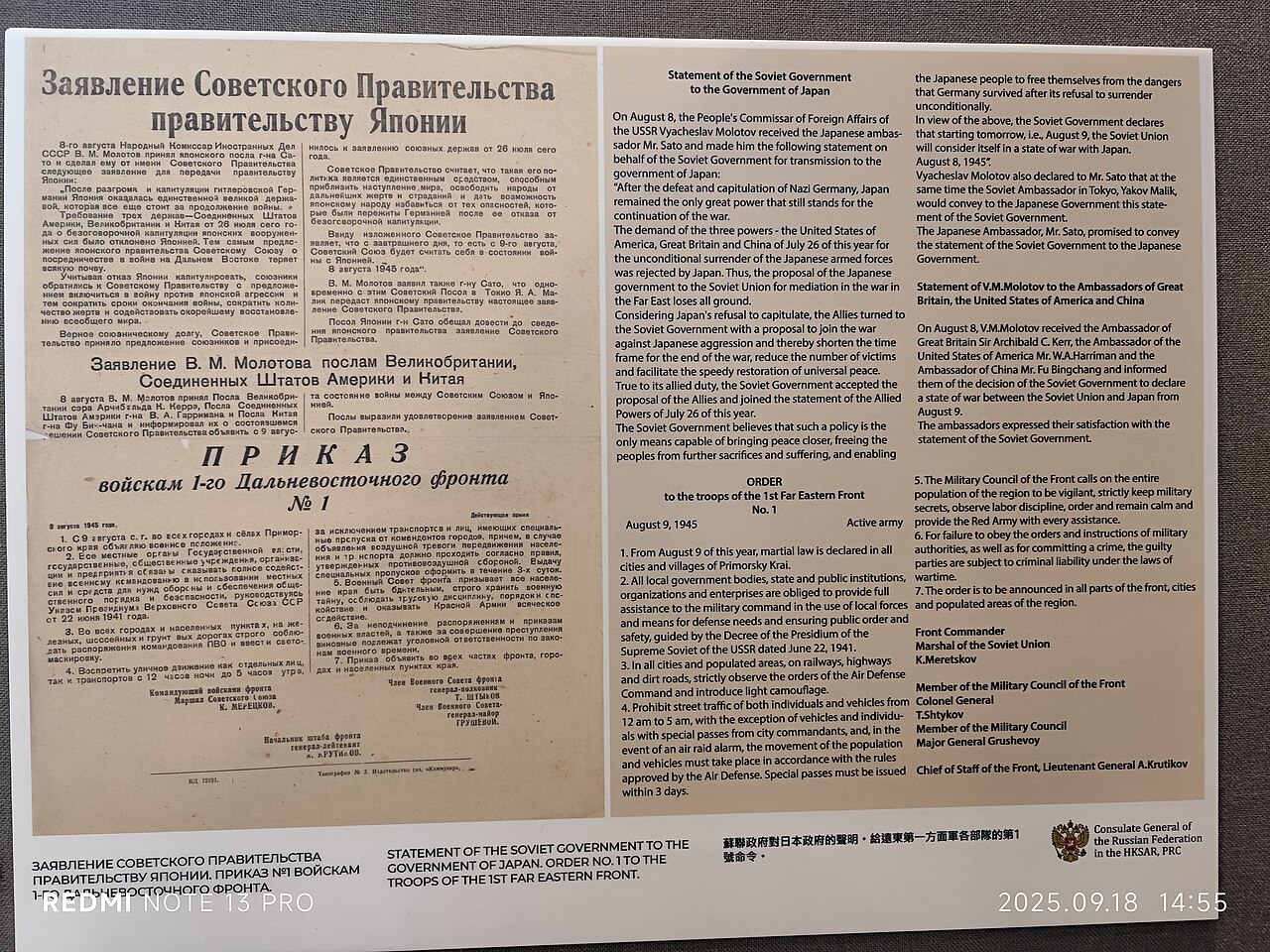
As agreed with the United Kingdom and the United States at the Tehran Conference in November 1943 and the Yalta Conference in February 1945, the Soviet Union entered the Pacific Theatre within three months of the end of the war in Europe. The invasion began on 9 August 1945, exactly three months after the German surrender on 8 May. At 5 p.m. Moscow time on 8 August, Soviet foreign minister Vyacheslav Molotov informed Japanese ambassador Naotake Satō that the Soviet Union had declared war. At one minute past midnight Trans-Baikal time on 9 August, the Soviets commenced their invasion simultaneously on three fronts.
The Soviet Union occupied Manchuria and the Japanese Mengjiang puppet state. The Soviet Navy launched an amphibious assault capturing the northern half of Japanese-occupied Korea. On 14 August it signed the Sino-Soviet Treaty of Friendship and Alliance with the Kuomintang government. The resumption of full-scale conflict in the Chinese Civil War prompted the Red Army to withdraw by 3 May 1946, handing much of Manchuria and Inner Mongolia to territories controlled by the Chinese Communist Party. The Soviets continued to occupy northern Korea until 1948 and the Port Arthur naval base until 1955.
Reader's Guide
The Soviet invasion of Manchuria was a decisive military campaign that directly contributed to Japan's unconditional surrender in August 1945. By fulfilling the agreements made at Tehran and Yalta, the Soviet Union opened a second front against Japan just as the atomic bombings were occurring, eliminating any hope Japan had of negotiating a conditional peace through Soviet mediation. The rapid defeat of the Kwantung Army and the occupation of Manchuria, Inner Mongolia, and northern Korea reshaped the geopolitical landscape of East Asia. The Soviet withdrawal from Manchuria in 1946, handing territory to the Chinese Communist Party, influenced the Chinese Civil War. The capture of Unit 731 scientists and their subsequent trial in Khabarovsk highlighted the use of biological warfare research. The occupation of northern Korea until 1948 set the stage for the division of the Korean Peninsula. The campaign demonstrated the strategic importance of coordinated Allied timing and the Soviet Union's role in ending World War II.
Strategic Timing and Diplomatic Foundations
The Soviet decision to strike Japan was not a spontaneous reaction to the atomic bombings but the culmination of a carefully negotiated sequence. At Tehran in November 1943 and Yalta in February 1945, Stalin committed the USSR to entering the Pacific conflict within three months of Germany's defeat. The German surrender on 8 May 1945 set the clock in motion, and by early August Soviet commanders were already positioning for an assault. Marshal Vasilevsky reported to Stalin on 3 August that an attack could commence as early as the 5th. The invasion ultimately launched on 9 August, precisely three months after the European victory. On the evening of 8 August, Foreign Minister Molotov delivered the declaration of war to Japanese ambassador Naotake Satō, and just over an hour later, at one minute past midnight Trans-Baikal time, Soviet forces surged forward. The fact that this fell between the Hiroshima and Nagasaki bombings was, as the planning timeline suggests, largely incidental to the broader diplomatic schedule that had been fixed months earlier.
The Three-Front Assault and the Kwantung Army
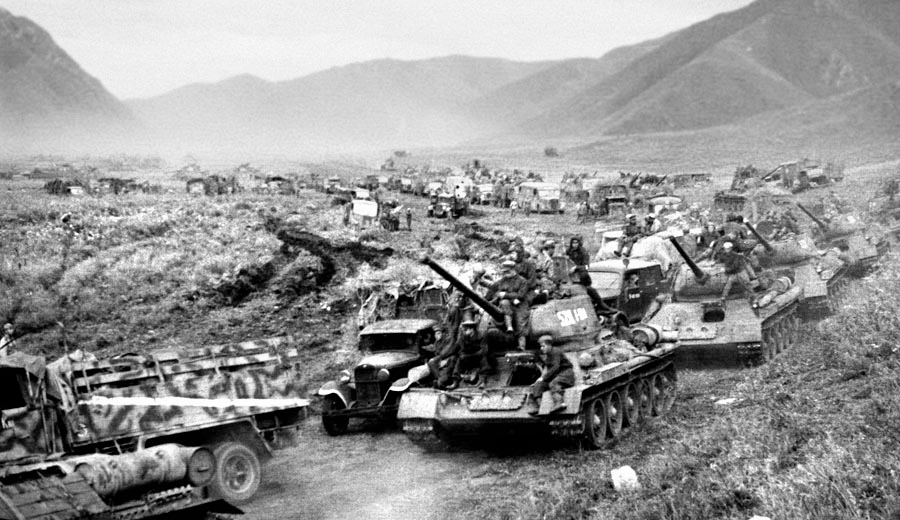
The Manchurian Operation was the largest campaign of the 1945 Soviet-Japanese War, which had resumed hostilities after nearly six years of relative peace. Soviet forces struck simultaneously along three axes on 9 August: the Khingan-Mukden Offensive in the Lesser Khingan-Mukden region, the Harbin-Kirin Offensive in the Harbin-Jilin area, and the Sungari Offensive. Together these operations enveloped the Kwantung Army, the Japanese force that had garrisoned Manchukuo and Mengjiang since the 1930s. The Kwantung Army formally surrendered on 16 August, yet sporadic fighting persisted until 2 September, the day the Japanese Instrument of Surrender was signed. The speed and coordination of the Soviet advance shattered what had been considered one of Japan's most formidable regional military formations, effectively ending organized Japanese resistance in the Far East.
The Surrender Question and Broken Mediation Hopes
For months before the invasion, Tokyo had pinned its hopes on Soviet diplomacy. Japanese leaders believed Moscow might serve as a neutral intermediary, brokering a conditional surrender that would preserve the emperor and limit Allied occupation terms. The Soviet entry into the war on 8 August shattered that expectation almost overnight. The combined shock of the atomic strikes on Hiroshima and Nagasaki, coupled with the rapid collapse of the Kwantung Army, is widely regarded as the decisive combination that pushed the Japanese cabinet toward unconditional surrender by 15 August. The Neutrality Pact of April 1941, which had allowed both sides to avoid a two-front war while Germany was still fighting, was effectively rendered obsolete. Stalin's earlier dilemma—securing Far Eastern territorial gains without opening a second front—had been resolved by the German capitulation, freeing Soviet resources to be redirected eastward in a manner that fundamentally altered Japan's strategic calculus in the war's final days.
Occupation, Withdrawal, and the Shadow of Unit 731
In the aftermath, Soviet forces occupied Manchuria, the Mengjiang puppet state in Inner Mongolia, and launched an amphibious operation to seize the northern half of Japanese-held Korea, where they established a Soviet Civil Administration. On 14 August, the USSR signed the Sino-Soviet Treaty of Friendship and Alliance with the Kuomintang government. The resumption of full-scale Chinese Civil War compelled the Red Army to withdraw by 3 May 1946, ceding much of Manchuria and Inner Mongolia to areas under Chinese Communist control. The Soviets retained a presence in northern Korea until 1948 and held the Port Arthur naval base until 1955. Perhaps the most troubling legacy involved the capture of scientists from the Kwantung Army's Unit 731, the notorious biological and chemical warfare division. These individuals faced the 1949 Khabarovsk war crimes proceedings, yet evidence suggests the Soviets simultaneously exploited their research and expertise for their own biological weapons program.
Gallery
Frequently Asked Questions
What was the Soviet invasion of Manchuria?
It was a large-scale Soviet military offensive directed at Japan's puppet states of Manchukuo and Mengjiang, formally designated the Manchurian Strategic Offensive Operation. The campaign marked the resumption of armed conflict between the two nations after nearly six years of peace.
When did the Soviet invasion of Manchuria begin?
The offensive launched on 9 August 1945, making it one of the very last military operations of World War II in the Pacific. It was the largest single campaign of the 1945 Soviet–Japanese War.
Why is the Soviet invasion of Manchuria considered important?
Historians widely regard it, alongside the atomic bombings, as a decisive factor that pressured the Japanese government into accepting unconditional surrender by 15 August 1945. It effectively collapsed Japan's hold on its northeastern puppet territories.
What was the scale of the Soviet invasion of Manchuria?
It was the largest campaign of the 1945 Soviet–Japanese War, targeting the two Japanese puppet states of Manchukuo and Mengjiang across Northeast Asia. The operation represented a massive resumption of hostilities after almost six years of relative peace between the two countries.
How did the Soviet invasion of Manchuria help end World War II?
The offensive struck Japan's northeastern holdings at a critical moment, compounding the shock of the atomic bombings and pushing the Japanese leadership toward unconditional surrender by 15 August 1945. It is generally cited as one of the final military actions that closed out the Pacific war.
More in World War Ii Topics 1-17
Spotted an error? Know more?
Reader corrections go straight into our review queue. Suggest an edit · How this site is sourced