Urticarial vasculitis
Rare autoimmune disease with urticaria and anti-C1q antibodies.

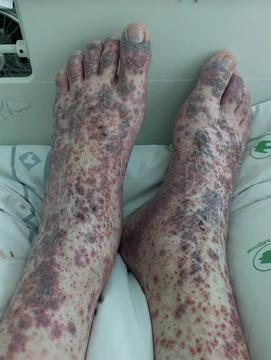
Urticarial vasculitis, also known as hypocomplementemic urticarial vasculitis syndrome (HUV), is a rare autoimmune skin condition characterized by fixed urticarial lesions that appear histologically as a vasculitis. First described in the 1970s, the disease involves anti-C1q antibodies that activate the complement pathway, leading to low levels of complement proteins and potential complications such as renal immune complex deposition.
- Field
- Dermatology, Immunology
- Known for
- Fixed urticarial lesions with vasculitis, anti-C1q antibodies, hypocomplementemia
- Diagnosis criteria
- Venulitis on skin biopsy, arthritis, ocular inflammation, abdominal pain, or positive C1q antibodies
- Treatment
- Corticosteroids, dapsone, colchicine, hydroxychloroquine, immunosuppressants, omalizumab, belimumab
Lore & Background
Urticarial vasculitis is a skin condition where fixed urticarial lesions show vasculitis on histology. The disease is linked to anti-C1q antibodies, which activate the complement pathway, causing low complement protein levels. These antibodies are autoantibodies against self proteins, not found in healthy individuals. In some cases, large immune complexes deposit in the kidney, especially with pre-existing renal conditions, due to macrophages' inability to bind the Fc portion of the C1q antibody. There is also speculation about an additional autoantibody against C1-inhibitor, leading to over-activation of the complement pathway and angioedema.
Reader's Guide
Urticarial vasculitis is significant as a rare autoimmune disorder that illustrates the interplay between autoantibodies and the complement system. Its diagnosis requires at least two criteria: venulitis on skin biopsy, arthritis, ocular inflammation, abdominal pain, or positive C1q antibodies. All patients test positive for anti-C1q antibodies, though the exact link between these antibodies and the disease is not thoroughly determined. Treatment remains nonspecific, involving corticosteroids, dapsone, colchicine, hydroxychloroquine, and immunosuppressants, with newer targeted medications like omalizumab and belimumab also used. The disease gained public attention through the 2010 documentary 'Fat, Sick and Nearly Dead.' Its legacy lies in highlighting the complexity of autoimmune vasculitides and the need for further research into targeted therapies.
Did You Know?
- Many HUV patients test positive for anti-C1q antibodies, but not all.
- The disease was first described in the 1970s.
More in Vasculitis 1-24
Spotted an error? Know more?
Reader corrections go straight into our review queue. Suggest an edit · How this site is sourced