Cryoglobulinemic vasculitis
Vasculitis from cold-insoluble immunoglobulins, often linked to hepatitis C.

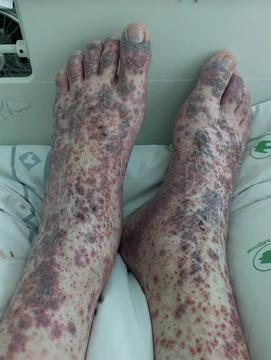
Cryoglobulinemic vasculitis is a condition where blood vessels become inflamed due to the buildup of abnormal proteins known as cryoglobulins. These proteins, which are immunoglobulins, remain dissolved at normal body temperature but turn solid and clump together when the temperature drops below 37 °C (98.6 °F). This clumping can block small blood vessels. The resulting inflammation is triggered by complement proteins that gather at these sites and set off inflammatory responses. The skin is the most common target, leading to a raised, pinpoint rash called purpura on the lower legs. The kidneys can also be affected, causing a type of kidney inflammation known as membranoproliferative glomerulonephritis.
The condition is rare and strongly linked to hepatitis C virus infection, with higher rates seen in Southern Europe. Only about 30% of people who have cryoglobulins in their blood actually develop vasculitis and its symptoms. In a study of 279 patients with hepatitis C-related disease, the average age at symptom onset was 54, and men and women were affected equally.
Cryoglobulinemia is categorized by the type of immunoglobulin involved—IgM or IgG—and whether it is monoclonal or polyclonal. Type II involves a mix of monoclonal IgM and polyclonal IgG, while type III consists of both IgM and IgG that are polyclonal. Both types have rheumatoid factor activity, meaning the IgM binds to the Fc part of IgG, which can activate complement proteins and deposit them in the lining of small and medium blood vessels. In contrast, type I cryoglobulinemia causes damage mainly through hyperviscosity syndrome, where the proteins clump and block vessels, reducing blood flow and potentially leading to tissue death if prolonged. Vasculitis itself typically only occurs in mixed types (II and III), as type I does not activate complement.
Most cases of cryoglobulinemic vasculitis are tied to an underlying condition, most often hepatitis C virus infection. Other associated conditions include Sjogren's syndrome, B-cell lymphoma, rheumatoid arthritis, systemic lupus erythematosus, and other hepatitis viruses. Type III is most frequently linked to autoimmune diseases.
At least half of those with cryoglobulinemic vasculitis have only mild symptoms. More severe cases can involve the kidneys, digestive tract, and nervous system, while heart and lung issues are rarer.
Quick Facts
- Field
- Hematology
Facts from the source article.
Lore & Background
Cryoglobulinemic vasculitis is classified by the type of immunoglobulin present: Type I involves monoclonal immunoglobulins causing hyperviscosity syndrome without complement activation, while Types II and III are mixed cryoglobulinemias with rheumatoid factor activity that activate complement and deposit in small and medium blood vessels. The large majority of cases are associated with underlying conditions, most commonly hepatitis C virus infection, but also Sjogren's syndrome, B-cell lymphoma, rheumatoid arthritis, systemic lupus erythematosus, and other hepatitis viral infections.
Reader's Guide
Cryoglobulinemic vasculitis represents a distinct form of vasculitis driven by abnormal immunoglobulin aggregation and complement activation. Its significance lies in its strong association with hepatitis C virus infection, which underlies most cases, and its potential to cause serious renal, neurological, and gastrointestinal damage. Diagnosis requires careful laboratory detection of cryoglobulins, which precipitate at 4 °C and redissolve at 37 °C, and assessment of complement levels and rheumatoid factor. Treatment involves immune modulator therapy, such as rituximab with glucocorticoids, and management of underlying conditions. The condition highlights the interplay between infectious agents, immune complexes, and vascular inflammation, with relapse risk studied in non-infectious cases.
Did You Know?
- Only about 30% of individuals with cryoglobulinemia develop vasculitis and associated symptoms.
- Type I cryoglobulinemia causes damage solely due to hyperviscosity syndrome, without complement activation.
- Approximately 20-40% of individuals with symptomatic cryoglobulinemic vasculitis eventually develop renal damage, usually years after initial diagnosis.
- Test tubes for cryoglobulin detection must be warmed to 37 °C before blood collection and stored at 4 °C for a week to allow precipitate formation.
Mechanism & Classification of Cryoglobulins
Cryoglobulinemic vasculitis stems from a peculiar temperature-dependent behavior of certain immunoglobulin proteins. At normal body temperature these proteins remain dissolved in the bloodstream, but once the environment drops below 37 °C they lose solubility and begin to clump together inside the tiniest blood vessels. In mixed cryoglobulinemia—types II and III—this process is compounded by a rheumatoid-factor-like interaction in which the Fc portion of IgM latches onto IgG, triggering a cascade of complement proteins that lodge in the endothelial lining of small and medium-sized vessels and ignite local inflammation. Type II cryoglobulinemia pairs a monoclonal IgM with polyclonal IgG, while type III involves polyclonal forms of both immunoglobulins. By contrast, type I cryoglobulinemia, driven by a single monoclonal species, does not activate complement at all. Instead it produces a hyperviscosity syndrome: the aggregated proteins physically obstruct flow, starving downstream tissues of adequate perfusion and, if the blockage persists, leading to outright necrosis. Because complement-mediated inflammation is absent in type I, true vasculitis is essentially confined to the mixed types.
Clinical Presentation & Disease Trajectory
The most visible hallmark of cryoglobulinemic vasculitis is a raised, pinpoint purpuric rash that typically appears on the lower extremities, though the condition reaches well beyond the skin. Patients frequently report fevers, aching muscles, joint pain, and signs of peripheral nerve injury. When the kidneys become involved, the damage takes the form of membranoproliferative glomerulonephritis, a finding that can emerge years after the initial diagnosis; roughly twenty to forty percent of symptomatic patients eventually develop this renal complication. At the milder end of the spectrum, at least half of all affected individuals experience only subtle symptoms, while more severe presentations can extend to gastrointestinal, neurological, and even cardiovascular or respiratory injury, though these are comparatively rare. A particularly sobering statistic is that only five to ten percent of people carrying hepatitis C–related cryoglobulins in their blood ever progress to overt symptoms. The disease can also relapse—meaning symptoms and inflammation reappear after a stretch of remission—and research into which immunoglobulin subtype predisposes a patient to such flare-ups remains an active area of investigation.
The Diagnostic Puzzle
Confirming cryoglobulinemic vasculitis is far from a straightforward blood draw. The cornerstone test requires that collection tubes be pre-warmed to 37 °C before any sample is taken; once the blood coagulates it is centrifuged, then the remaining plasma is held at 4 °C for an entire week. If cryoglobulins are truly present they will precipitate into a visible white sediment, and re-warming that sample back to body temperature should cause the precipitate to dissolve again. Despite this elegant principle, the procedure is technically demanding and prone to both false-positive and false-negative results. After the cryoglobulin layer is isolated, it must be immunofixed and labeled so clinicians can determine whether the case is type I, II, or III. Supporting laboratory work includes nonspecific inflammatory markers such as C-reactive protein and erythrocyte sedimentation rate, complement levels, rheumatoid factor activity, metabolic panels, urinalysis, and urine protein measurements to track renal function over time. Because the condition is so often secondary to another disease, physicians must also screen for viral RNA, autoantibodies, and malignant serological markers, and a tissue biopsy may be performed to look for immune-complex deposition in affected organs.
Epidemiology, Associations & Therapeutic Approach
Cryoglobulinemic vasculitis is an uncommon condition, and its incidence tracks closely with the geographic spread of hepatitis C virus infection, which is notably higher in Southern Europe. In a review of 279 patients whose symptomatic disease was linked to hepatitis C, the mean age at presentation was 54 years, and men and women were represented in roughly equal numbers. Importantly, only about thirty percent of people who carry cryoglobulins ever develop the vasculitic syndrome, underscoring that mere presence of the proteins is not sufficient. Beyond hepatitis C, the large majority of cases are tied to an underlying medical condition—Sjögren's syndrome, B-cell lymphoma, rheumatoid arthritis, systemic lupus erythematosus, and other viral hepatitis infections all feature in the differential. Type III cryoglobulinemia shows a particular affinity for autoimmune diseases. Treatment therefore operates on two fronts: managing the immune-driven inflammation with modulators such as rituximab combined with glucocorticoids to suppress B-cell proliferation and reduce cryoglobulin output, while simultaneously addressing the root cause. The principal risks of rituximab-based regimens include increased susceptibility to infection and the development of anemia.
Frequently Asked Questions
Who is Cryoglobulinemic vasculitis?
It is a rare small-vessel inflammatory disorder in which abnormal immunoglobulin proteins solidify below normal body temperature and obstruct tiny vessels. The lodged protein clumps recruit complement proteins, which then ignite a local inflammatory cascade. The condition strikes men and women at equal rates and most often announces itself around age 54 in its hepatitis C–linked form.
What is Cryoglobulinemic vasculitis known for?
Its hallmark 'attack' is a raised, pinpoint purpuric rash on the lower legs, but it also targets the kidneys (producing membranoproliferative glomerulonephritis), joints, muscles, and peripheral nerves. Patients frequently report fevers alongside the musculoskeletal and neurological symptoms. Three subtypes are recognized depending on whether the offending proteins are a single clone or a mix of monoclonal and polyclonal immunoglobulins.
Why is Cryoglobulinemic vasculitis important?
It acts as a critical clinical bridge between chronic viral infection and systemic small-vessel inflammation, reminding clinicians to screen for hepatitis C in anyone presenting with unexplained purpura plus kidney injury. Its low incidence makes it diagnostically tricky, yet recognizing it early prevents irreversible organ damage. The equal sex distribution and mid-50s onset window also help narrow the differential diagnosis.
What's Cryoglobulinemic vasculitis's backstory/origin?
In the overwhelming majority of cases, chronic hepatitis C virus infection is the 'villain' that drives the immune system to churn out the abnormal cryoglobulin proteins. Those proteins remain soluble at 37 °C but precipitate and clump whenever local tissue temperature dips below that threshold, lodging in small vessels and triggering complement activation. Type I involves a single immunoglobulin clone, while Types II and III involve mixed monoclonal or polyclonal immunoglobulin combinations.
More in Vasculitis 1-24
Spotted an error? Know more?
Reader corrections go straight into our review queue. Suggest an edit · How this site is sourced