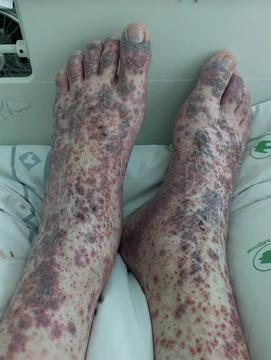
Behçet's disease
Chronic inflammatory disorder affecting multiple body systems.

Behçet's disease, also known as Behçet's syndrome, is a chronic inflammatory disorder that affects multiple parts of the body, including the mouth, genitals, eyes, joints, and occasionally the brain, spinal cord, and blood vessels. It was initially described by Turkish dermatologist Hulusi Behçet in 1937. The disease is characterized by painful sores on mucous membranes, eye inflammation, and arthritis, with symptoms that often come and go.
Quick Facts
- Pronounce
- b · ɛ · ˈ · tʃ · ɛ · t, tr · behˈtʃet · lang
- Field
- Rheumatology, Immunology
- Symptoms
- Mouth sores, genital sores, inflammation of the eye, arthritis, chronic fatigue
- Complications
- Blindness, joint inflammation, blood clots, aneurysm
- Onset
- 20s to 40s
- Duration
- Long term
- Causes
- Unknown
- Diagnosis
- Based on symptoms
- Differential
- Reactive arthritis, Stevens–Johnson syndrome, Sweet syndrome
- Medication
- Immunosuppressive medication such as corticosteroids
- Prognosis
- Often improves with time
- Frequency
- Rare (US, EU), more common (Middle East, Asia)
Facts from the source article.
Lore & Background
Behçet's disease is a type of inflammatory disorder that affects multiple parts of the body. The most common symptoms include painful sores on the mucous membranes of the mouth and other parts of the body, inflammation of parts of the eye, and arthritis. The sores can last from a few days up to a week or more. Less commonly there may be inflammation of the brain or spinal cord, blood clots, aneurysms, or blindness. Often, the symptoms come and go. The cause is unknown, but it is believed to be partly genetic and is not contagious. Diagnosis is based on at least three episodes of mouth sores in a year, together with at least two of the following: genital sores, eye inflammation, skin sores, or a positive skin prick test.
Reader's Guide
Behçet's disease is significant as a rare but serious inflammatory disorder that can lead to permanent vision loss in 20 percent of cases and life-threatening complications such as pulmonary artery aneurysm rupture. Although there is no cure, treatments include immunosuppressive medication such as corticosteroids and anti-TNFs, as well as lifestyle changes. Lidocaine mouthwash may help with pain, and colchicine may decrease the frequency of attacks. The disease is more common in the Middle East and Asia, with about 2 per 1,000 affected in Turkey, and onset is usually in a person's twenties or forties. Its legacy includes ongoing research into its autoimmune mechanisms and genetic associations, such as with HLA-B51 and the GIMAP gene family.
Did You Know?
- Nearly all people with Behçet's disease present with painful ulcerations inside the mouth.
- The disease is sometimes known as Silk Road disease due to its prevalence along old silk trading routes.
Clinical Presentation & Diagnostic Criteria
Behçet's disease is a multisystem inflammatory condition whose hallmark is the recurrence of painful ulcers on mucous membranes, particularly inside the mouth. Nearly every affected individual will experience these aphthous, non-scarring oral lesions, which can persist from a few days to over a week and tend to relapse throughout a person's life. Genital ulceration—typically around the anus, vulva, or scrotum—occurs frequently and leaves scarring in roughly three-quarters of patients. Skin manifestations such as erythema nodosum, pustular vasculitis, and pyoderma-gangrenosum-like lesions may also appear. Joint inflammation, usually a non-erosive arthritis of the large lower-extremity joints, affects up to half of those diagnosed. Because the disease is not contagious and its exact cause remains unknown, though a partial genetic contribution is suspected, clinicians rely on a clinical diagnostic framework: at least three episodes of oral sores within a single year, combined with at least two additional findings from a list that includes genital ulceration, ocular inflammation, characteristic skin lesions, or a positive skin-prick test.
Ocular & Neurological Complications
Among the most feared consequences of Behçet's disease are its effects on the eyes and the central nervous system. Ocular involvement may emerge early in the disease course and, in roughly one-fifth of cases, progresses to irreversible vision loss. The inflammatory process can take several forms: anterior uveitis, which brings painful redness, hypopyon, and diminished acuity; posterior uveitis, characterized by painless visual decline and floating shadows; and the rarer retinal vasculitis, which produces painless vision loss with possible visual-field defects. Optic-nerve damage, though uncommon, typically manifests as progressive atrophy and is the leading cause of visual impairment in this condition. Neurological involvement, while less frequent, carries a particularly grim prognosis. The most common presentation is chronic meningoencephalitis, with lesions localizing to the brainstem, basal ganglia, and deep white matter—patterns that can mimic multiple sclerosis. In chronic cases, brainstem atrophy becomes evident. The spectrum ranges from aseptic meningitis to dural sinus thrombosis, organic brain syndrome with confusion and seizures, and sudden sensorineural hearing loss. These neurological manifestations tend to appear late in the disease trajectory and are associated with a poor overall outlook.
Treatment & Systemic Management
No cure currently exists for Behçet's disease, so management focuses on suppressing the underlying immune-driven inflammation and alleviating symptoms. The mainstay of therapy involves immunosuppressive agents, including corticosteroids and anti-TNF biologics, often supplemented by lifestyle modifications. For the immediate discomfort of oral ulcers, lidocaine-based mouthwash can provide topical relief, while colchicine has shown value in reducing how often flare-ups occur. Beyond the more visible mucocutaneous and joint symptoms, the disease can quietly affect internal organs. Gastrointestinal involvement—abdominal pain, nausea, bloody or non-bloody diarrhea—tends to center on the terminal ileum and ileocecal valve, producing ulcers that may appear aphthous or punched-out, sometimes extending up to five centimeters. Pulmonary manifestations range from hemoptysis and pleuritis to the catastrophic rupture of a pulmonary-artery aneurysm, which can cause fatal hemorrhage. Renal complications, though rare, include glomerulonephritis, amyloidosis, and IgA nephropathy, while cardiac involvement can manifest as chronic aortic regurgitation from aortic-root disease. The episodic, multi-organ nature of the condition demands long-term, multidisciplinary monitoring.
Epidemiology & Historical Context
Although recognized worldwide, Behçet's disease shows a striking geographic distribution. It remains uncommon in the United States and most of Europe, yet prevalence climbs markedly across the Middle East and Asia. In Turkey, the country most closely associated with the condition, approximately two in every one thousand residents are affected. The disease typically announces itself during a person's twenties or forties, and while its precise etiology has never been fully elucidated, researchers believe a partial genetic predisposition plays a role. Importantly, the condition is not transmissible from person to person. The syndrome bears the name of Hulusi Behçet, a Turkish dermatologist who first described the constellation of findings in 1937. His observations laid the groundwork for what would become a recognized multisystem inflammatory disorder. Decades of subsequent research have expanded the clinical picture to include ocular, neurological, vascular, gastrointestinal, and renal manifestations, yet many questions about pathogenesis and optimal long-term therapy remain open. The geographic clustering and the partial genetic link continue to fuel investigations into why certain populations are disproportionately vulnerable, making Behçet's disease an active and evolving area of medical inquiry.
Frequently Asked Questions
Who is Behçet's disease?
Behçet's disease is a chronic, multi-system inflammatory condition first formally described in 1937 by Turkish dermatologist Hulusi Behçet. It can involve the mouth, genitals, eyes, joints, and occasionally the brain, spinal cord, or blood vessels.
What is Behçet's disease known for?
Its signature 'attacks' are painful mucosal ulcers, recurrent eye inflammation, and joint pain that flare in waves and then partially subside. It sits at the intersection of dermatology and rheumatology because of how broadly it targets tissue.
Where does Behçet's disease appear most?
The condition clusters strongly along the Middle East and Asian regions often called the Silk Road corridor. In Turkey specifically, roughly two in every one thousand people carry the diagnosis, making it one of the better-recognized vasculitic syndromes there.
Why is Behçet's disease important?
It remains a landmark small-vessel vasculitis and a core teaching example in rheumatology and dermatology. Its striking geographic clustering also makes it a valuable natural model for studying how genetic background and environment interact to drive autoimmune inflammation.
More in Vasculitis 1-24
Spotted an error? Know more?
Reader corrections go straight into our review queue. Suggest an edit · How this site is sourced