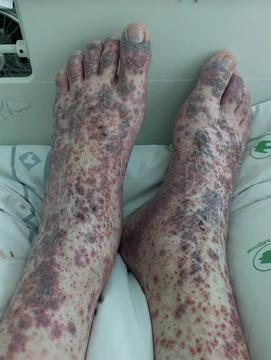
Granulomatosis with polyangiitis
Rare autoimmune vasculitis affecting respiratory tract and kidneys.

Granulomatosis with polyangiitis (GPA) is a rare, long-term autoimmune disease that causes inflammation of small- and medium-sized blood vessels (vasculitis) and the formation of clumps of inflammatory cells called granulomas. It most often affects the upper respiratory tract, lungs, and kidneys, though other organs can be involved. The condition was previously called Wegener's granulomatosis. If the heart, lungs, or kidneys are severely damaged, the disease can be fatal.
The exact cause of GPA is unknown. Genetics play a role, but the risk of inheriting the disease is low. Bacteria and viruses have also been suggested as possible triggers.
Symptoms vary widely depending on which blood vessels are affected. Early signs are often nonspecific, which can delay diagnosis. Nearly everyone with GPA has involvement of the nose or sinuses, leading to crusting, stuffiness, nosebleeds, a runny nose, and sometimes a “saddle-nose” deformity from a hole in the nasal septum. Eye inflammation—such as scleritis, episcleritis, or conjunctivitis—occurs in just over half of patients. Kidney disease, usually a rapidly progressive form of glomerulonephritis, develops in about 75% of cases and can lead to chronic kidney disease. Other common features include ear problems (conductive or sensorineural hearing loss), strawberry-like gum inflammation, loosening of teeth, mouth ulcers, narrowing of the windpipe (subglottic stenosis), lung nodules, infiltrates, cavities, coughing up blood, arthritis (pain or swelling in about 60% of people), skin nodules or purpura, and occasionally nerve damage. The heart, gastrointestinal tract, and brain are rarely affected.
Diagnosis is often suspected after a long period of unexplained symptoms. A blood test for antineutrophil cytoplasmic antibodies (ANCAs) is helpful: more than 90% of people with GPA test positive, typically for the type that reacts with proteinase 3 (cANCA). However, a positive test is not conclusive, and a negative test does not rule out the disease. A biopsy of the kidneys or, rarely, the lungs may show necrotizing granulomatous inflammation with vasculitis. Necrotizing granulomas are a hallmark, though not always present, and about half of biopsies are inconclusive.
Treatment depends on severity.
Quick Facts
- Causes
- Autoimmune disease
Facts from the source article.
Lore & Background
Granulomatosis with polyangiitis is a systemic disorder of unknown cause, though microbes and genetics have been implicated. It primarily involves the upper respiratory tract, lungs, and kidneys, with typical signs including nosebleeds, nasal crusting, and inflammation of the sclera, episclera, or conjunctiva of the eye. The disease was formerly known as Wegener's granulomatosis. Diagnosis is often delayed due to nonspecific initial symptoms, and it is confirmed through ANCA testing and biopsy showing necrotizing granulomatous inflammation with vasculitis.
Reader's Guide
Granulomatosis with polyangiitis is significant as a prototypical ANCA-associated vasculitis, affecting small- and medium-sized vessels and leading to potentially fatal organ damage. Its treatment depends on severity, with severe cases managed by immunosuppressants such as rituximab or cyclophosphamide combined with high-dose corticosteroids, and plasma exchange used in cases with lung, kidney, or intestinal damage. The disease is rare in Japanese and African-American populations but more common in people of Northern European descent. Classification criteria from the American College of Rheumatology and the Chapel Hill Consensus Conference help standardize diagnosis for research, though the condition remains challenging to diagnose due to its variable presentation.
Did You Know?
- More than 90% of people with GPA test positive for antineutrophil cytoplasmic antibodies (ANCAs).
- The disease affects men and women equally and is estimated to affect three cases per 100,000 people in the United States.
- Bacterial colonization with Staphylococcus aureus has been hypothesized as an initiating factor of the autoimmunity seen in GPA.
The Three-Stage Clinical Journey
EGPA unfolds in a distinct but not universally predictable sequence of three phases. The prodromal, or allergic, stage is where nearly every patient encounters asthma or allergic rhinitis; more than ninety percent report a new onset or worsening of pre-existing asthma that may require systemic corticosteroid treatment. On average, this respiratory allergy precedes the remaining manifestations by three to nine years. Nasal polyps, rhinorrhea, nasal obstruction, and sinusitis round out this early picture. The second phase brings a surge in eosinophils, with their share of total white blood cells climbing from a normal five percent to as high as sixty percent. This overabundance most frequently damages the lungs and digestive tract, producing weight loss, night sweats, cough, abdominal pain, gastrointestinal bleeding, fever, and malaise. The eosinophilic stage can persist for months or years, and its symptoms may fade to resurface later. The final, hallmark stage is vasculitis—active inflammation of small and medium-sized blood vessels that restricts blood flow, triggers clot formation, and can culminate in tissue infarction and cell death. Not every patient traverses all three stages, and the order may vary, making EGPA a highly variable condition ranging from mild skin lesions to life-threatening organ damage.
From Eponym to Descriptive Name
The condition we now call eosinophilic granulomatosis with polyangiitis carries a naming history that reflects a broader shift in medical nomenclature. In 1951, Jacob Churg and Lotte Strauss published the first description of the syndrome, using the term allergic granulomatosis to characterize what they observed. For decades afterward, the disease was known as Churg–Strauss syndrome, an eponym honoring the two physicians. Starting in 2012, the medical community began a deliberate effort to strip eponyms from the family of vasculitides, and the condition was transitioned to its current descriptive name. To ease the shift, it was referred to as eosinophilic granulomatosis with polyangiitis (Churg–Strauss) for a transitional period before the parenthetical was dropped entirely. The new name is more informative, immediately signaling the eosinophilic inflammation, granulomatous tissue changes, and polyarterial involvement that define the pathology. EGPA is classified as a type of systemic necrotizing vasculitis, an extremely rare autoimmune condition that inflames small and medium-sized blood vessels in individuals with a background of airway allergic hypersensitivity, or atopy.
Diagnosis and the ANCA Divide
Diagnosing EGPA relies on a combination of tissue findings and serological markers. Pathological examination of affected tissue reveals eosinophil granulocytes and granulomas, while blood testing may detect antineutrophil cytoplasmic antibodies, or ANCA, which are autoantibodies that mistakenly target specific proteins within the cytoplasm of neutrophils. The presence or absence of ANCA splits EGPA into two distinct pathological subsets. The ANCA-positive subtype, accounting for roughly thirty to forty percent of cases, tends to manifest with predominantly vasculitis-like features. The ANCA-negative subtype, by contrast, is more commonly associated with eosinophilic-related symptoms. Although the precise pathogenic mechanisms remain incompletely understood, the ANCA finding points toward a role for B cells, the precursors of the plasma cells that produce these autoantibodies. The American College of Rheumatology established diagnostic criteria in 1990 for what was then called Churg–Strauss syndrome, listing features such as asthma, eosinophilia exceeding five hundred cells per microliter, mononeuropathy or polyneuropathy, unfixed pulmonary infiltrates, paranasal sinus abnormalities, and histological evidence of extravascular granulomatous inflammation.
Treatment, Complications, and Mortality
Managing EGPA demands active suppression of the immune system, typically beginning with glucocorticoids and followed by additional agents such as cyclophosphamide or azathioprine. Despite treatment, the disease can produce devastating complications, particularly during the vasculitic stage. Blood clots may form within damaged arteries, especially in the abdominal region, leading to infarction, cell death, or slow tissue atrophy. Severe abdominal complaints are common, most often stemming from peritonitis or ulcerations and perforations of the gastrointestinal tract, though acalculous cholecystitis and granulomatous appendicitis have also been reported. The single most serious complication is heart disease, which accounts for nearly half of all deaths among EGPA patients. Among cardiac-related fatalities, the most frequent cause is inflammation of the heart muscle driven by the high eosinophil burden, though some deaths result from inflammation of the coronary arteries or pericardial tamponade. Kidney involvement, while less common, can manifest as glomerulonephritis, impairing the kidneys' ability to filter blood and allowing metabolic wastes to accumulate in the bloodstream.
Frequently Asked Questions
Who is Granulomatosis with polyangiitis?
GPA is a rare, chronic autoimmune condition in which the immune system mistakenly attacks small and medium-sized blood vessels, producing inflammation and clumps of granuloma tissue. It most frequently targets the upper airways, lungs, and kidneys, and it was formerly known as Wegener's granulomatosis.
What is Granulomatosis with polyangiitis known for?
Its signature ability is to drive granulomatous inflammation and vasculitis in small- to medium-caliber vessels, often accompanied by a cANCA antibody directed against proteinase 3. It typically strikes the respiratory tract and renal system first, though it can extend to other organs.
Why is Granulomatosis with polyangiitis important?
Although rare—roughly three cases per 100,000 people in the United States—GPA carries major clinical weight because untreated progression can cause irreversible organ damage. It also anchors the broader ANCA-associated vasculitis family and helps clinicians differentiate related conditions.
What is Granulomatosis with polyangiitis's origin?
No single trigger has been identified, though genetic susceptibility and possible viral or bacterial exposures are thought to lower the threshold for onset. It affects men and women at roughly equal rates, and the hereditary risk of passing it to offspring remains low.
More in Vasculitis 1-24
Spotted an error? Know more?
Reader corrections go straight into our review queue. Suggest an edit · How this site is sourced