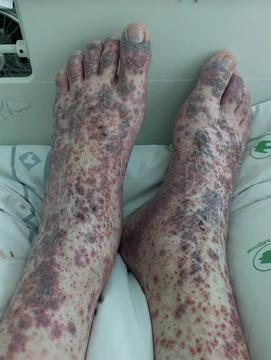
Polyarteritis nodosa
Rare vasculitis of medium arteries; rosary sign aids diagnosis.

Polyarteritis nodosa (PAN) is a rare condition in which the body’s medium-sized muscular arteries become inflamed and die (necrotizing vasculitis). It most often affects the kidneys and other internal organs but usually spares the lungs. A key diagnostic clue is the appearance of small aneurysms along the arteries, which look like beads on a rosary—hence the term “rosary sign.” PAN can be linked to hepatitis B or hepatitis C infection, and it can also occur in infants. Without treatment, only about 13% of people survive five years; with treatment, that number jumps to 80%. Death typically results from kidney failure, heart attack, or stroke. Because PAN can affect nearly any organ system, symptoms vary widely and stem from reduced blood flow (ischemia) to the affected tissues. Up to 90% of people experience general symptoms like fever, fatigue, weakness, loss of appetite, and unintentional weight loss. - Rashes, swelling, open sores (ulcers), and firm lumps under the skin (subcutaneous nodules) may appear. Some people develop a purple, lace-like rash (livedo reticularis) or small, raised purple spots (palpable purpura). - Nerve damage often causes numbness, pain, burning, or weakness in the limbs (peripheral neuropathy). The most common neurological sign is mononeuritis multiplex—damage to two or more separate nerves—which occurs in more than 70% of patients. This usually starts as an uneven (asymmetric) pattern but can become symmetric as the disease progresses. If the central nervous system is involved, strokes or seizures may occur. - Kidney problems are common and often lead to tissue death (infarction). About one-third of patients develop high blood pressure due to narrowing of the renal artery. Protein or blood may appear in the urine, and nearly all patients have some degree of kidney failure from narrowed or clotted arteries. - Inflammation of the heart’s arteries can cause a heart attack, heart failure, or inflammation of the sac around the heart (pericarditis). - Damage to the arteries supplying the intestines can cause belly pain, reduced blood flow (mesenteric ischemia), or a hole in the bowel (perforation). - Muscle aches and joint pain are common.
- Field
- Medicine (vasculitis)
- Known for
- Systemic necrotizing vasculitis of medium-sized arteries; rosary sign on angiography
- Associated infections
- Hepatitis B (30% of cases), hepatitis C, HIV
- Five year survival with treatment
- 80%
- Five year survival without treatment
- 13%
Lore & Background
Polyarteritis nodosa may affect nearly every organ system, presenting with a broad array of signs and symptoms resulting from ischemic damage. Constitutional symptoms such as fever, fatigue, weakness, loss of appetite, and unintentional weight loss occur in up to 90% of affected individuals. Skin manifestations include rashes, swelling, necrotic ulcers, subcutaneous nodules, palpable purpura, and livedo reticularis. Neurologic involvement often presents as mononeuritis multiplex, the most common neurologic sign, developing in more than 70% of patients. Kidney involvement is common, often leading to renal insufficiency, high blood pressure in about one-third of cases, and deposition of protein or blood in the urine. Cardiovascular involvement can cause heart attack, heart failure, and pericarditis. Gastrointestinal damage may cause abdominal pain, mesenteric ischemia, and bowel perforation.
Reader's Guide
Polyarteritis nodosa is significant as a classic example of systemic vasculitis with a distinctive angiographic finding—the rosary sign of small aneurysms. Its association with hepatitis B virus in about 30% of cases highlights an immune complex-mediated mechanism. Diagnosis relies on clinical criteria from the American College of Rheumatology, including weight loss, livedo reticularis, testicular pain, muscle pain, nerve disease, high blood pressure, elevated kidney tests, hepatitis B serology, arteriogram findings, and tissue biopsy. No specific lab test exists, and the condition must be differentiated from other vasculitides by its typical sparing of the lungs. Treatment involves immunosuppressive medications such as prednisone and cyclophosphamide, with therapy resulting in remissions or cures in 90% of cases. Untreated, the disease is fatal in most cases, with death often due to kidney failure, myocardial infarction, or stroke. About 60% of those who achieve remission experience relapse within five years, though recurrence is only about 6% in hepatitis B-associated cases.
Did You Know?
- Small aneurysms in PAN are strung like the beads of a rosary, giving the 'rosary sign' as a key diagnostic feature.
- Without treatment, five-year survival is 13%; with treatment, it rises to 80%.
- Mononeuritis multiplex develops in more than 70% of patients with polyarteritis nodosa.
- The condition was featured in the 1956 American film Bigger Than Life, where the protagonist is diagnosed with PAN.
More in Vasculitis 1-24
Spotted an error? Know more?
Reader corrections go straight into our review queue. Suggest an edit · How this site is sourced