
Duke University
A private research university in Durham, North Carolina, founded in 1838.

Ildar Sagdejev ( Specious ) · CC BY-SA 4.0
Duke University is a private research institution located in Durham, North Carolina. Its origins trace back to 1838, when Methodists and Quakers founded a school in what is now the town of Trinity. That school relocated to Durham in 1892. In 1924, industrialist James Buchanan Duke—whose wealth came from tobacco and electric power—created the Duke Endowment, and the institution was renamed to honor his late father, Washington Duke.
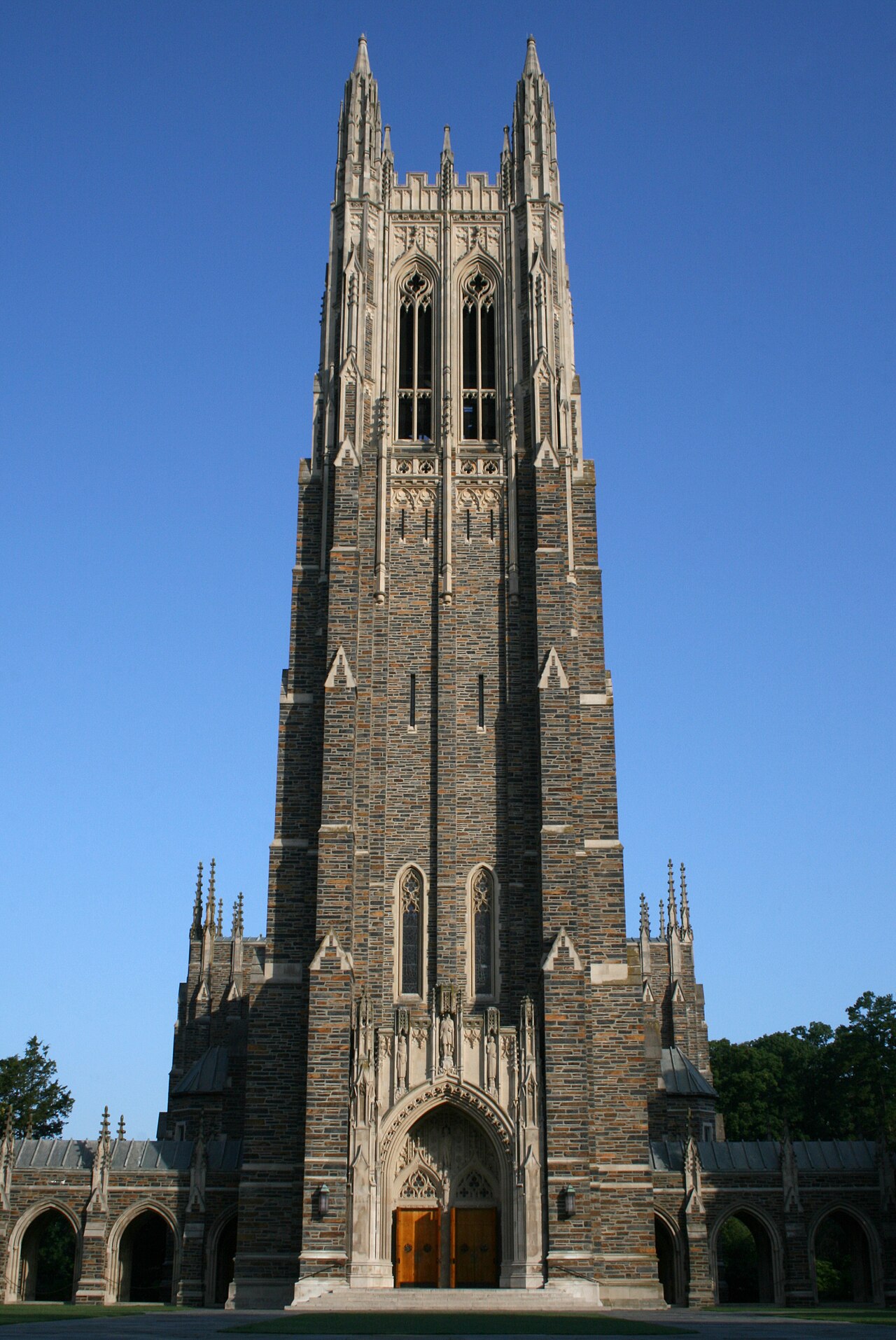
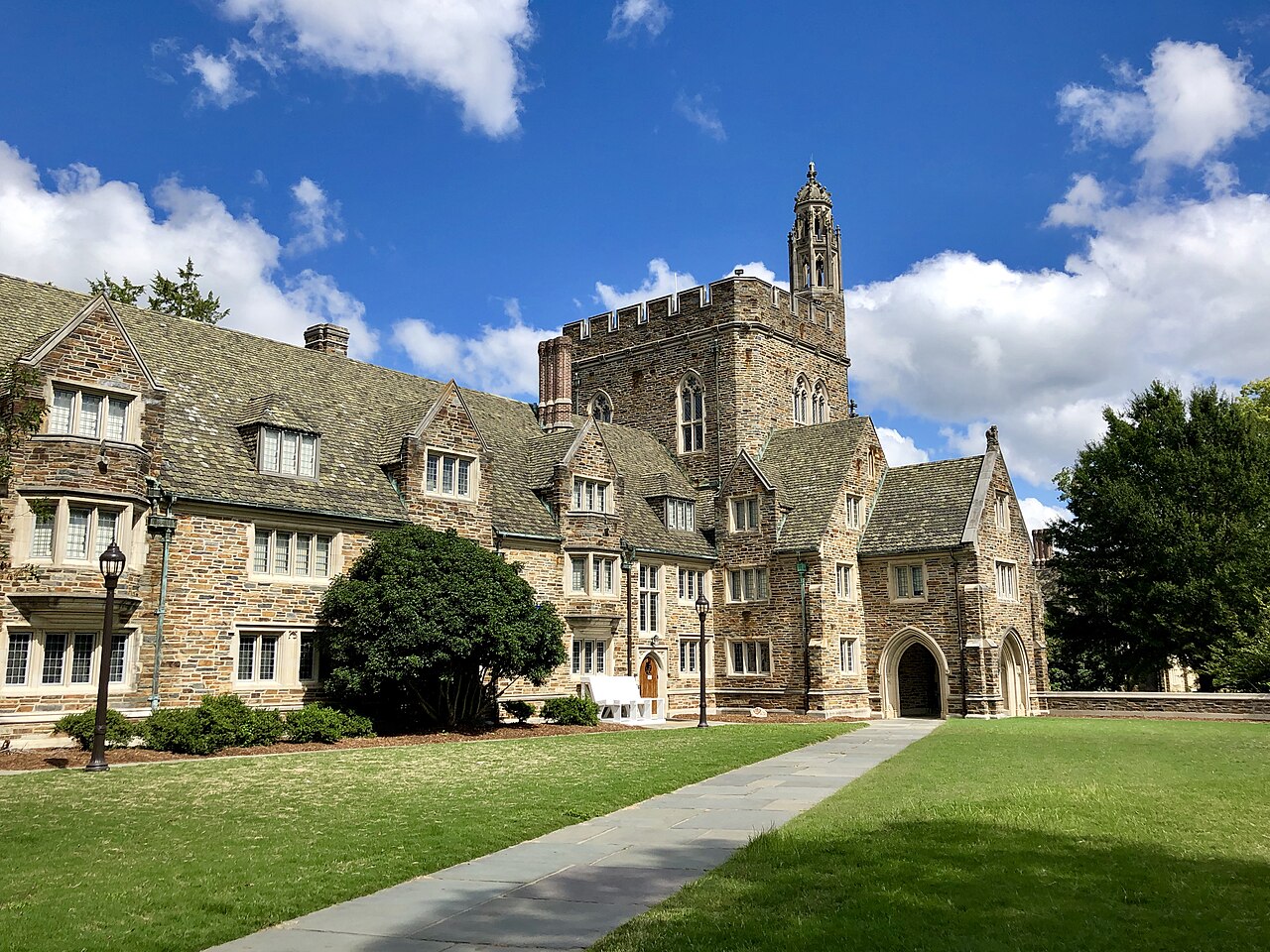
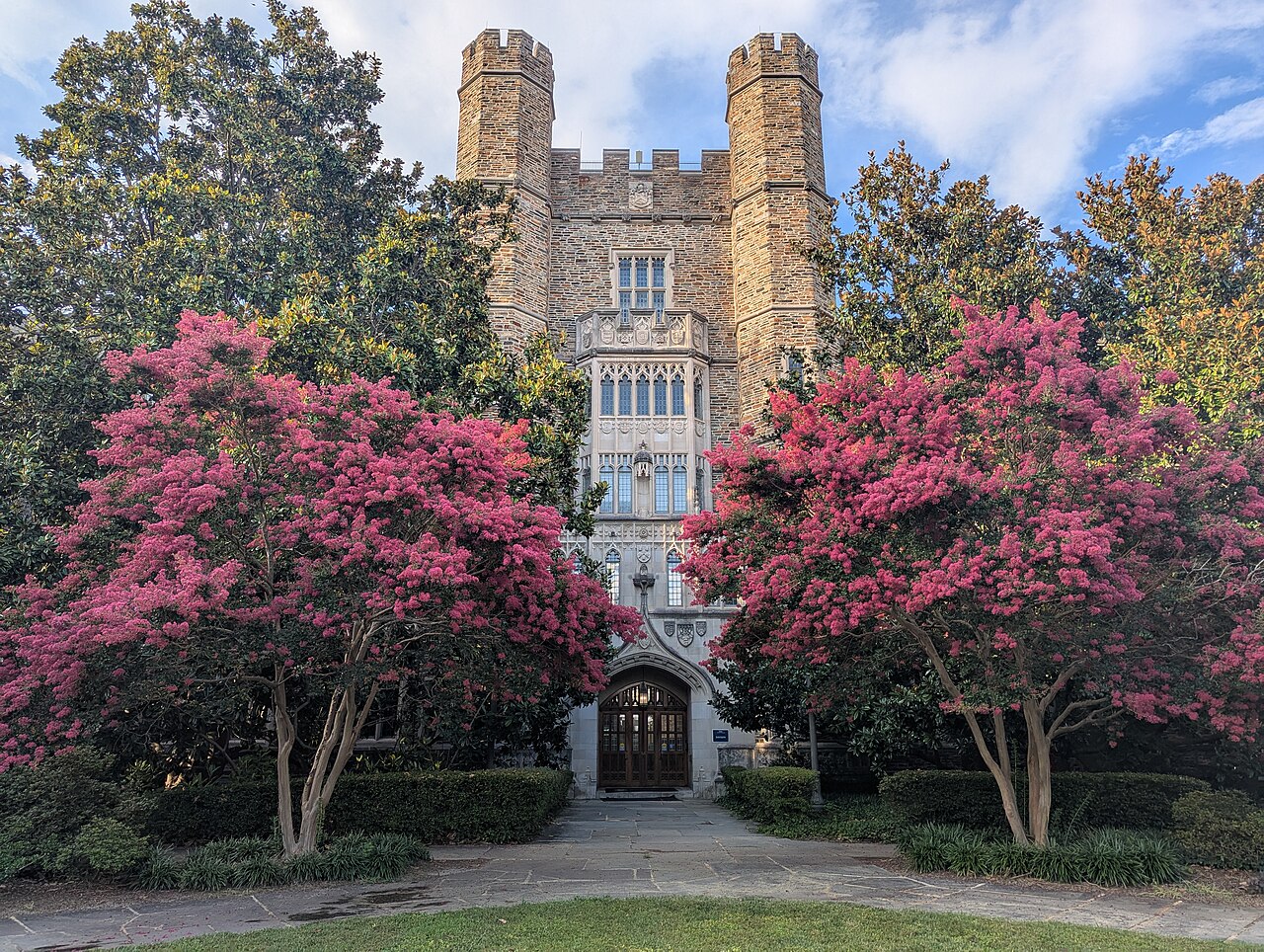
The university’s main campus covers more than 8,600 acres across three connected sub-campuses in Durham, plus a marine laboratory in Beaufort. West Campus, largely designed by architect Julian Abele, features Gothic architecture and is centered around the 210-foot Duke Chapel, the highest point on campus; it sits next to the Medical Center. East Campus, located 1.5 miles away, houses all first-year students and is built in the Georgian style. Duke also runs two concurrent schools in Asia: the Duke–NUS Medical School in Singapore, founded in 2005, and Duke Kunshan University in Kunshan, China, established in 2013.
Duke is one of the three anchor institutions of the Research Triangle region, alongside North Carolina State University in Raleigh and the University of North Carolina at Chapel Hill. In 2024, the university spent over $1.5 billion on research. Its endowment stands at $11.9 billion, ranking it as the twelfth-wealthiest private academic institution in the United States. Duke’s athletic teams, called the Blue Devils, compete in 27 NCAA Division I sports. The university is a charter member of the Atlantic Coast Conference and has won 17 NCAA team championships and 24 individual national titles.
**History**
**Beginnings**
Duke opened in 1838 as Brown’s Schoolhouse, a private subscription school in Randolph County, in what is now the town of Trinity. It was organized by the Union Institute Society, a group of Methodists and Quakers. In 1841, North Carolina granted a charter, and the school became the Union Institute Academy. It was renamed Normal College in 1851, and then Trinity College in 1859, reflecting support from the Methodist Church.
In 1892, Trinity College moved to Durham, thanks largely to the generosity of Julian S. Carr and Washington Duke—both wealthy Methodists involved in tobacco and electricity. Carr, a longtime trustee and the college’s largest benefactor, had already donated $10,000 in 1887; he gave a 62-acre tract called Blackwell Park, valued at $50,000, for the original Durham campus (now East Campus). Washington Duke contributed $85,000, with $50,000 designated for a main building and the rest for an endowment. He later added three separate $100,000 gifts in 1896, 1899, and 1900, on the condition that the college admit women on equal terms with men. As Duke’s history department noted in 2018, both men chose to support education in a state where it had not been a priority, and both backed women’s rights.
In 1910, William Preston Few became president of Trinity College and pushed to transform it into a global university, aiming to make it a southern counterpart to Yale and Harvard.
In 1924, James B. Duke established the Duke Endowment with a $40 million trust fund. Income from the fund was to go to hospitals, orphanages, the Methodist Church, and four colleges, including Trinity. President Few insisted the institution be renamed Duke University to honor the family’s generosity and to distinguish it from other schools named Trinity. James B. Duke initially worried the name change might seem self-serving, but he eventually agreed as a memorial to his father. The endowment fueled rapid growth: East Campus was rebuilt from 1925 to 1927 in Georgian style, and by 1930 most of the Collegiate Gothic buildings on West Campus were finished. Duke Chapel was completed in 1935.
In 1878, while still in Randolph County, Trinity awarded A.B. degrees to three sisters—Mary, Persis, and Theresa Giles—who had studied with private tutors and in classes alongside men. After the move to Durham in 1892, the board of trustees voted to again admit women as day students. When Washington Duke made his 1896 donation requiring equal footing for women, four women were enrolled, three of them faculty members’ children. In 1903, Duke wrote to the board withdrawing that condition, noting it was the only limitation he had ever placed on a donation. A women’s dormitory, the Mary Duke Building, was built in 1897. By 1904, 54 women were enrolled. In 1930, the Woman’s College was established as a coordinate to the men’s undergraduate college (which had been named Trinity College in 1924).
According to Duke’s Human Rights Center, the school’s policy in the 1920s excluded Black students from admissions and restricted Black people from using certain campus facilities, such as dining halls and dorm housing. In 1948, a group of divinity school students petitioned the divinity school to desegregate—the first organized effort to push for a change in Duke’s admission policy.
Quick Facts
- Latin Name
- Universitas Dukiana
- Motto
- la · Eruditio et Religio (Latin)
- Motto Eng
- "Knowledge and Religion"
- Religious Affiliation
- Historically affiliated with the United Methodist Church
- Accreditation
- SACS
- Academic Affiliations
- AAU · COFHE · IAMSCU · NAICU · ORAU · URA
- Endowment
- $12.3 billion (2025; the university is also the primary beneficiary (32%) of the independent Duke Endowment.)
- Budget
- $10.3 billion in expenditures (FY 2024)
- President
- Vincent Edward Price
- Provost
- Alec Gallimore
- Students
- 17,325 (fall 2025)
- Undergrad
- 6,525 (fall 2025)
Facts from the source article.
Lore & Background
Duke first opened in 1838 as Brown's Schoolhouse, a private subscription school founded in Randolph County, North Carolina, in the present-day town of Trinity. Organized by the Union Institute Society, a group of Methodists and Quakers, Brown's Schoolhouse became the Union Institute Academy in 1841. The academy was renamed Normal College in 1851, and then Trinity College in 1859. In 1892, Trinity College moved to Durham, largely due to the generosity of Julian S. Carr and Washington Duke. In 1924, James B. Duke established The Duke Endowment, and the institution was renamed Duke University.
Reader's Guide
The campus spans over 8600 acres on three contiguous sub-campuses in Durham, and a marine lab in Beaufort. West Campus incorporates Gothic architecture with the 210 ft Duke Chapel at the campus' center. East Campus, 1.5 mi away, home to all first-years, contains Georgian-style architecture. The university also administers two concurrent schools in Asia: Duke–NUS Medical School in Singapore (established in 2005) and Duke Kunshan University in Kunshan, China (established in 2013). Duke's athletic teams are known as the Blue Devils and compete in 27 NCAA Division I intercollegiate sports. Duke is a charter member of the Atlantic Coast Conference (ACC).
Did You Know?
- Duke forms one of the corners of the Research Triangle region together with North Carolina State University and the University of North Carolina at Chapel Hill.
- In 2024, Duke spent more than $1.5 billion on research.
- Its endowment is $11.9 billion, making it the twelfth-wealthiest private academic institution in the United States.
Geographic Anchoring in the American South
Duke University occupies a position within the Southern region of the United States, specifically in North Carolina. This places it among a cluster of states that include Alabama, Arkansas, Delaware, Florida, Georgia, Kentucky, Louisiana, Maryland, Mississippi, Oklahoma, South Carolina, Tennessee, Texas, Virginia, and West Virginia. Unlike institutions in the Northeast corridor spanning Connecticut through Vermont, or the Midwest stretch from Illinois to Wisconsin, Duke's Southern location situates it within a distinct geographic and cultural context. It is also separate from Western institutions stretching from Alaska to Wyoming, or the standalone category of Washington, D.C. The state of North Carolina, where Duke resides, shares its regional grouping with fifteen other Southern states, each maintaining their own rosters of colleges and universities. This geographic placement means Duke is neither part of the insular areas such as Guam or Puerto Rico, nor among the Compact of Free Association territories, nor in the Minor Outlying Islands. Its location firmly anchors it in the continental Southern landscape of American higher education.
Position Within the National Higher Education Map
The available facts frame Duke within a comprehensive taxonomy of American higher education that spans every state, territory, and even institutions operating outside U.S. borders. Duke sits within the North Carolina entry of the South section, one of four major geographic divisions—Northeast, Midwest, South, and West—plus Washington, D.C. and insular areas. This structure reveals that Duke is one node in a vast network that includes institutions from all fifty states, the District of Columbia, and territories such as Guam, Puerto Rico, and the U.S. Virgin Islands. The taxonomy also acknowledges American-accredited institutions headquartered abroad and satellite campuses of domestic universities operating internationally. Within this sprawling map, Duke's presence in North Carolina places it among a dense concentration of Southern institutions, distinct from the Northeast's eight-state cluster or the Midwest's twelve-state grouping. The very existence of this organized listing underscores that Duke is part of a national ecosystem where every state, from Alaska to Wyoming, maintains its own catalog of accredited colleges and universities.
Classification Among America's Diverse Institutional Landscape
The non-geographical lists referenced in these facts reveal the multiple axes along which Duke can be situated within American academia. Institutions are catalogued by rankings, by endowment size, by enrollment scale, and by numerous identity-based or disciplinary categories. Duke's position relative to these lists—whether it appears among the largest by enrollment, the most heavily endowed, or within specific disciplinary rosters such as law schools, medical schools, or engineering programs—reflects the multidimensional nature of institutional identity. The taxonomy also distinguishes between community colleges, liberal arts colleges, historically black colleges and universities, Hispanic-Serving Institutions, and faith-based schools of various denominations including Baptist, Catholic, and Lutheran. Duke's classification within this spectrum, alongside or apart from categories like the Ivy League, tribal colleges, women's colleges, or men's colleges, speaks to the diversity of the American higher education landscape. The existence of lists for defunct military academies, dental schools, and online colleges further illustrates the breadth of institutional types against which Duke's identity is defined.
The Broader Ecosystem of American and International Academia
The facts paint a picture of an American higher education ecosystem that extends well beyond the continental forty-eight states. Duke, situated in North Carolina, exists within a system that also encompasses the insular territories—Guam, Puerto Rico, and the U.S. Virgin Islands—each with their own college offerings. The Compact of Free Association territories, including Palau, the Federated States of Micronesia, and the Marshall Islands, each maintain a single community college, while the United States Minor Outlying Islands have no institutions at all. This gradient of institutional presence, from the dense clusters of the Northeast and Midwest to the sparse offerings in Pacific territories, contextualizes Duke's role within a much larger federal and territorial framework. Furthermore, the acknowledgment of American-accredited institutions operating abroad and satellite campuses of domestic universities highlights that the boundaries of American higher education are not confined to U.S. soil. Duke's place in North Carolina anchors it within this expansive, multi-layered system that the U.S. Department of Education tracks through its College Navigator resource.
Gallery

Frequently Asked Questions
What is Duke University?
Duke University is a private, research-focused institution of higher education situated in Durham, North Carolina. It traces its roots back to 1838, when a small subscription school was established by local Methodist and Quaker communities.
How did Duke University get its name?
The school was renamed in 1924 after Washington Duke, the late father of tobacco-and-power industrialist James Buchanan Duke. James created the Duke Endowment to fund the institution, and the university carried the family name in honor of his father.
Where is Duke's campus and how is it laid out?
The main campus spans roughly 8,600 acres in Durham and is organized into three contiguous sub-campuses. Duke also operates a marine laboratory in Beaufort, North Carolina, extending its research footprint to the coast.
What is Duke's athletic nickname?
Duke's teams compete under the moniker the Blue Devils. The identity has become one of the most recognizable in college athletics, especially in basketball and baseball.
How significant is Duke's research output?
In 2024 the university reported research spending exceeding $1.5 billion, supported by an endowment of approximately $11.9 billion. That scale of funding places Duke among the top private research universities in the country.
More in Universities And Colleges 1-19
Spotted an error? Know more?
Reader corrections go straight into our review queue. Suggest an edit · How this site is sourced