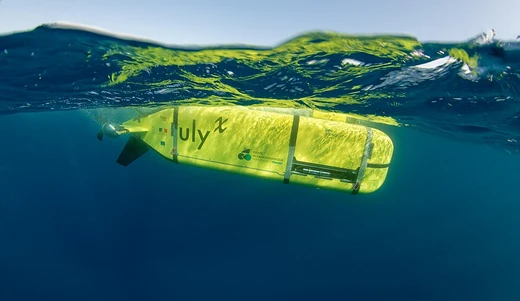
Vaimos
Autonomous sailboat for ocean surface measurements.

Vaimos (Voilier Autonome Instrumenté pour Mesures Océanographiques de Surface) is an autonomous sailing robot designed to collect measurements at the ocean surface. It is the result of a collaboration between ENSTA Bretagne and IFREMER, with ENSTA Bretagne developing control algorithms and software architecture, and IFREMER building the mechanics and embedded instrumentation.
- Full name
- Voilier Autonome Instrumenté pour Mesures Océanographiques de Surface
- Collaborators
- ENSTA Bretagne and IFREMER
- Notable trip
- Brest-Douarnenez, over 100 km in autonomous mode
- Longest trip
- Over 350 km
- Competition
- World Robotic Sailing Championship (WRSC) 2013 in Brest, France
Lore & Background
Vaimos follows a desired trajectory composed of a sequence of lines. It operates in two modes: direct mode, where the direction is consistent with the wind and the distance to the line corresponds to GPS error (approximately 10 meters); and tack mode, used when the direction is in the no-go zone and the distance to the line is less than 70 meters. Two nested control loops are implemented in its computer: a low-level controller tunes the rudder and sail to achieve a desired heading, while a second loop generates the desired heading to make the line attractive. This two-loop strategy guarantees the robot stays within a required corridor, as illustrated by a spiral experiment where the robot follows a square spiral. The proof of corridor containment uses interval analysis and set inversion, though it assumes the robot obeys uncertain state equations, which is not always the case in practice.
Reader's Guide
Vaimos represents a practical application of autonomous sailing for oceanographic data collection, demonstrating sustained autonomous operation over distances exceeding 350 km. Its control architecture, with nested loops and two distinct modes for wind-relative navigation, addresses the challenge of maintaining a trajectory in variable wind conditions. The spiral experiment and the formal proof using interval analysis and set inversion highlight the theoretical underpinnings of its corridor-guaranteeing behavior, though the notes acknowledge that the proof's assumptions about state equations may not always hold in real-world conditions. Its participation in the WRSC 2013 places it within the broader context of robotic sailing competitions, which test endurance and navigation algorithms. The collaboration between ENSTA Bretagne and IFREMER combines academic control theory with practical marine engineering, resulting in a platform that has logged significant autonomous mileage, including the Brest-Douarnenez trip of over 100 km.
Did You Know?
- One of its longest trips was Brest-Douarnenez, covering over 100 km in autonomous mode.
- It participated in the World Robotic Sailing Championship (WRSC) 2013 in Brest, France.
- The robot uses two nested control loops to guarantee it stays inside a required corridor.
More in Underwater and Surface Drones, Part 2 1-24
Spotted an error? Know more?
Reader corrections go straight into our review queue. Suggest an edit · How this site is sourced