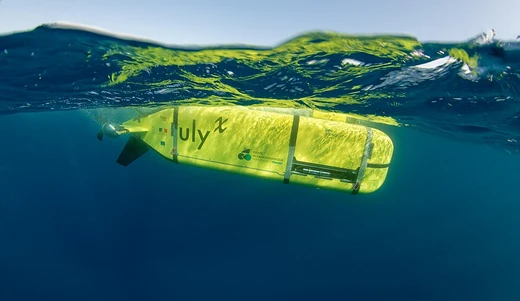
SPURV
First U.S. Navy autonomous underwater vehicle, operated from 1957 to 1979.

SPURV (Self-Propelled Underwater Research Vehicle) was an autonomous underwater vehicle (AUV) developed in 1957 at the University of Washington's Applied Physics Laboratory. Funded by the U.S. Office of Naval Research, it was the first AUV used by the U.S. Navy. A total of seven SPURV units operated until 1979.
The vehicle was designed by mechanical engineer Bob Van Wagennen and electrical engineer Wayne Nodland. Terry Ewart performed the hydrodynamics calculations on a Berkeley EASE analog computer. Boeing machined the hull from a single forging of 7078-T6 aluminum.
SPURV could dive to at least 3,000 meters, with a maximum depth of 3,600 meters. It traveled at 4–5 knots for about four hours. Its main battery consisted of two sets of 16 silver-zinc cells connected in parallel through diodes, delivering 24 volts and 200 ampere-hours. Four solid-state converters provided secondary power.
Acoustic signals from a research vessel guided SPURV underwater. It collected data to model physical properties such as ocean currents and temperature.
The first deployment was in 1957 from the Navy seagoing tug Tatnuck (ATA-195) during a cruise to Cobb Seamount. Stan Murphy and Terry Ewart built a tracking system for the Tatnuck that plotted SPURV’s range on a strip chart recorder and its x-y position on a chart plotter.
Later SPURV units made one or two cruises per year, totaling about 20 month-long missions. These studied small-scale ocean variability, including internal waves, fine-structure data, dye diffusion from a point source at 1,000 meters, and oceanographic data for acoustic transmission experiments. On some operations, two SPURVs ran in lock-step—one above the other or side by side at constant spacing—to measure spatial coherences of small-scale ocean structure. Most units carried a vertical rake of temperature and conductivity sensors, the forerunner of Seabird sensors. The vehicle could always be tracked from the ship, often using a bottom or other reference system, with corrections for the ship’s pitch, roll, and heading.
SPURV’s final operation was in 1979 during a submarine wake study experiment. The Applied Physics Laboratory still possesses all five hulls, but they have not been used since.
- Year built
- 1957
- Builder
- University of Washington's Applied Physics Laboratory
- Funding agency
- United States Office of Naval Research
- Number of vehicles
- 7
- Operating depth
- at least 3000 meters
- Maximum depth
- 3600 meters
- Speed
- 4-5 knots
- Endurance
- about 4 hours
- Primary battery
- 2 sets of 16 silver zinc cells connected in parallel through diodes, 24-volt, 200 ampere-hour
- Secondary power
- 4 solid-state converters
Lore & Background
SPURV was designed by Bob Van Wagennen (mechanical) and Wayne Nodland (electrical), with hydrodynamics calculated by Terry Ewart on a Berkeley EASE analog computer. The vehicle was machined by Boeing from a forging of 7078-T6 aluminum. Acoustic signals from an accompanying research vessel guided SPURV below the surface, allowing it to generate models of underwater physical properties such as ocean currents and temperature.
SPURV first operated from the Navy seagoing tug Tatnuck (ATA-195) during a 1957 cruise to Cobb Seamount. A tracking system built by Stan Murphy and Terry Ewart plotted range on a strip chart recorder and x-y position on a chart plotter. Later SPURVs were used on one to two cruises per year by Terry Ewart and the Applied Physics Lab's Ocean Physics Department, conducting about 20 month-long cruises to study small-scale ocean variability, including internal wave and fine-structure data, point-source release dye diffusion at 1000 meters, and oceanographic data for acoustic transmission experiments.
In some operations, two SPURVs ran in lock-step—one above the other or side by side at constant spacings—to study spatial coherences of small-scale ocean structure. Most SPURVs carried a vertical rake of temperature and conductivity sensors using what later became Seabird sensors. They could be tracked from the ship, usually with bottom or other reference systems and pitch, roll, and heading corrections. The last operation was in 1979 in a submarine wake study experiment. The Applied Physics Laboratory still retains all five hulls, unused since then.
Reader's Guide
SPURV established the foundational concept of an autonomous underwater vehicle for the U.S. Navy, demonstrating that a self-propelled, untethered vehicle could gather oceanographic data under acoustic guidance. Its design and construction—machined from a single aluminum forging and powered by silver-zinc cells—reflected the engineering constraints and innovations of the late 1950s. Over two decades, the seven SPURV vehicles enabled about 20 month-long cruises, collecting data on internal waves, fine-structure variability, dye diffusion at depth, and acoustic transmission properties. The ability to operate two SPURVs in lock-step allowed study of spatial coherence in ocean structure, a technique that advanced understanding of small-scale ocean physics. The vehicle's tracking system, which used acoustic signals and shipboard plotting, set a precedent for AUV navigation and data correlation. Although the hulls have not been used since 1979, SPURV's legacy lies in proving the viability of AUVs for sustained scientific research and in providing a platform that directly informed later developments such as SPURV II.
Did You Know?
- Its primary battery consisted of 2 sets of 16 silver zinc cells connected in parallel through diodes, providing 24 volts and 200 ampere-hours.
- The first SPURV operation was from the Navy seagoing tug Tatnuck during a 1957 cruise to Cobb Seamount.
Origins in the Arctic
The Special Purpose Underwater Research Vehicle, commonly known as SPURV, holds the distinction of being the very first autonomous underwater vehicle ever built. Conceived in 1957 at the Applied Physics Laboratory of the University of Washington, this American-made machine was designed with a singular scientific purpose: to gather oceanographic data in the harsh, remote environment of Arctic waters. At a time when no uncrewed submersible existed, SPURV represented a bold leap forward, proving that a machine could descend into the ocean's depths and collect meaningful measurements without a human being aboard. Its classification as an AUV—meaning it operated entirely on its own without a remote operator—marked a fundamental departure from the manually piloted submersibles that had dominated underwater exploration up to that point. The vehicle's creation signaled the birth of an entirely new category of marine technology, one that would eventually spawn dozens of successor designs across the following decades.
Engineering Profile
As the earliest model in the AUV lineage, SPURV relied on screw propeller thrusters to propel itself through the water, a propulsion method that distinguished it from later designs which adopted automatic buoyancy control. The vehicle's physical footprint was substantial by modern standards: it weighed 484 kilograms, a figure that speaks to the relatively primitive materials and systems available in the late 1950s. Despite its bulk, SPURV was capable of descending to a depth of 3,650 meters, a remarkable achievement for a machine of that era. Its operational endurance was limited to approximately 5.5 hours of travel, a constraint that reflected the battery technology of the time. Crucially, SPURV required no human operator at any point during its missions; it navigated and executed its data-collection tasks independently. This autonomy, combined with its Arctic deployment, made it a pioneering instrument for gathering oceanographic measurements in conditions that would have been extremely hazardous for a crewed submersible.
Two Decades of Service and the Road to SPURV II
SPURV served the University of Washington's research program for over two decades, remaining in active use to collect oceanographic data until 1979. That span of operational service is notable for a first-generation machine, suggesting the vehicle proved remarkably reliable and useful in the field. During the latter portion of its active career, engineers at the Applied Physics Laboratory began developing a successor, SPURV II. The stated goals for the second-generation vehicle were twofold: improved movement performance and enhanced sensing capabilities. These upgrades addressed limitations inherent in the original design, where the screw-propeller drive and the sensor suite of the late 1950s had constrained both maneuverability and the quality of data that could be gathered. SPURV II thus represented a natural evolutionary step, building directly on the operational experience accumulated over twenty-two years of Arctic and oceanographic missions. The transition from SPURV to SPURV II illustrates how early autonomous underwater technology matured through iterative refinement rather than wholesale redesign.
A Foundation for a Growing Field
SPURV's significance extends far beyond its own operational record. As the first AUV ever constructed, it established the conceptual and technical template upon which the entire autonomous underwater vehicle field was built. By the early 2000s, ten distinct AUV designs had emerged worldwide, ranging from screw-driven models to underwater gliders and bionic-inspired vehicles. The contrast between SPURV and its modern descendants is striking: the Deepglider, one of the most recent models, weighs just 62 kilograms—less than one-seventh of SPURV's mass—yet can reach depths of 6,000 meters and travel up to 8,500 kilometers. Where SPURV's 5.5-hour endurance seemed ambitious in 1957, contemporary vehicles now sustain missions lasting weeks or even months. The progression from a 484-kilogram Arctic research tool to a lightweight, long-range global explorer encapsulates six decades of relentless innovation in propulsion, buoyancy control, battery chemistry, and autonomous navigation, all traceable back to that first uncrewed dive in the 1950s.
Frequently Asked Questions
What exactly is SPURV?
SPURV stands for Self-Propelled Underwater Research Vehicle, an autonomous underwater vehicle (AUV) built in 1957 at the University of Washington's Applied Physics Laboratory with funding from the U.S. Office of Naval Research. It holds the distinction of being the first AUV ever put into service by the U.S. Navy.
Who were the engineers behind SPURV?
Mechanical engineer Bob Van Wagennen and electrical engineer Wayne Nodland led the design, while Terry Ewart handled the hydrodynamics work using a Berkeley EASE analog computer. Boeing was responsible for machining the hull out of a single forging of 7078-T6 aluminum.
How deep could SPURV operate?
SPURV was rated for operating depths of at least 3,000 meters, with a maximum recorded depth of 3,600 meters. That made it a remarkably capable research platform for its era.
How long did SPURV serve and how many were built?
A total of seven SPURV units were produced and remained in active operation from 1957 until 1979, giving the program roughly two decades of service life.
Why does SPURV matter in the history of underwater drones?
As the very first autonomous underwater vehicle adopted by the U.S. Navy, SPURV proved that a self-propelled, remotely operated AUV could perform serious deep-water research missions. It set the template for every subsequent generation of military and scientific AUVs that followed.
More in Underwater and Surface Drones, Part 2 1-24
Spotted an error? Know more?
Reader corrections go straight into our review queue. Suggest an edit · How this site is sourced