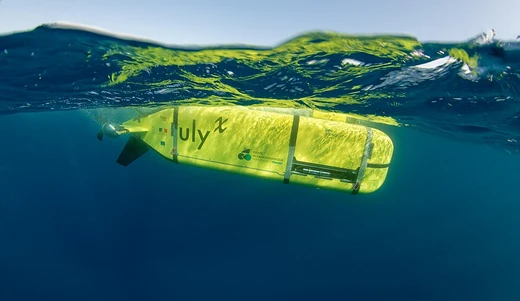
Maya AUV India
India's first indigenously developed AUV for scientific applications.

The Maya AUV is a small autonomous underwater vehicle created by the Marine Instrumentation Division of India’s National Institute of Oceanography (NIO). It is used for oceanography, coastal environment monitoring, and naval tasks like mapping naval mines for mine countermeasures.
The vehicle measures about 1.7 meters in length and 0.234 meters in diameter, with a free-flooding slender-ellipsoid nose that can be swapped to accommodate different scientific sensors. Its main pressurized hull, rated for operations up to 200 meters depth, contains electronics, navigation sensors, batteries, and the actuators for the rudders and fins. A single rear thruster propels the AUV, and an aft mast houses the GPS and communication antennas. Navigation relies on a Doppler Velocity Log and a MEMS Inertial Measurement Unit. The AUV weighs roughly 54 kilograms in air, has an aluminum alloy hull, runs on lithium polymer batteries, and cruises at a nominal speed of 1.5 meters per second. Its endurance is 7.2 hours.
Development began in 2003 with joint funding from NIO and the Department of Electronics and Information Technology, New Delhi (known as the Department of Information Technology before 2012). Horizontal plane tests were completed in May 2005, and the first dive missions were tested on May 12, 2006, making it India’s first indigenously developed AUV for scientific use. Part of the work occurred under an Indo-Portuguese collaboration (the MAYASub project) to build and test two AUVs for marine science, supported by AdI Portugal. Sensors include an Aanderaa dissolved oxygen sensor, WetLabs chlorophyll and turbidity sensors, an RBR CTD instrument, and TRIOS hyper spectral radiometers. The AUV uses standard LQ controllers for horizontal and vertical plane control. NIO licensed the AUV technology to VEA Automation and Robotics in 2009 and to L&T in 2010.
Quick Facts
- Developed By
- National Institute of Oceanography, India
- Country
- India
- Year Of Creation
- 2003-2007
- Purpose
- Chemical Oceanography, Biological Oceanography, Oceanography, and Data collection
Facts from the source article.
Lore & Background
The development of Maya began in 2003, with horizontal plane tests completed in May 2005. The first set of dive missions was tested on May 12, 2006, making it India's first indigenously developed AUV for scientific applications. The project was jointly funded by NIO and the Department of Electronics and Information Technology, New Delhi, India (known as the Department of Information Technology before 2012). Part of the development was done under an Indo-Portuguese collaboration (MAYASub project) aimed at building and testing the joint operation of two AUVs for marine science, via AdI Portugal.
The vehicle has a slender-ellipsoid nose that is free-flooding and houses scientific payloads; the nose-cone is swappable to use alternate sensors. The main pressurized hull is built from an aluminum alloy and houses electronics, navigation sensors, batteries, and actuators for rudders and fins. Propulsion is by a single rear thruster, with a mast for GPS and communication antennae in the aft section. Navigation sensors include a Doppler Velocity Log and a MEMS Inertial Measurement Unit. The AUV uses standard LQ controllers for control in the horizontal and vertical planes.
Reader's Guide
The Maya AUV represents a foundational step in India's indigenous underwater robotics capability. As the country's first domestically developed AUV for scientific use, it demonstrated the feasibility of small, modular autonomous platforms for oceanographic research and naval mine countermeasures. Its swappable nose-cone design allowed flexibility in sensor payloads, accommodating instruments such as an Aanderaa dissolved oxygen sensor, WetLabs chlorophyll and turbidity sensors, an RBR CTD, and TRIOS hyper spectral radiometers. The vehicle's development was supported by an Indo-Portuguese collaboration under the MAYASub project, which aimed to test joint operations of two AUVs for marine science. NIO signed licensing agreements for the AUV technology with VEA Automation and Robotics in 2009 and with L&T in 2010, indicating a pathway toward commercial and defense applications. The Maya AUV thus served as a technology demonstrator and a platform for advancing Indian expertise in autonomous underwater systems, with implications for both civilian oceanography and naval surveillance.
Did You Know?
- The Maya AUV has an endurance of 7.2 hours and a nominal speed of 1.5 m/s.
- Its nose-cone is swappable to accommodate different scientific sensors depending on the application.
Frequently Asked Questions
What is the Maya AUV?
The Maya AUV is a compact autonomous underwater vehicle roughly 1.7 meters long and 54 kg in weight, designed to operate at depths up to 200 meters. It cruises at a nominal speed of 1.5 m/s and can stay on mission for about 7.2 hours before needing to surface.
Who built the Maya AUV and where does it come from?
It was developed by the Marine Instrumentation Division of India's National Institute of Oceanography (NIO). The vehicle is notable as the first AUV in the country to be designed and built entirely indigenously for scientific oceanographic work.
What missions is the Maya AUV actually used for?
Its primary roles span oceanographic research, coastal-environment monitoring, and naval mine countermeasures such as mapping submerged mines. The swappable free-flooding ellipsoid nose lets operators fit different scientific sensors without rebuilding the hull.
What are the Maya AUV's main physical specifications?
The vehicle measures about 1.7 m in length with a 0.234 m diameter, weighs roughly 54 kg in air, and carries its electronics, navigation suite, and batteries inside a pressurized hull rated to 200 m. Its endurance on a single battery charge is approximately 7.2 hours at a cruising speed of 1.5 m/s.
Why is the Maya AUV considered a milestone for Indian ocean technology?
Before the Maya, India relied on imported platforms for autonomous underwater science missions. By delivering a home-grown AUV that handles both civilian oceanography and naval mine-mapping tasks, NIO demonstrated that the country could independently design, build, and deploy capable underwater autonomous systems.
More in Underwater and Surface Drones, Part 2 1-24
Spotted an error? Know more?
Reader corrections go straight into our review queue. Suggest an edit · How this site is sourced