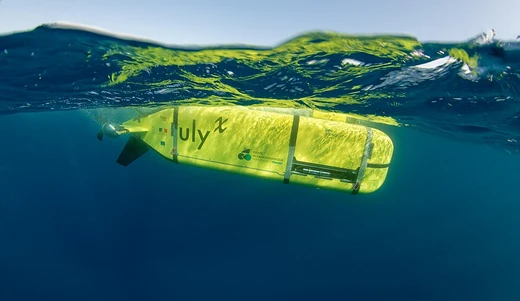
Seaglider
A deep-diving AUV for months-long oceanographic and military missions.

The Seaglider is an Autonomous Underwater Vehicle (AUV) built for extended missions that can last months and span thousands of miles. In military contexts, it is typically called an Unmanned Underwater Vehicle (UUV). The vehicle collects data on ocean temperature, salinity, and other properties, transmitting this information via satellite telemetry when it reaches the surface.
Development began at the University of Washington (UW) in the 1990s, led by oceanography professor Charles C. Eriksen, with primary funding from the US Office of Naval Research. In June 2008, iRobot obtained an exclusive five-year license to manufacture the Seaglider for customers outside UW. By May 2013, Kongsberg Underwater Technology, Inc., a subsidiary of Kongsberg Maritime, had secured sole rights to produce, market, and further develop the technology through UW's Center for Commercialization. The license was held by Kongsberg's subsidiary Hydroid, Inc., which was sold to Huntington Ingalls Industries (HII) in March 2020. In 2024, the license returned to UW, now managed by the Integrative Observational Platforms (IOP) Seaglider group, which continues to build and support the gliders as of 2025.
The Seaglider moves through water with very low energy consumption, using buoyancy changes for propulsion. Its pressure vessel houses batteries, electronics, and motors, while an external fairing provides a stable, low-drag hydrodynamic shape. Designed to reach depths of 1,000 meters, the hull compresses during descent to match the glider's density to the surrounding seawater. Buoyancy is adjusted by inflating or deflating a bladder outside the pressure vessel, causing the glider to rise or sink. This vertical motion is converted into horizontal movement by its wings, allowing it to travel forward at an angle. The glider follows a zigzag path between the surface and its maximum depth, surfacing periodically to connect via satellite with a shore-based station for data upload and new piloting instructions.
In May 2010, a Seaglider was deployed in the Gulf of Mexico to monitor and collect data during the Deepwater Horizon oil spill. The US Navy tested the Seaglider for use with the Littoral Combat Ship in 2013. By 2016, the Navy was deploying the LBS-Glider from T-AGS vessels and preparing to deploy it from DDGs.
- Developer
- University of Washington (UW)
- Lead designer
- Charles C. Eriksen
- Initial development
- 1990s
- Primary funding
- US Office of Naval Research
- Maximum depth
- 1,000 meters
- Propulsion
- Buoyancy-driven (bladder inflation/deflation)
- Current manufacturer
- UW Integrative Observational Platforms (IOP) Seaglider group
Lore & Background
Seaglider was initially developed by the University of Washington in the 1990s by a team led by professor of oceanography Charles C. Eriksen, with funding primarily from the US Office of Naval Research. In June 2008, iRobot received an exclusive five-year license to produce the Seaglider for customers outside the University of Washington. In May 2013 Kongsberg Underwater Technology, Inc. announced that they had completed negotiations with the University of Washington's Center for Commercialization to obtain the sole rights to produce, market and continue the development of Seaglider technology. The Seaglider license was in Kongsberg's subsidiary Hydroid, Inc., which was sold to Huntington Ingalls Industries in March 2020. In 2024 the license was transferred back to UW; it now resides in UW's Integrative Observational Platforms Seaglider group, which currently (as of 2025) manufactures and supports the gliders.
Seaglider "flies" through the water with extremely modest energy requirements using changes in buoyancy for thrust. It has a pressure vessel containing its batteries, electronics, motors, etc., with a surrounding fairing that gives it a stable low-drag hydrodynamic shape. Designed to operate at depths of up to 1,000 meters, the hull compresses as it sinks to match the glider's density to the increasing density of the seawater. It changes buoyancy by inflating or deflating a bladder external to the pressure vessel, making the glider rise or sink. This vertical motion is converted to horizontal motion via the glider's wings so that it moves forward at a slant. The glider thus flies in a zigzag pattern from the surface to the maximum desired depth and back to the surface again. Whenever it surfaces, it can connect via satellite to a shore-side base station to upload data and download new piloting instructions.
Reader's Guide
Seaglider UUVs are in use worldwide, collecting oceanic physical properties and performing various other missions for oceanographers, including the U.S. Navy, government agencies, universities, and research organizations. In May 2010 Seaglider was deployed in the Gulf of Mexico to help monitor and gather data during the Deepwater Horizon oil spill incident. In 2013 the US Navy tested Seaglider for use in the Littoral combat ship. As of 2016, the US Navy was deploying LBS-Glider from T-AGS and was preparing to deploy from DDGs. The vehicle's ability to operate for many months and cover thousands of miles with minimal energy makes it a persistent platform for ocean observation. Its license history reflects a transition from university research through commercial entities (iRobot, Kongsberg/Hydroid, Huntington Ingalls Industries) and back to the University of Washington, where it is currently manufactured and supported by the Integrative Observational Platforms Seaglider group.
Origins and Academic Birth
The Seaglider traces its roots to the 1990s at the University of Washington, where a research team under oceanography professor Charles C. Eriksen set out to build an autonomous underwater vehicle capable of sustained, long-range ocean missions. Backed primarily by the US Office of Naval Research, the project produced a deep-diving glider designed to operate for many months at a time while traversing thousands of miles of open ocean. In military service contexts the platform is more commonly labeled an Unmanned Underwater Vehicle, or UUV, rather than an AUV. The vehicle was conceived as a tool for collecting oceanic physical properties—temperature, salinity, and other key measurements—and for performing a broad range of missions for oceanographers, government agencies, universities, and research organizations around the world. Its global satellite telemetry system allows it to transmit collected data back to shore-side base stations, making it a self-sufficient sensor platform that requires no crew or support ship for routine operations. This combination of endurance, range, and autonomous data collection set the Seaglider apart from earlier, shorter-range underwater survey tools.
Buoyancy-Driven Flight and Engineering
Rather than relying on propellers or thrusters, the Seaglider propels itself through the water by manipulating its own buoyancy, a technique that demands extremely modest energy. At its core sits a pressure vessel housing batteries, electronics, and motors, encased in a surrounding fairing that provides a stable, low-drag hydrodynamic profile. To change its vertical position, the glider inflates or deflates a bladder located outside the pressure vessel, causing it to rise or sink. The clever engineering trick is that this purely vertical motion is converted into forward travel by a pair of wings, so the vehicle advances along a slanted path. The result is a characteristic zigzag trajectory: the Seaglider descends from the surface to its maximum operating depth of 1,000 meters, then climbs back up, repeating the cycle. As it sinks, the hull itself compresses under pressure, a design feature that lets the glider's density track the increasing density of the surrounding seawater. Each time it breaks the surface, the vehicle links via satellite to a shore-side base station, uploading its accumulated oceanographic data and downloading fresh piloting instructions for the next leg of its mission.
From Oil Spill to Naval Deployment
The Seaglider has proven its operational value in some of the most demanding marine environments. In May 2010, amid the catastrophic Deepwater Horizon oil spill in the Gulf of Mexico, the glider was deployed to help monitor the spread of the slick and gather critical oceanographic data in real time, providing situational awareness that surface vessels alone could not deliver. On the military front, the US Navy began evaluating the platform in 2013, testing its integration with the Littoral Combat Ship to explore new roles for autonomous underwater surveillance. By 2016 the Navy had moved from testing to active deployment, fielding the LBS-Glider variant from T-AGS supply vessels and preparing to launch it from DDG destroyers as well. Beyond these high-profile operations, Seaglider UUVs operate worldwide for a broad community of users—oceanographers, government agencies, universities, and research organizations—collecting temperature, salinity, and other physical properties of the ocean. This versatility, spanning environmental disaster response, naval warfare, and fundamental scientific research, has made the platform a mainstay of modern underwater observation.
A Journey Through Commercial Hands
The commercial stewardship of the Seaglider has changed hands several times since its academic origins. In June 2008, iRobot secured an exclusive five-year license to manufacture and sell the glider to customers outside the University of Washington, marking the platform's first major step into the broader commercial market. That arrangement gave way in May 2013 when Kongsberg Underwater Technology, a division of Kongsberg Maritime, completed negotiations with UW's Center for Commercialization to obtain sole rights to produce, market, and continue developing Seaglider technology. The license was housed in Kongsberg's subsidiary Hydroid, Inc., which was subsequently sold to Huntington Ingalls Industries in March 2020. In a notable reversal, the license was transferred back to the University of Washington in 2024. Today it resides within UW's Integrative Observational Platforms Seaglider group, which, as of 2025, handles both the manufacturing and ongoing support of the gliders. This journey from a university research project through multiple defense-industry partnerships and back to its academic home underscores the platform's enduring significance in both scientific and military oceanography.
Frequently Asked Questions
What is the Seaglider?
The Seaglider is an autonomous underwater vehicle designed to carry out oceanographic or military missions that can stretch across thousands of miles over several months. In defense applications it is generally referred to as an Unmanned Underwater Vehicle (UUV).
Who created the Seaglider and when?
Oceanography professor Charles C. Eriksen led its development at the University of Washington starting in the 1990s, with primary financial backing from the US Office of Naval Research. In June 2008, iRobot secured an exclusive licensing arrangement for the platform.
How does the Seaglider propel itself underwater?
Rather than using a conventional propeller, it moves by cyclically inflating and deflating an internal bladder to shift its buoyancy, which drives it up and down through the water column. This energy-efficient method lets it cover vast distances on a single battery charge.
What data does the Seaglider collect and how does it report back?
During its dive it samples ocean temperature, salinity, and other water-column properties. When it resurfaces, it transmits the gathered data to researchers via satellite telemetry.
How deep can the Seaglider operate and why does that matter?
It is rated for a maximum operating depth of 1,000 metres, which allows it to reach the mesopelagic zone and gather data well below the surface layer. That depth range, combined with its months-long endurance, makes it one of the longest-range deep-diving AUVs in its class.
More in Underwater and Surface Drones, Part 2 1-24
Spotted an error? Know more?
Reader corrections go straight into our review queue. Suggest an edit · How this site is sourced