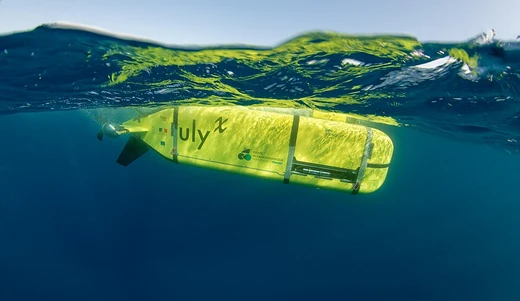
Mayflower AI sea drone
Autonomous research vessel aiming to cross the Atlantic without crew.

The Mayflower AI sea drone, also known as the Mayflower Autonomous Ship or Mayflower 400 (MAS400), is an autonomous research vessel designed to cross the Atlantic Ocean without a human crew or assistance. It is notable for being named after the 17th-century sailing ship Mayflower and for its use of artificial intelligence to navigate and avoid collisions.
- Length
- 15 meters
- Hull type
- aluminum trimaran
- Propulsion
- solar-powered with backup diesel generator
- Speed
- up to 10 knots (20 km/h)
- Cost
- $1.3 million
- Owner
- ProMare (not-for-profit marine research organization) in partnership with IBM
- First attempt date
- June 15, 2021
Lore & Background
The Mayflower AI sea drone was named after the Mayflower sailing ship, which carried English and Dutch Pilgrims from England to New England between September and November 1620. The autonomous vessel was originally intended to set sail in September 2020 to coincide with the 400th anniversary of that voyage, taking the same route. The 15-meter long aluminum trimaran is solar-powered and capable of speeds up to 10 knots, with a backup diesel generator. It cost $1.3 million to build and is owned by the not-for-profit marine research organization ProMare in partnership with IBM. The ship can sample water for pollutants and study marine life during its voyage. A three-week voyage was planned: from Plymouth, UK, through the Isles of Scilly and over the site of the sunken Titanic, to land in Plymouth, Massachusetts. The vessel has a highly trained 'captain' and 'navigator' knowledgeable in collision-avoidance rules, both controlled by artificial intelligence.
MAS400 began its first transatlantic attempt on June 15, 2021, but had to return to England after three days due to mechanical problems. Its second attempt began April 27, 2022, departing from England bound for Virginia. After about a month at sea, the vehicle developed an issue with the charging circuit for the generator starter batteries. The decision was made to switch to backup navigation and divert to Halifax, Nova Scotia, arriving there on June 9 after being towed the last 186 nautical miles. After the issues—attributed to basic ground faults—were corrected, Mayflower continued its voyage but changed its final destination back to the original planned port of Plymouth, Massachusetts, docking there on June 30, 2022, alongside the replica Mayflower II. Since that voyage, the Mayflower has been located at Woods Hole Oceanographic Institution, where scientists have been preparing the vessel for future research activities.
Reader's Guide
The Mayflower AI sea drone represents a significant step in autonomous maritime research, demonstrating the feasibility of long-distance, crewless ocean crossings for scientific purposes. Its successful, though troubled, transatlantic voyage in 2022 showed that AI-based navigation and collision avoidance can operate in real-world conditions, even when mechanical issues arise. The vessel's ability to sample water for pollutants and study marine life during its journey highlights its potential as a platform for oceanographic research without the cost and risk of a human crew. The partnership between ProMare and IBM underscores the role of advanced computing in modern exploration. The Mayflower's legacy is tied to its namesake's historic voyage, but its own journey—marked by mechanical setbacks, a diversion to Halifax, and a final docking alongside the replica Mayflower II—illustrates the challenges of autonomous technology at sea. Its current location at Woods Hole Oceanographic Institution suggests ongoing development for future research activities, cementing its place as a pioneering vessel in the field of uncrewed marine science.
Did You Know?
- The Mayflower AI sea drone was named after the early 17th century sailing ship Mayflower.
- It is a 15-meter long aluminum trimaran powered by solar energy with a backup diesel generator.
- The vessel cost $1.3 million to build and is owned by ProMare in partnership with IBM.
- During its second attempt, it was towed the last 186 nautical miles into Halifax, Nova Scotia.
Frequently Asked Questions
What is the Mayflower AI sea drone?
It is an autonomous research vessel, officially called the Mayflower Autonomous Ship (MAS400), engineered to sail across the Atlantic Ocean with no human crew aboard. The name pays homage to the famous 17th-century sailing ship.
Who owns and operates the Mayflower AI sea drone?
The vessel belongs to ProMare, a not-for-profit marine research organization, developed in partnership with IBM. IBM contributed the artificial-intelligence systems that let the ship navigate and steer around obstacles on its own.
What are the Mayflower AI sea drone's key technical specs?
The MAS400 is a 15-meter aluminum trimaran powered primarily by solar panels with a backup diesel generator, capable of reaching up to 10 knots (roughly 20 km/h). Its total build cost came to about $1.3 million.
How does the Mayflower AI sea drone avoid collisions at sea?
Onboard AI continuously monitors the surrounding water and traffic, then makes real-time steering adjustments to keep the vessel clear of other ships and hazards. This autonomous decision-making is what allows the crossing to proceed without a human helmsman.
Why is the Mayflower AI sea drone considered a milestone?
It aims to complete a full transatlantic voyage entirely uncrewed and unassisted, a first for a vessel of its kind. Beyond the navigational challenge, it also serves ProMare's mission of gathering sustainable, solar-powered ocean research data.
More in Underwater and Surface Drones, Part 2 1-24
Spotted an error? Know more?
Reader corrections go straight into our review queue. Suggest an edit · How this site is sourced