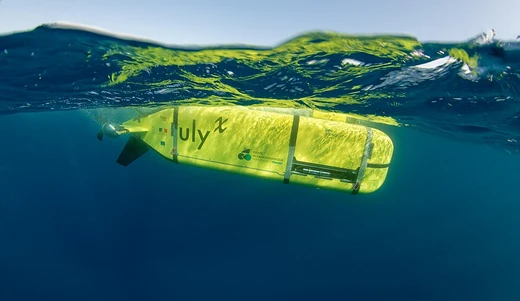
Global Explorer ROV
Deep-water ROV used for science and survey expeditions.

The Global Explorer ROV is a deep water remotely operated vehicle designed and built by Chris Nicholson of Deep Sea Systems International, Inc. of Falmouth, Massachusetts. It has made numerous dives below 9,000 ft on science and survey expeditions for National Geographic, the National Oceanographic and Atmospheric Administration (NOAA) and other research organizations.
- Designer
- Chris Nicholson
- Builder
- Deep Sea Systems International, Inc.
- Location
- Falmouth, Massachusetts
- Maximum depth
- below 9,000 ft
- Notable expeditions
- Loch Ness Science Survey (2001, 2003), Arctic Ocean (2002, 2005), Celebes Sea (2007)
Lore & Background
The Global Explorer ROV was designed and built by Chris Nicholson of Deep Sea Systems International, Inc. in Falmouth, Massachusetts. It has been deployed on multiple expeditions for National Geographic, NOAA, and other research organizations, diving below 9,000 ft to collect specimens, photographs, and video.
In 2001, Dr. Robert Rines organized an expedition to search for the Loch Ness Monster using the Global Explorer ROV. The search did not find the Monster but photographed an image on the bottom that looked like a large dead animal. A second expedition in 2003 also ended without success. In 2002, the ROV dove to the bottom of the Canada Basin on NOAA's Arctic Exploration 2002, collecting live specimens and obtaining digital still photographs and video of sea life in the first ever census of marine life throughout the entire water column from the surface of the ice to the seafloor.
In 2005, the ROV was the key tool on NOAA's Hidden Ocean Arctic 2005 expedition, obtaining live specimens down to 9,000 feet and high definition video and still images. In August 2007, it was instrumental in locating the submarine USS Grunion, which disappeared during World War II with 70 men on board and had been listed by the US Navy as missing in action, cause unknown. Later in 2007, the ROV joined NOAA and National Geographic on an expedition to the Celebes Sea, equipped with a high definition color video camera, a digital still camera, a 12-chambered suction sampler, and static canister samplers.
Reader's Guide
The Global Explorer ROV's significance lies in its repeated use on high-profile science and survey expeditions, particularly for NOAA and National Geographic. It was the first ROV to conduct a census of marine life throughout the entire water column from ice surface to seafloor during the 2002 Arctic Exploration. Its ability to dive below 9,000 ft and collect live specimens, high-definition video, and still images made it a key tool for deep-sea research. The ROV also contributed to historical discovery by locating the WWII submarine USS Grunion in 2007, an expedition financed by the commander's family. In the Celebes Sea expedition, it collected live specimens and imagery of unusual and unfamiliar specimens despite strong currents. The ROV's legacy includes its role in two Loch Ness Monster searches, which did not find the Monster but produced an image of a large dead animal on the bottom. Its design by Chris Nicholson of Deep Sea Systems International, Inc. and its deployment across Arctic, Atlantic, and Pacific waters demonstrate its versatility for both scientific and survey missions.
Founding Vision & Organizational Structure
GUE was established as a nonprofit 501(c)(3) entity in High Springs, Florida, by Jarrod Jablonski alongside a small collective of educators, explorers, and diving instructors. Their stated purpose was to advance education, conservation, and exploration within the aquatic world. The founders explicitly aimed to build upon the legacy of the Cousteau Society, envisioning a decentralized network of satellite organizations where local advocates could drive detailed diver training, active exploration, and sustainable conservation work. In its earliest days, GUE operated out of the same space as the Extreme Exposure dive store, a co-location that later ended when the shop relocated, freeing GUE to grow independently. The organization's board of directors reflects its diverse membership, including Jablonski himself—an Explorers Club fellow—alongside entrepreneur Robert Carmichael, researcher Todd Kincaid, Corey Jablonski, Gideon Liew, Richard Lundgren, and Sam Meacham.
The DIR Philosophy & Rigorous Training Model
Within the broader diving community, GUE has built a reputation for a training style that deliberately departs from the norms set by other recreational training bodies. The organization extends classroom and in-water time, sets objective performance benchmarks, and mandates periodic requalification for both instructors and divers. This approach traces its intellectual roots to the Hogarthian gear configuration championed by William Hogarth Main and was further systematized through the Doing It Right (DIR) framework, which Jablonski helped architect. DIR standardizes equipment layout and procedural protocols, a design choice GUE argues reduces in-water confusion and enables teams to function cohesively. Critics note the rigidity of these guiding principles, making it one of the more controversial elements of the curriculum. The course catalog, which numbered 26 offerings across four subject areas by mid-2017, spans recreational, foundational, technical, and cave diving. GUE Fundamentals remains the most widely taken class, serving as the gateway for non-GUE divers before they progress into technical and cave specialties.
The Woodville Karst Plain Project & Conservation Legacy
The Woodville Karst Plain Project stands as GUE's most prominent satellite and nonprofit affiliate. When WKPP introduced a standardized gear and procedure protocol in 1995, the result was a marked drop in diving incidents within the Woodville Karst Plain cave system—a tangible demonstration of the safety benefits GUE advocates. GUE members actively participate in WKPP's science and exploration missions, and this partnership carried real political weight: it helped persuade the state of Florida to allocate more than two hundred million dollars toward upgraded wastewater treatment, a measure designed to protect groundwater and support the conservation of Wakulla Springs State Park. Exploration records followed, with GUE and WKPP divers achieving a 5.6-kilometer penetration in Wakulla Springs in 1998, then setting new depth records in 2001 and 2006. Beyond Florida, GUE launched Project Baseline, a global initiative to document the condition of aquatic environments worldwide, extending the organization's conservation mandate far beyond its home state.
Institutional Recognition & Global Footprint
GUE's influence extends well beyond its own membership rolls. In 2013, the organization secured CEN certification through the European Underwater Federation, validating several of its diver and instructor grades against international standards including EN 14153-2, EN 14153-3, EN 14413-2, and ISO 11107 for nitrox diving. That institutional milestone was followed in February 2016 by the British Sub-Aqua Club completing a review on how to integrate GUE-certified divers into its local branches, a step signaling growing acceptance of GUE's training model in the UK. The organization's global footprint is further evidenced by conferences held in Gainesville, Florida in 2005 and 2006, a 2007 gathering in Budapest, a DIR-system workshop in Italy, and a 2003 Ocean Conservancy beach clean-up on Hutchinson Island in Martin County. GUE volunteers also contributed to the Rubicon Foundation's effort to scan and archive Undersea and Hyperbaric Medical Society journals, and the organization supplied video footage for the Reading Public Museum's interactive groundwater exhibit in 2002.
Frequently Asked Questions
Who designed and built the Global Explorer ROV?
Chris Nicholson is the designer, and the vehicle was constructed by Deep Sea Systems International, Inc., a firm based in Falmouth, Massachusetts.
What is the Global Explorer ROV's primary role?
It operates as a deep-water remotely piloted workhorse, carrying out scientific observation and ocean-survey tasks that require a tethered platform at extreme depths.
How deep can the Global Explorer ROV dive?
The vehicle has repeatedly reached depths past 9,000 feet, placing it firmly in the deep-sea operational category.
What notable expeditions has the Global Explorer ROV joined?
Its mission history includes the Loch Ness Science Survey (2001 and 2003), Arctic Ocean work (2002 and 2005), and a deployment in the Celebes Sea (2007).
Why is the Global Explorer ROV significant to ocean research?
It has provided a dependable deep-sea platform for organizations such as National Geographic and NOAA, enabling hands-on data collection in regions of the ocean that are otherwise extremely difficult to access.
More in Underwater and Surface Drones, Part 2 1-24
Spotted an error? Know more?
Reader corrections go straight into our review queue. Suggest an edit · How this site is sourced